


The roaring neighs of Turkish stallions pierced through the plains of northern India, raising dust and instilling alarm and fear in the minds and hearts of a beleaguered populace. This was the Indian subcontinent in the thirteenth century CE. The throne of Ḍhillikā (Delhi) had already succumbed to invasions from Ghor, as had the opulent Gahadvalas of central India with their capital at Varanasi. Loyalists of the Turkish Ghurids were installed to administer the subjugated territory, laying the foundations of the 'Delhi Sultanate' – an ambitious imperial formation that actively sought to extend its frontiers and consolidate its political authority. It was not the first time that the subcontinent had witnessed a political invasion or foreign rule. In fact, it had previously fended off intrusions from Śakas, Hūṇas and various other formidable 'foreign' powers who had made their entrance into the subcontinent from the same north-western corridors, but had gradually assimilated into its civilisational matrix.
What was relatively unfamiliar, however, was the sharper religious dimension that sometimes accompanied the assertion of the new political order, particularly where local religious practices came into conflict with the convictions of ruling elites. The new rulers were fervent to overwrite the faith of this bewilderingly diverse race of image-worshippers whose practices they deeply abhorred. One dynasty succeeded the previous one. The Khiljis succeeded the Mamluks, and Ghiyasuddin Tughlaq founded the Tughlaq dynasty by replacing the Khiljis. Political and religious tensions, however, continued unabated.
Ghiyasuddin’s eldest son, Prince Jauna Khan (who succeeded to the throne as Muhammad bin Tughlaq) led violent expansionist campaigns in the peripheral regions. Out of rampant terror and fear of loss of religion, Harisingh Dev, a Kṣatriya chieftain of Ayodhya,1 retreated into the forest and went incognito. The vulnerable city gradually became a military station of the Delhi Sultanate. Over the course of decades, some thousands of the city’s residents were coerced into converting to Islam, including Harisingh’s nephew Gaj Singh and his family. For decades, these converted masses, led by Gaj Singh, went from place to place, visiting the pandits of yore and requesting for the means of their purification and a way to return to the Hindu fold,2 but to no avail. The scholars offered no solace, remarking that once someone had fallen from dharma, they were permanently polluted and could not be absolved. Not finding any hope or solution to their plight, they grew despondent.
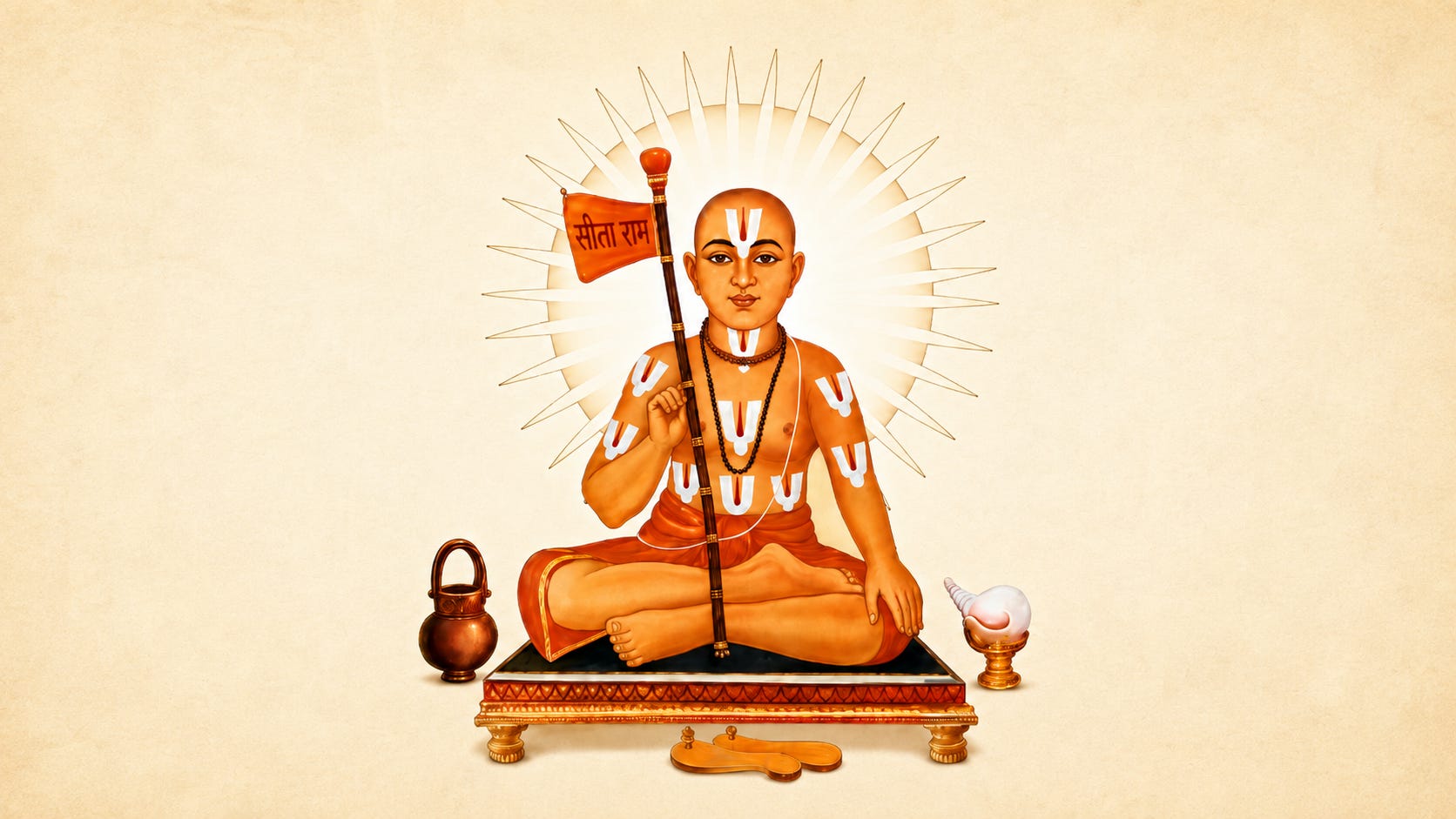
Meanwhile, in a quiescent cavern on the Panchganga Ghat in Kashi, the city that illuminates all,3 resided a radiant yogi, the resounding sound of whose conch tore through the ears of the tyrants, and whose form exuded transcendental brilliance. His glimpse bestowed immense comfort upon the suffering populace. This was none other than Swami Rāmānanda, the progenitor of the stream of Rāma-Bhakti in medieval north India. When the suffering Gaj Singh heard of the glories of this saint who had even admitted a Muslim, Kabīra, into the Vaiṣṇava fold, he gathered hope. He arrived in Kashi, and humbly pleaded their case. "Fear not, O son", said the effulgent saint, "the fall from dharma under duress or situations of emergency does not lead to permanent degradation.4 Thirty days from now, I shall come to Ayodhya and redeem you all. Observe a fast, and wait for my arrival.” As if resuscitated, the Kṣatriya bowed in reverence and returned to Ayodhya.
Rise Of The ‘Second Sun’
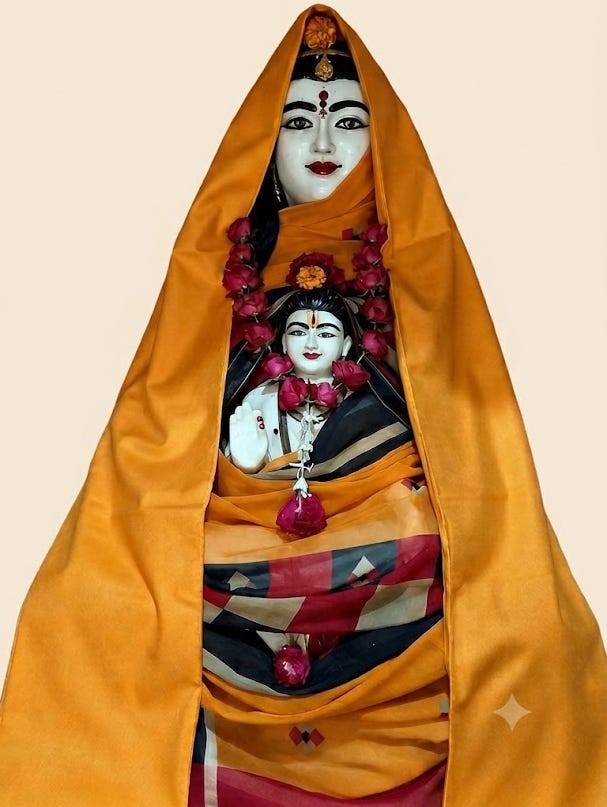
A Kanyakubja Brahmin couple resided in the holy city of tīrtha-rāja (‘king’ of all holy places) Prayag, where the Ganga and Yamuna make a confluence with the invisible Saraswati, giving the place the name ‘Triveṇī’. Austere and pious, Punyasadan Vajapeyi and his wife Sushila5 were devout in their observance of dharma and worshipped Veṇī Mādhava6 with great devotion, and carried in the abyss of their heart the wish of having an offspring as luminous and auspicious as Rāma. One day, they supplicated at the feet of Veṇī Mādhava. As a signal of divine succour, the dakṣiṇāvartī (clockwise) conch of Veṇī Mādhava fell into Sushila’s outstretched veil, assuring that their prayer was heard and a divine being would soon be born.
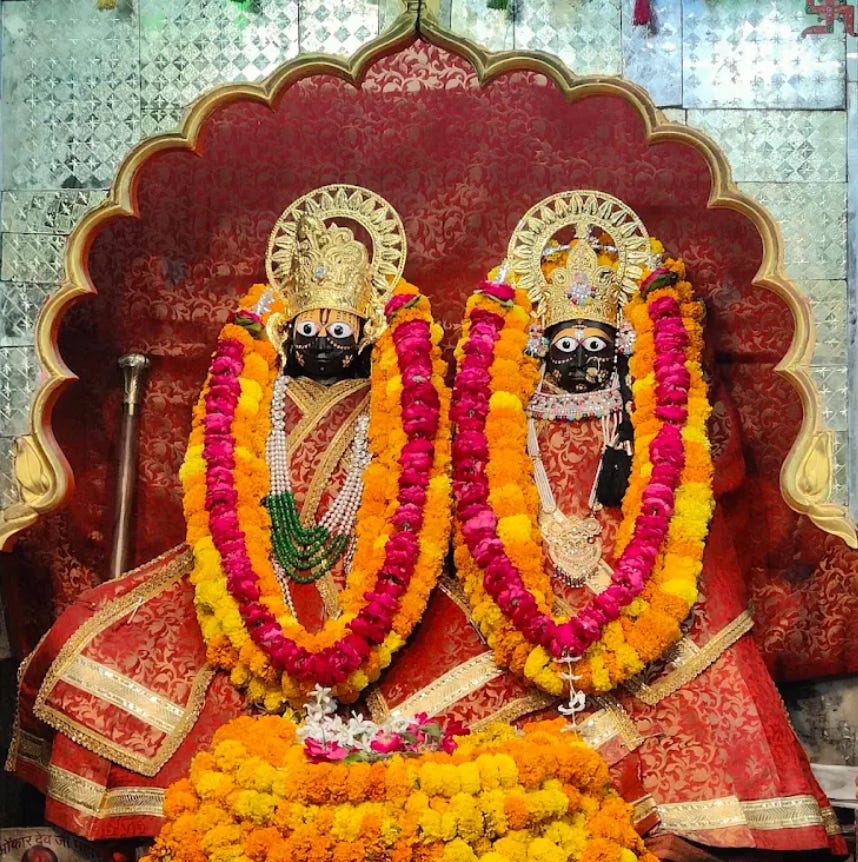
The seventh of the waxing phase of the lunar month of Māgha in Vikrama Saṁvata 1356 (1299-1300 CE)7 arrived. Coincidentally, it was also Makar Sankranti, the auspicious day of the solar calendar marked by the sun’s ascent into Capricorn. Sixty six thousand holy tīrthas were covertly present in the city.8 In the biting cold, Prayag was beaming with huge crowds of devotees flocking to the confluence of the holy waters, while ascetics made their residence in humble hamlets in the floodplain to perform kalpa-vāsa (month-long residence in Prayag during the winter month of Māgha while observing austere vows). Vedic scholars began reciting auspicious incantations, and an ethereal energy filled the ambience of Punyasadan Vajapeyi’s home. Under such extremely auspicious astronomical arrangements, the propagator of Rāma-Bhakti and an embodiment of Rāma himself9 was born from Sushila’s pious womb.
āvirbhūto mahāyogī dvitīya iva bhāskaraḥ । rāmānanda itikhyāto lokoddharaṇa kāraṇaḥ ॥
“The great yogi by the name Rāmānanda appeared. As if a second sun, he was the cause of upliftment of the world.”10
After the janma-saucha (period of ritual pollution following birth) was over, the Nāma-karaṇa sacrament was performed, and the brilliant child was named ‘Rāmadatta’.11 Some months later, in an auspicious hour, Anna-prāśana ceremony was held and the child was offered a number of preparations, of which he only accepted kheer (rice pudding) made with the milk from superior cows. For his whole life, he is said to have lived only on kheer.12
The Divine Conch Reverberates!
One morning, as his father sat in meditation before the home altar, the child Rāmadatta sneaked in, picked up the divine conch and blew it resoundingly, such that everybody who heard entered a state of momentary trance. Upon regaining external consciousness, the parents rushed to find the young boy with the conch in his hand. At the same time, a divine speech reassured them and instructed them to gladly give the conch to the boy. Thenceforth, the luminous Rāmadatta would blow the conch every day at dawn, noon and dusk, bringing transcendental joy to all pious beings.13
The Journey To Kashi
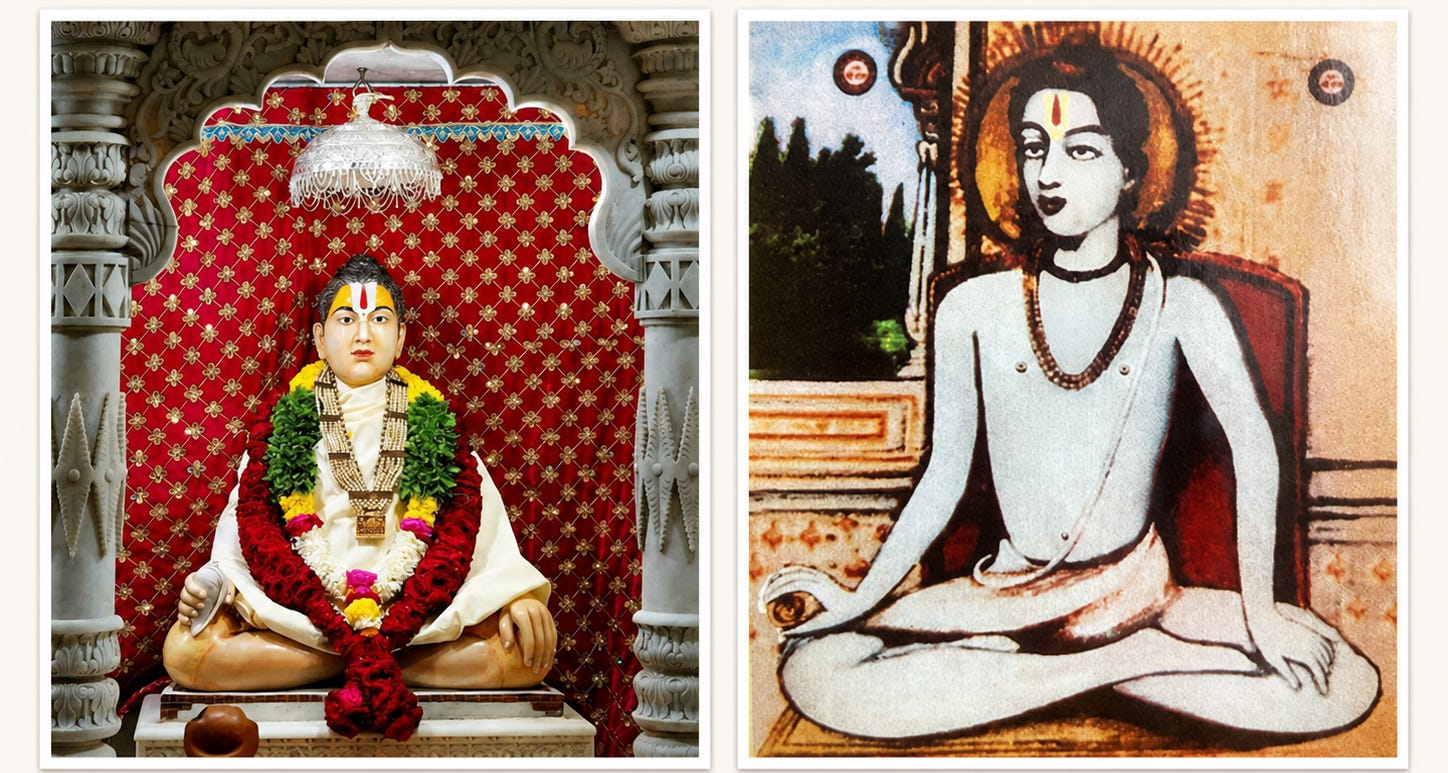
At the age of five, Vājapeyi Ji began imparting Vālmki Rāmāyaṇa and the Gitā to Rāmadatta, which the erudite boy memorised and recited with great precision. After some time had passed, the Upanayana saṁskāra was performed. The brahmachari Rāmadatta was given the sacred thread and initiated into the Gāyatrī mantra, and was customarily instructed to "go to Kashi for the study of scriptures." Rāmadatta rose from his seat and began proceeding towards Kashi. As is the custom even today, the relatives pleaded with the brahmachari to convince him to turn back. However the truthful Rāmadatta was undeterred, and the parents ultimately relented. Rāmadatta was brought to Kashi, where he began his Vedic learning at Śrī Maṭha,14 the seminary of Swami Rāghavānanda,15 an illustrious Vaiṣṇava renunciate, on the Panchganga Ghat in Kashi.
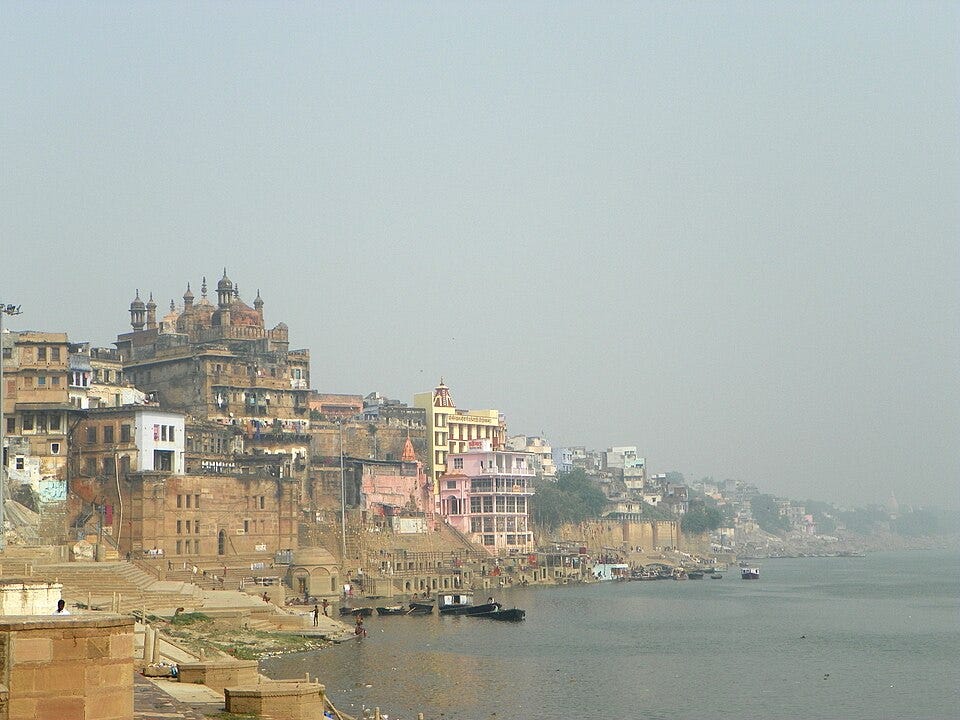
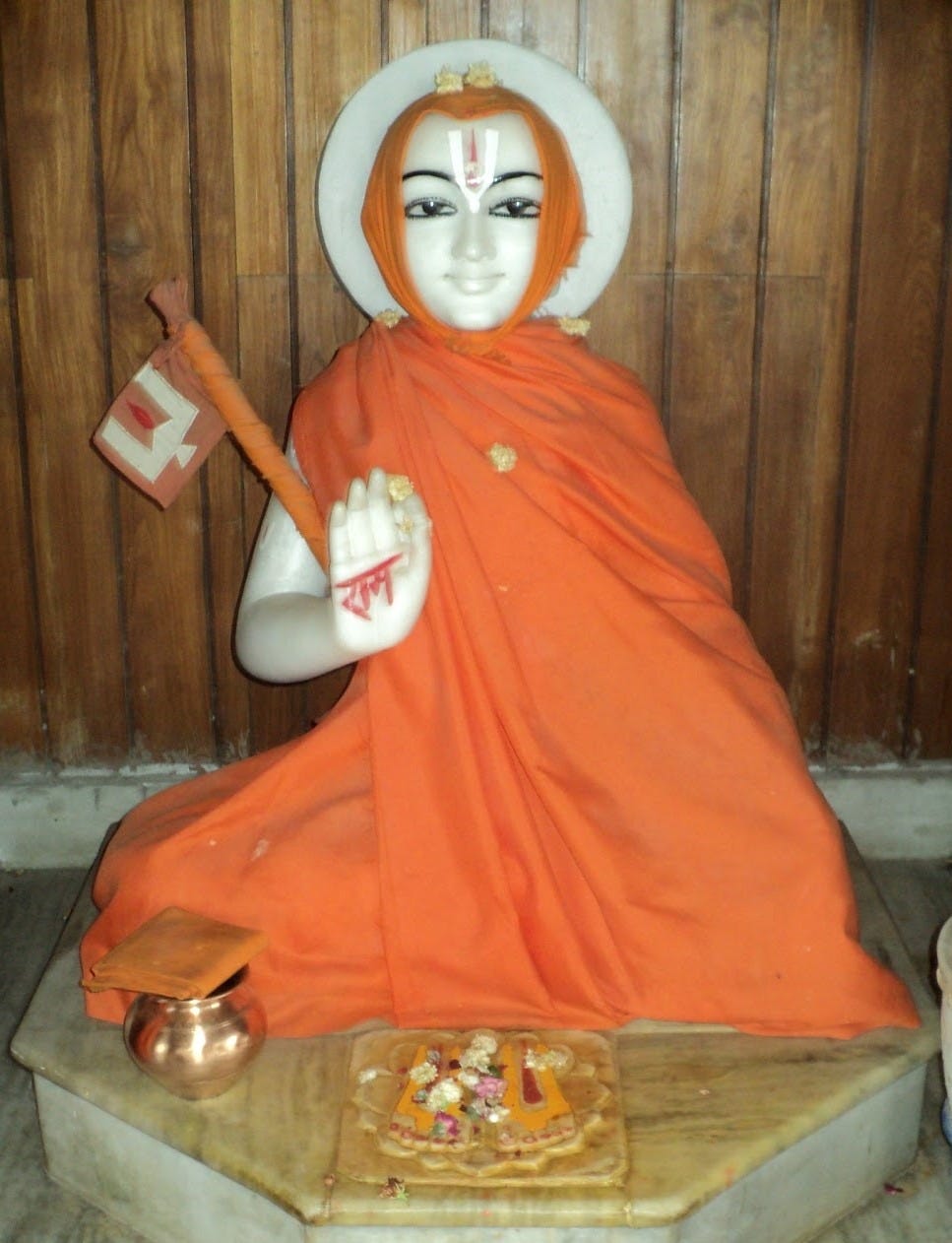
Panchganga derived its name from the presence of ‘five holy waters’. A purāṇic shrine, the temple of Bindu Mādhava ruled its skyline; it was among the five key tīrthas in Varanasi’s pilgrim geography.16 The French merchant Jean-Baptiste Tavernier, who toured ‘Benares’ in 166517, described it as the "most imposing structure along the Banaras waterfront." In its vicinity, he spoke of the presence of a Vedic seminary with ‘a temple of Rāma’,18 which very possibly stood in the place of the then extinct Śrī Maṭha, lost during the destruction of Kashi’s riverscape by Sikandar Lodi in late Fifteenth century CE.19 A re-inception of the Śrī Maṭha was completed in the twentieth century around a modest but intact marble shrine of Swami Rāmānandācārya’s sandals (pādukā).
From Rāmadatta To Rāmānanda
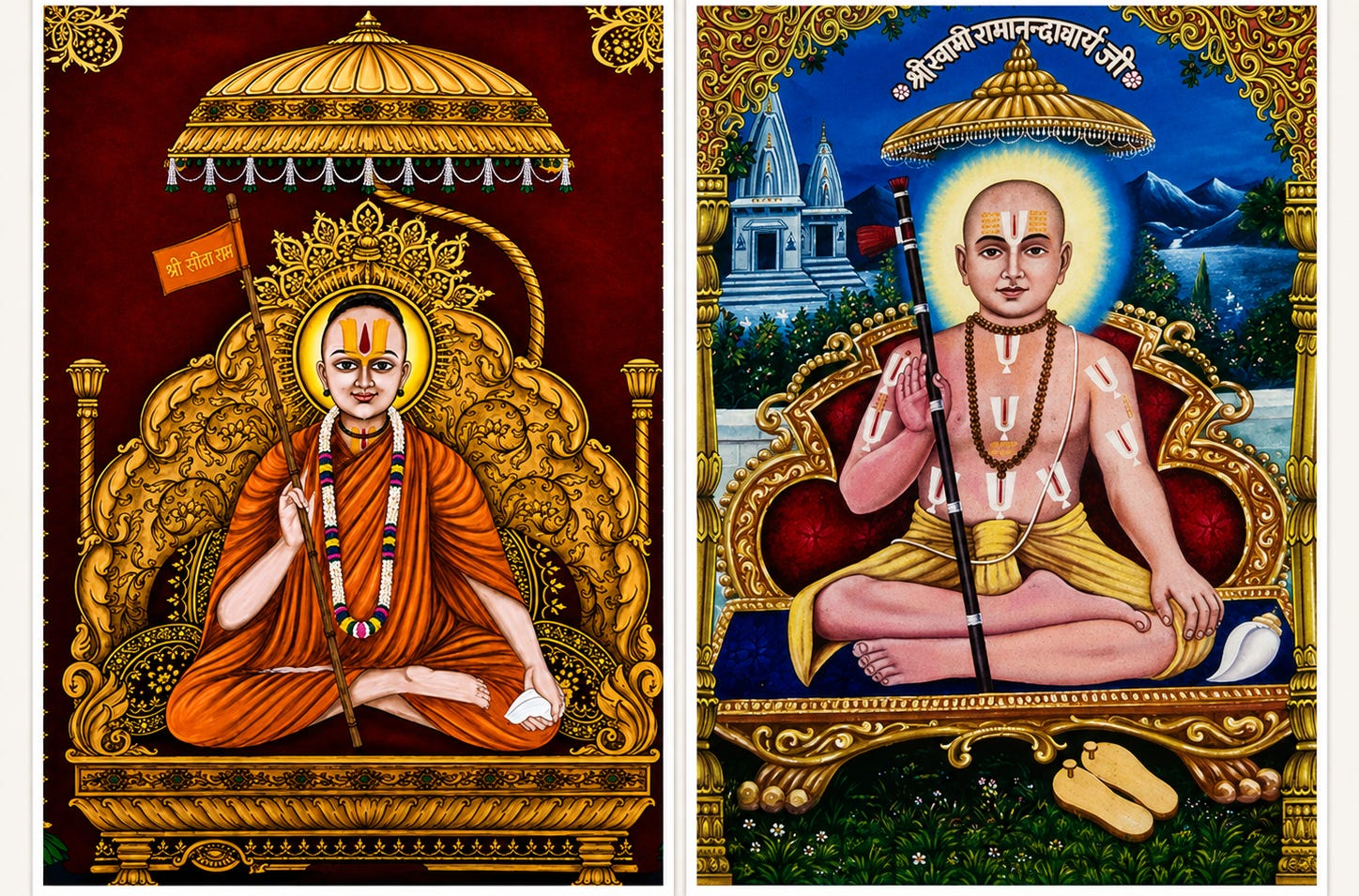
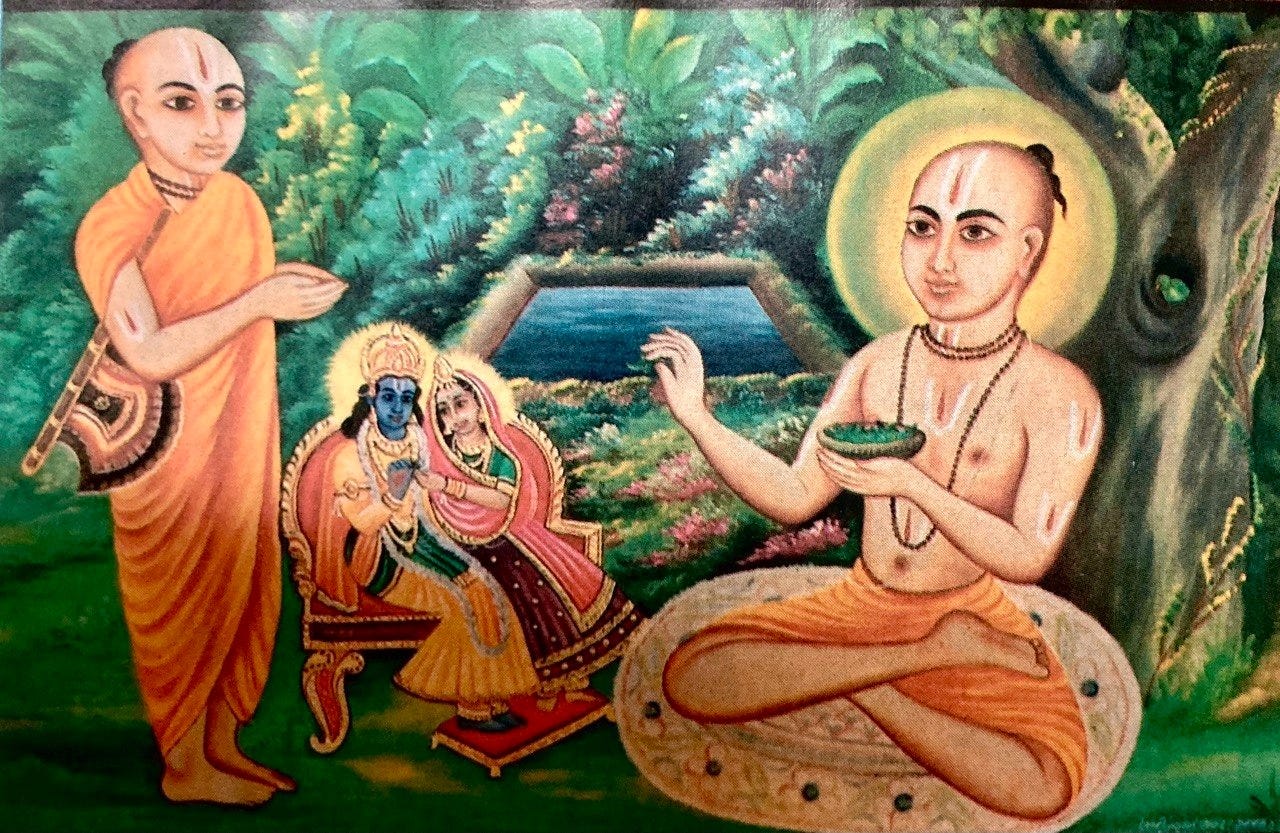
After successfully completing his education in the Vedic scriptures, the samāvartana saṁskāra (graduation ceremony) was done. While the parents expected the brahmachari to prepare for married life ahead, as do all others, Rāmadatta’s heart brimmed with renunciation, devotion and intense empathy for the society. The tyranny of the times and the suffering of his people invoked the purpose of his birth. He sat humbly at Swami Rāghavānanda’s feet, and requested to become a renunciate. The all-knowing spiritual master accepted, and with the consent of the venerable mother-father, initiated Rāmadatta into the Śrī Vaiṣṇava tradition with the pañca-saṁskāras (five sacraments) – which included branding the shoulders with heated metal seals (tapta-mudrā-s) of Bhagavān’s divine weapons (āyudha, mainly dhanur-bāṇa, i.e. bow-arrow and śaṅkha-cakra i.e. conch-discus),20 applying the vertical Tilak mark (Ūrdhva-puṇḍra) on the forehead and eleven other spots on the body, awarding of a Vaiṣṇava name, imparting of the six-syllable Rāma Tāraka Mantra, and tying Tulasi beads around the neck.21 With great elation, Swami Rāghavānanda then initiated his extraordinary disciple into the renunciate22 order, and named him ‘Rāmānanda’. He also blessed him with divine yogic abilities.
A Fellowship Beyond Birth And Caste
With the ascent of the radiant Rāmānanda as its Ācārya, Śrī Maṭha manifested itself as the ‘grand Gomukha’23 from where the Rāma-Bhakti-gaṅgā (Ganga of devotion to Rāma) began to flow and inundate the northern lands. Soon, word spread about the austerities, yogic potencies and devotional discourses of Swami Rāmānanda. Deserving seekers began to come and take dīkṣā from him.
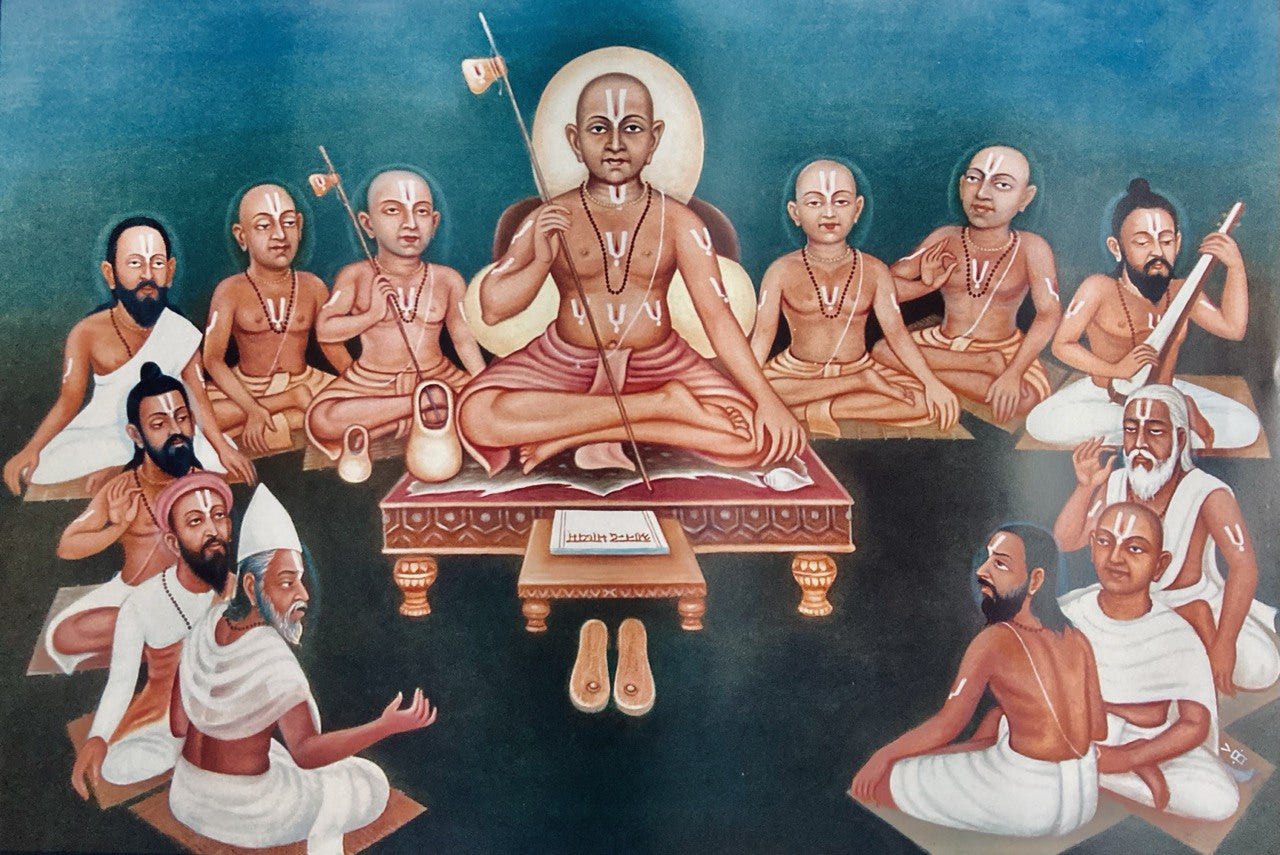
Besides Anantānanda and many other Brahmin disciples like Sukhānanda, Surasurā, Narahari, Bhāvānanda, Yogānanda and Gālavānanda, Swami Rāmānanda also graced Pīpā who was the Rajput king of Gagron, Dhannā who was a Jat agriculturist, Sena who was a barber of Bāndhavagaḍha as well as Kabīra (Kabīra) who was raised in the family of Muslim weavers24 and Raidāsa (Ravīdāsa) who was born in the family of tanner-cobblers, both of them being his two most well-known disciples. Quite revolutionarily, he initiated women as disciples, three of whom are known through the Bhaktamāla – Padmāvati as well as wives of Pīpā and Surasurā. Not only did Swami Rāmānanda award Vaiṣṇava dīkṣā, he even initiated many of them into the renunciate order (Bairāgīs) regardless of their birth, considering their renunciation and devotion as the foremost qualifications.
The Glory Of The Rāma-Tāraka Mantra
The Ācārya revealed the meaning of the name ‘Rāma’, "The Supreme Absolute Truth Who is infinitely blissful, and in Whom wise yogis take delight and merge their minds, He is called Rāma.”25 He further elaborated on the glories and the spiritual succession of the Rāma mantra that had been received by him from his preceptor Swami Rāghavānanda, and had now been passed on to his disciples –
"The six-syllable Rāma Mantra is Mantrarāja, the king of all spiritual mantras. It is also called Tāraka, since it delivers its jāpaka (chanter) from the ocean of material existence. The Supreme Being Śrī Rāma revealed this mantra to Brahmā.26 Lord Śiva also meditated upon it for ages and propitiated his dearest Lord Śrī Rāma, who then granted a boon that anyone who receives the Tāraka Mantra by Lord Śiva on their deathbed in Kashi shall be liberated without doubt. O dear disciples, a devotee who meditates on the Rāma Tāraka Mantra becomes paṅkti-pāvana, that is, he purifies the rows in which he sits and eats.27
Hearing the discourses on the divinity of Rāma’s name, form and attributes, the disciples were ecstatic. In a state of devotional trance, Sena composed and sang an offering to his beloveds, Guru and Govinda –
“Having prepared it with incense, lamps and ghee, I go to offer this āratï to You, O Husband of Lakṣmī.
Hail to You, O Lord Hari, Hail to You! Ever Hail to You, O Rāja Rāma, Ruler of All!
Sublime is the lamp, and taintless is the wick. You verily are immaculate and pure, O Lord of Kamalā!
Rāmānanda knows devotion to Rāma. He describes it as complete and supremely blissful.
He of wondrous form, the master of the senses, who delivers across the terrifying world-ocean, says Saina, remember Him, the embodiment of supreme joy!'” 28
The Promise Fulfilled
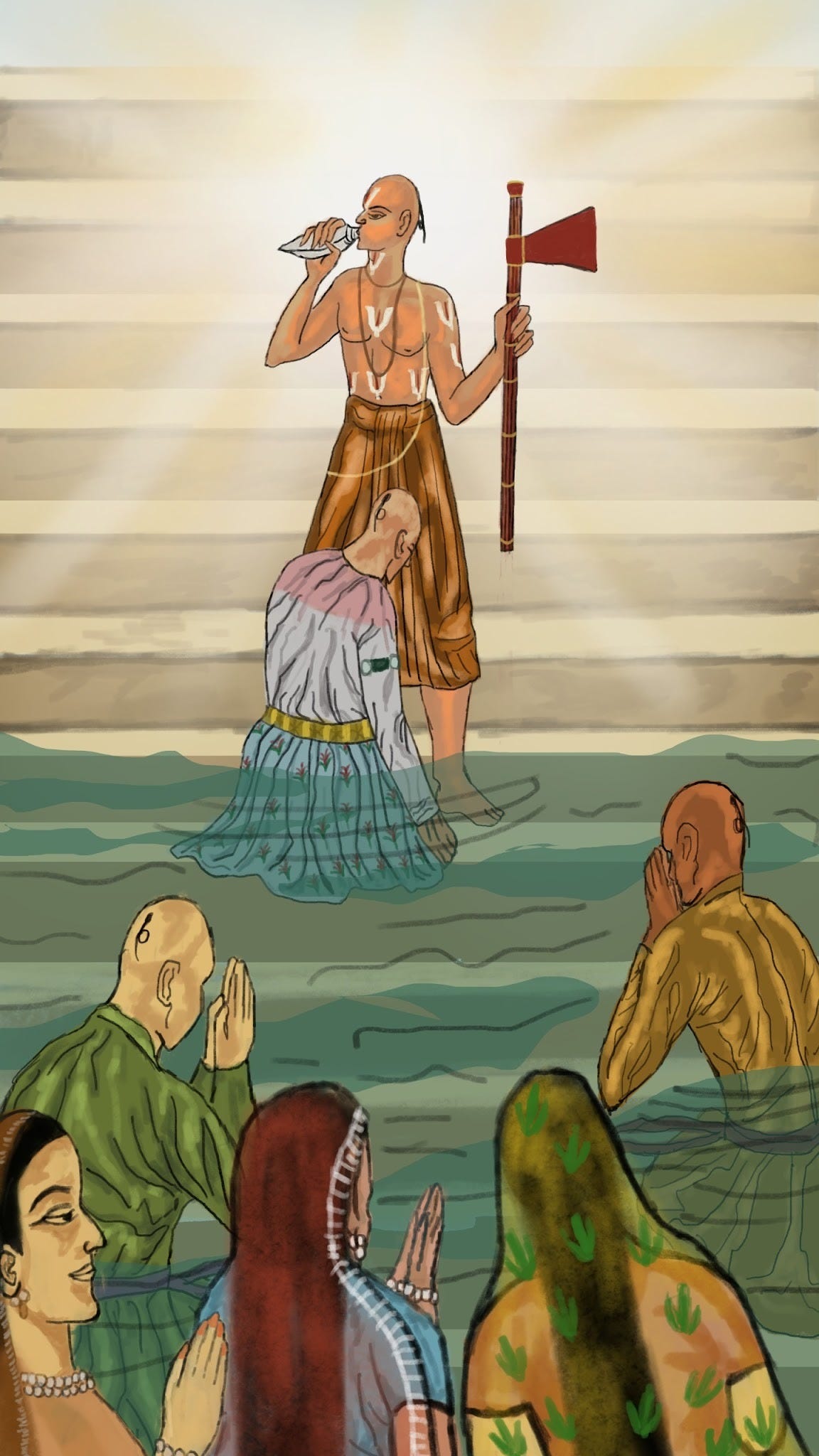
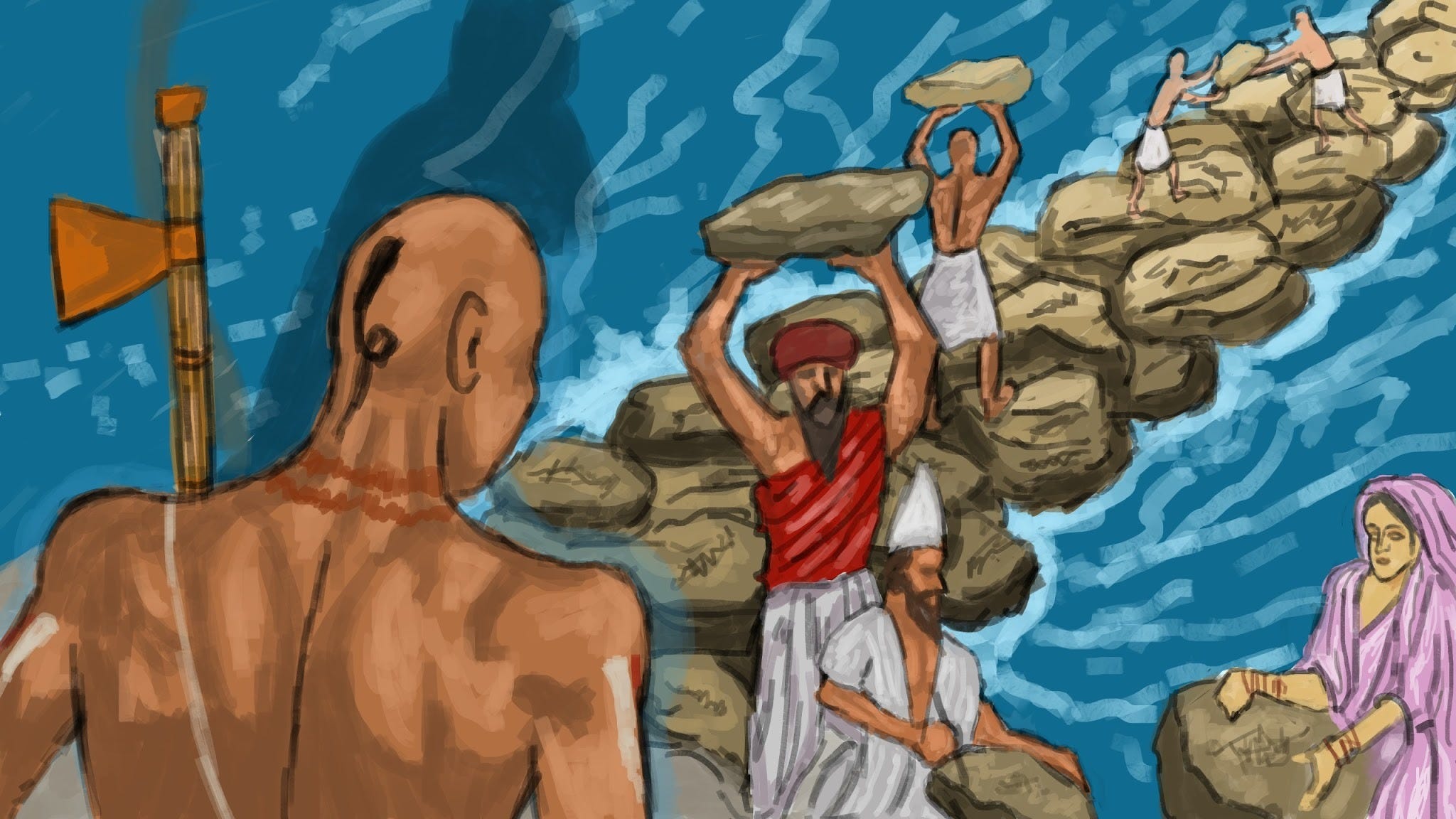
Gaj Singh, the nephew of Ayodhya’s exiled chieftain, and the numerous forced converts of Ayodhya awaited the arrival of the divine saint who had promised to come to their rescue. On the said day, the miraculous Swami Rāmānanda, flanked by Anantānanda and many other prominent disciples, arrived in Ayodhya. After taking darśana at the birthplace of Rāma, he arrived at the banks of the Saryu, where along with the king and all his kinsmen, many hundreds of forcibly converted Hindus lined up in the waters of the holy river Saryu. At that time, the Swami blew his miraculous conch, and led a loud chant of ‘Śrī Rāma-nāma’ and behold! The marks of conversion29 diminished from their bodies. Then, anointing their foreheads with the illustrious Vaiṣṇava tilaka and placing Tulasi beads around their necks, the benevolent Ācārya imparted the all-purifying and all-liberating supreme Rāma Mantra to all the initiates, marking their return to dharma. Thus, the inhabitants of Ayodhya who had become “mlecchas” under force and had been deserted by a rigid orthodoxy, were not only embraced by Swami Rāmānanda but also bravely restored into the mainstream.30 With Tulasi beads around their necks, their tongues uttering the name of Rāma, and the vertical Tilaka markings on the forehead, even the polluted ones became purified as Vaiṣṇavas under the influence of Rāmānanda.31
Pīpā, Gagron And The Call To Renunciation
At the earnest request of his illustrious disciple Pīpā, Swami Rāmānanda graced his province of Gāṅgarauna (Gagron) in Rajasthan, residing there for some time with his disciples. Pīpā was overwhelmed at the sight of his guru. In divine ecstasy, he exclaimed –
pīpā ke piṁjare basyo, rāmānanda ko rūpa।
sabe andherā miṭa gayā, dekhyā ratana anūpa॥
“Within the cage of Pīpā’s heart resides the form of Swami Rāmānanda. All dark ignorance has evaporated, for I have beheld the unequalled jewel (of Rāma)”.32
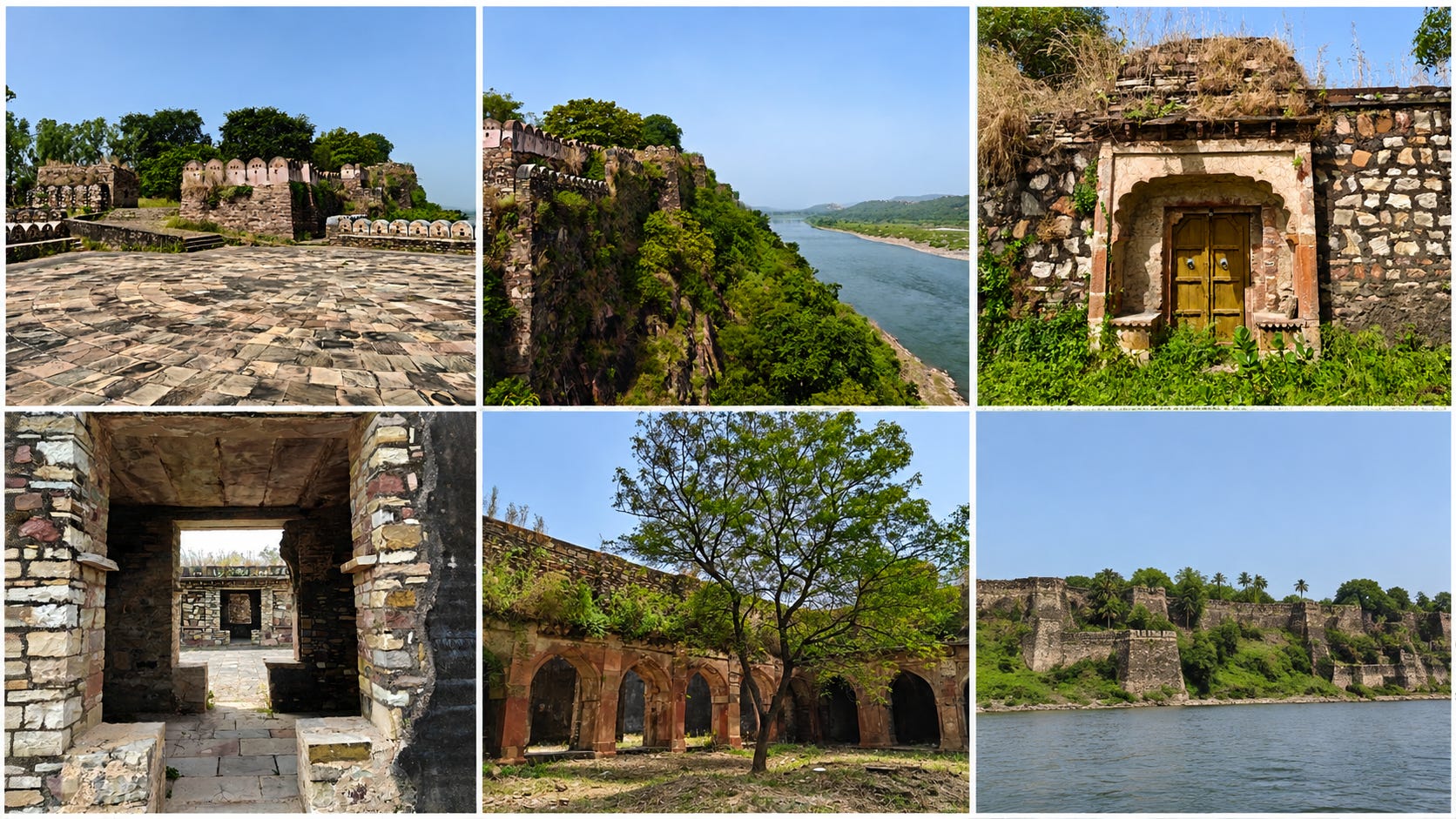
Pīpā expressed his desire for renunciation to his spiritual master, and was initiated into the Bairāgī order. When Swami Rāmānanda prepared to leave for Kashi, Pīpā’s youngest queen, Sita Sahchari Ji, who was equally detached from mundane leisurely life, was also allowed to join the retinue.
A Sacred Geography Of The Digvijaya
To spread his social programme of universal welfare through devotion and self-surrender (prapatti) to Rāma, Śrī Rāmānandācārya resolved to tour the country with his entourage of disciples.33 Leaving from Kashi, they arrived at the mouth of the Ganga on the shores of the ‘Eastern Sea’. After taking a bath in the Gangasagar tīrtha34 on the Sagara island where the hermitage of Sage Kapil had once stood before it submerged in the sea, Swami Rāmānanda revived the holy tīrtha by consecrating an idol of sage Kapil, along with images of Goddess Ganga and King Sagara.
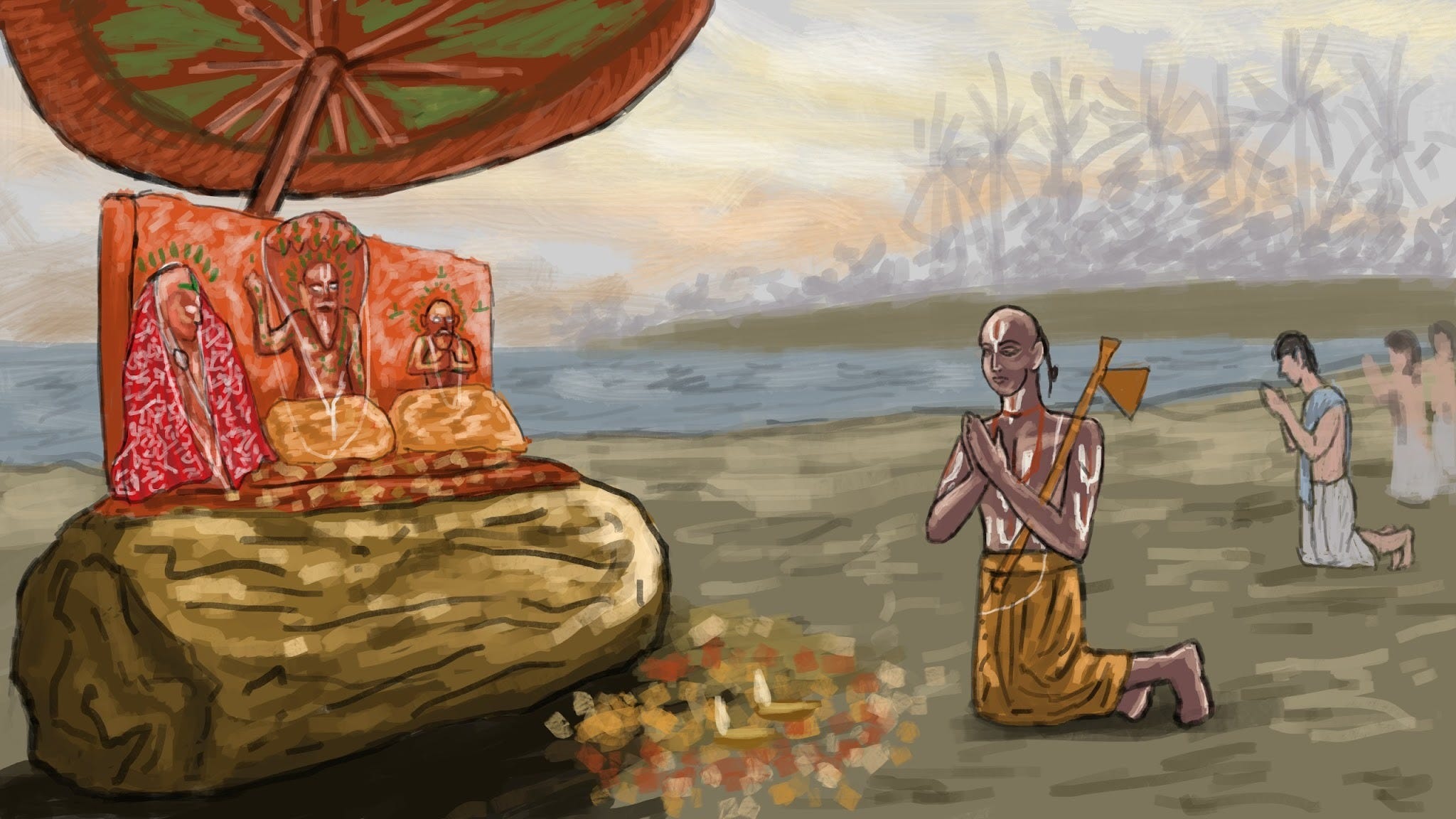
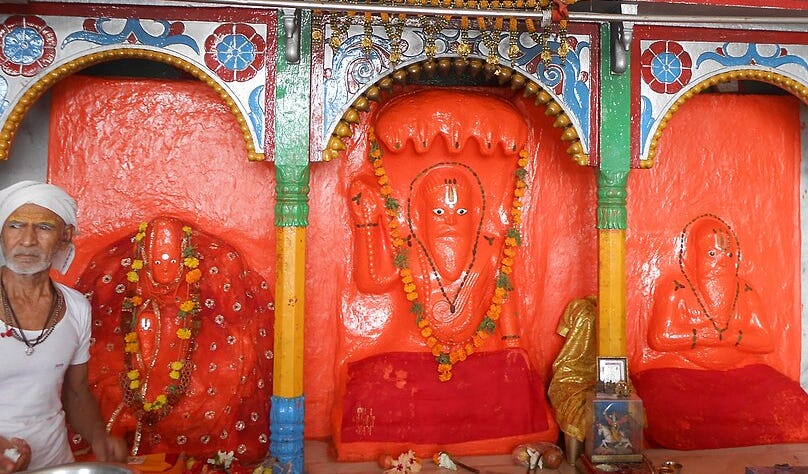
The retinue then reached Puri, where they took darśana of Lord Jagannātha, followed by Veṅkateśvara at Tirupati, Varadrāja at Kanchi, Raṅganātha at Srī Rangam, Rāmeśvara in Rameshwaram, Padmanābha in Anandapuram (Thiruvananthapuram), Janārdana in Varkala. After residing briefly in Mysore, the group crossed Maharashtra and reached Prabhasa region in Gujarat, where they took darśana in Dwārakā and Somanātha.35
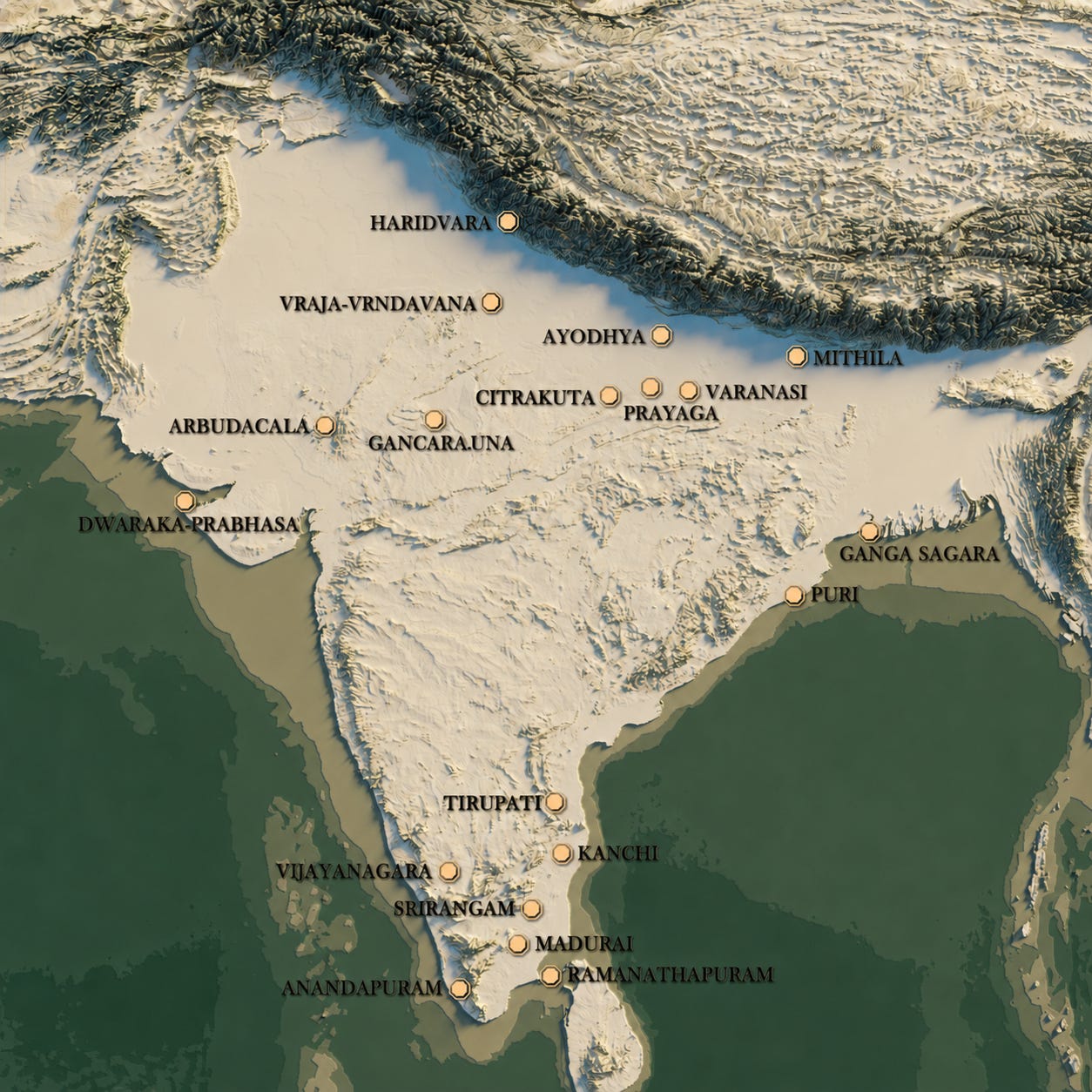
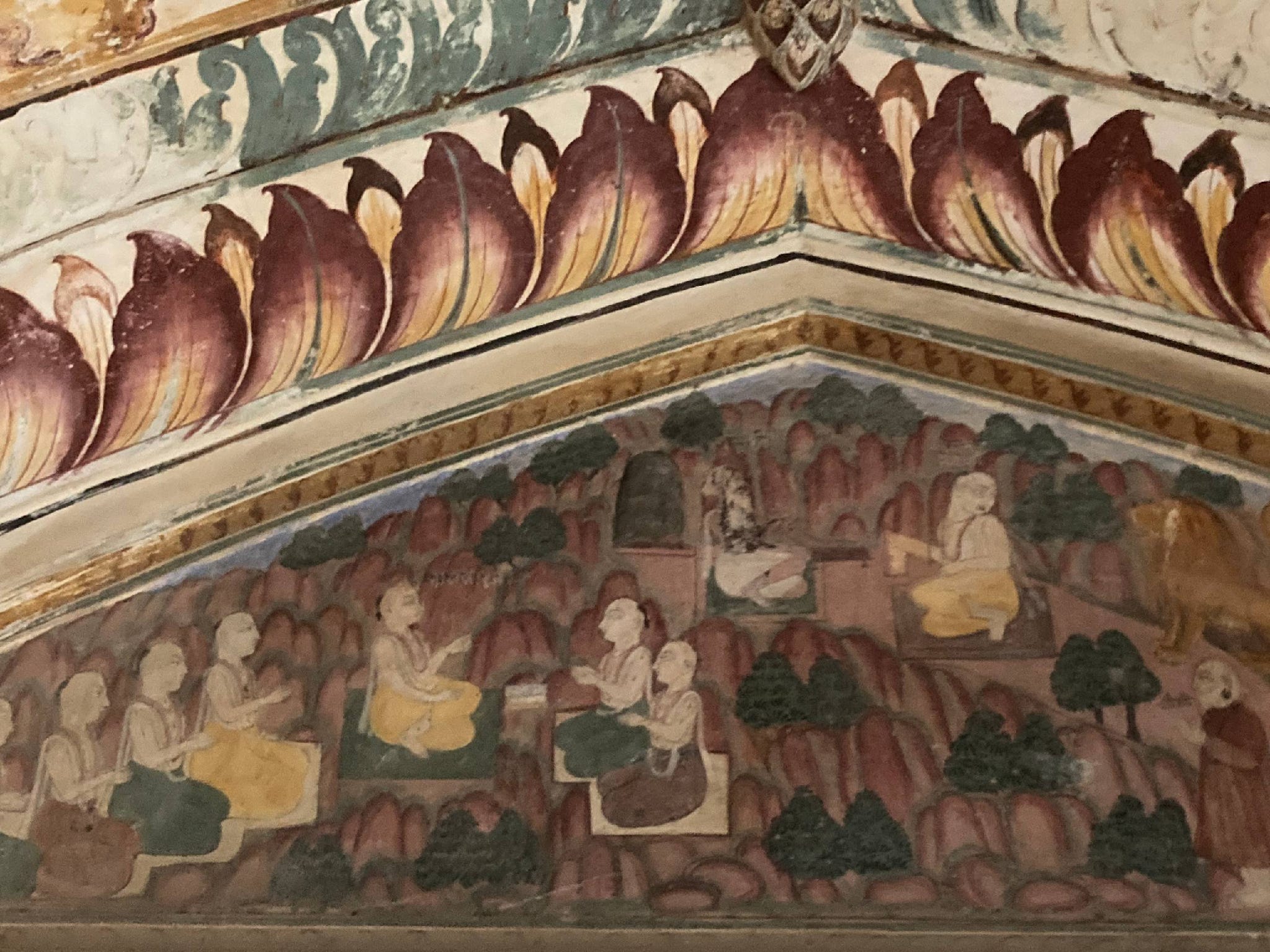
When the retinue arrived at Arbudācala (Mt. Abu, Rajasthan), Sursurānanda inquired about various vital aspects of Vaiṣṇava dharma, such as the ideal mantra, the prescribed methods of meditation, the symptoms of a Vaiṣṇava, their activities, their places of residence. The luminous Ācārya, seated on the Vyāsa-āsana, replied in detail to each of these spiritual inquiries. This conversation came to be canonised in the form of ‘Śrī-Vaiṣṇava-Matābja-Bhāskara’.36 Born out of his answers to these spiritual inquiries by Sursurānanda, it encapsulated his magnanimous vision that would lead to ‘the success and spread of the sect across the length and breadth of the subcontinent’.37 Finally, travelling through Chitrakoot, Haridwar, Vrindavan, Prayag, Mithila and Ayodhya, he returned with his retinue to Kashi.
Who May Take Refuge?
Not only did the compassionate Swami Rāmānanda defend dharma against totalitarian tyranny, but he also attempted to emancipate a suffering Hindu society that had become infested with sectarian infighting and internal alienation. He declared emphatically in the Śrī-Vaiṣṇava-Matābja-Bhāskara:
sarve prapatteḥ adhikāriṇaḥ sadā śaktā aśaktā padayor jagatprabhoḥ।
apekṣyate tatra kulaṁ balaṁ ca no na cāpi kālo na ca śuddhatāpi vai॥
“All are eligible at all times, for taking refuge at the lotus-feet of the Lord of all the worlds. Neither their birth, nor their strength, disability, time or purity is to be considered.”38
The door to Rāma’s sanctuary was thrown open to every human. There was no gatekeeping to devotion.
jāti pāti pūche nahi koī, hari ko bhaje so hari kā hoī.
“Let no man’s caste or creed be asked; whoever adores Hari is His own.”
The great Ācārya did not stop here. In a clearly revolutionary declaration for the existing social order, Swami Rāmānanda advised that Vaiṣṇavas born in lower varṇas should be served with reverence.39 By establishing that Rāma was pleased by someone who serves his devotees, who are all venerable irrespective of their birth or their social standing, he bolstered the worldview wherein devotion, not birth, reigned supreme.
Bhakti Over Birth
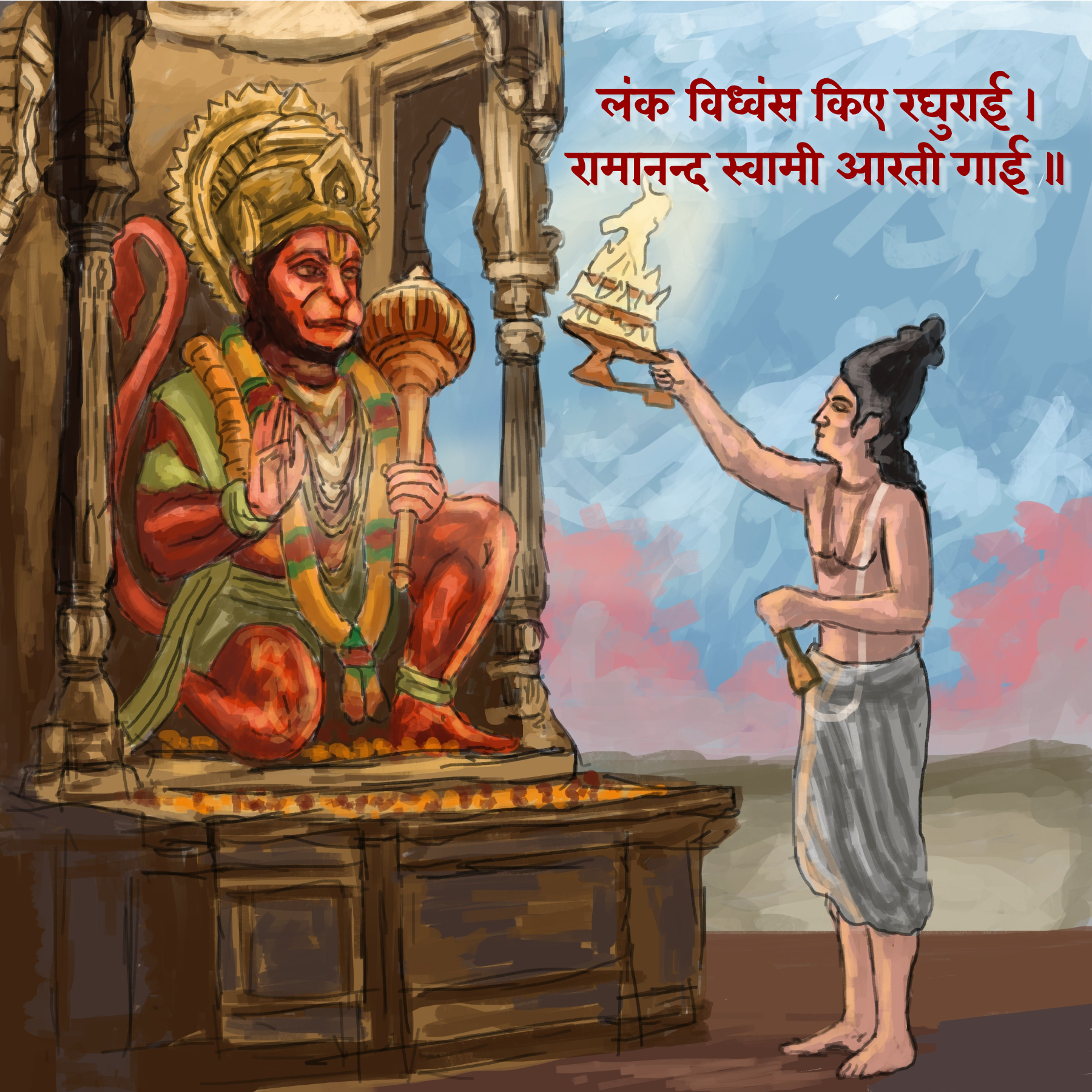
By incorporating people from virtually all social locations in the generous distribution of the Rāma Mantra, Swami Rāmānanda kindled a characteristic transformation in northern India, heralding the arrival of a prolonged current of Bhakti. Besides, the hagiographies are also replete with narratives of his display of mystic powers to subdue hostile adversaries viz. Tāntrikas, Kaulas, Aghorīs etc as well as his dialogues with stalwarts from various schools of philosophy, from Vedantīs to Yogīs and Jainas. According to Pitambar Datt Barthwal, many vernacular compositions are attributed to him, one of them being a mystic incantation by the name Ādhyātma Rāmarakṣā. Besides, Swami Rāmānanda also composed the popular Āratī of Hanuman, ‘Aratī kīje Hanumān lalā kī, duṣṭa-dalana Raghunātha kalā kī’.40
After gracing the world in his earthly form for a long lifetime, Swami Rāmānanda passed the final instructions to his disciples, and departed to Sāketa (the heavenly abode of Lord Ram). As is the case for his birth, the date and year of his disappearance are also highly contested. Agastya Saṁhitā and Prasaṅga Pārijāta give 1411 CE and circa 1458 CE respectively as the year of his disappearance.41
The Rāmānandī Hagiographical Tradition
In northern India, hagiographical texts predominate in medieval literature pertaining to religious sects and saints, the basic structure of which was laid out by the Bhaktamāla (fl. 1580-1624 CE) and its commentaries.42 A highly celebrated text containing anthologies and life sketches of devotees of all four ‘yugas’ and across sects, it was composed by Nābhādāsa, who was fourth in the disciplic lineage from Swami Rāmānanda, from the distinguished Rāmānandi seat of Galta near Jaipur. Soon after, the Bhakta-Paracaī texts were composed by Anantadāsa (fl. 1588), who was also a Rāmānandi and a disciple of Nābhādāsa’s godbrother Vinoda Dāsa. 43 According to Lorenzen, the ‘explosion’ of hagiographies during this period was owing to the increasing reliance by devotional communities centred on their founders as sources of divine authority.44
Rather than mistaking hagiographies for ‘mere panegyric accounts’ glorifying the ‘saints’ of their respective guruparamparās,45 it is important to understand their role as exemplars, as mirrors to larger historical context shaping the lives of their subjects, and as ‘multiple lenses through which a particular historical time and larger attitudes of the period towards the past and present of that period could be seen’.46 Moreover, the contradictions between memory and history, in which memory stands for orality and subjectivity and history for literacy and objectivity, so often highlighted in memory studies in the case of hagiographies, is not always tenable.47
Prasaṅga Pārijāta And The Recovery Of Traditional Memory
In the 1930s, the librarian Balak Ramji Vinayaka came across an ancient manuscript of a text named ‘Prasaṅga Pārijāta’ in the stacks of Sarnath Library, written in the extinct literary language of Paishachi. The author ‘Chetana Das’ introduced himself as a disciple of Swami Rāmānanda, and stated the completion of the text to Samvat 1517 (circa 1461 CE). Composed in 108 aṣṭapadīs (ritual stanzas of eight couplets) each with a phala-śruti (merit), the text came with a warning that pre-empted its publication for a long time –
“…that the story be reduced to writing in extraordinary rhymes and language which none may follow unless explained and which may be preserved by the enlightened beings, for there are some portions of it which should not be publicised and be kept confidential unless the events foretold in them happen … therefore, this text is composed in the divine Prakrit in Paishachi language by adding symbolic words … Whosoever reveals these details before time shall go mad. But one who recites them after they’re manifest, will obtain tattva-jñāna and the want of four puruṣārthas will be fulfilled.”48
The text was eventually brought to light in a literary conference in Lucknow, not without troubles, and later published for the first time from Ayodhya in 1951. Although replete with supernatural elements, and despite a bleak sense of chronology, Prasaṅga Pārijāta seems to have inspired many twentieth-century works of Hindi literature, viz. the poetic hagiography ‘Śrī-Rāmānandāyana’ by Swami Srī Jayaramadeva (1940 CE), later reworked in prose ‘Śrīmad-Rāmānandācārya-Carita’ and the novels ‘Śaṅkhanāda’ and ‘Kāśī Mārtaṇḍa’ (both in Hindi, with later English translations), thus contributing to collective narrative memory of Swami Rāmānanda amongst the Rāmānandīs.
In Sanskrit literature, the first contemporary hagiography appears to have been Śrīmad Rāmānanda Digvijayaḥ (lit. ‘The Triumphal Tour of Śrīmad Rāmānanda’, first published in 1928) by Bhagavad-dasa Brahmachari alias Swami Bhagwadacharya, followed by Śrī Ācārya Vijaya of Gosvami Harikrishna Shastri, a scholar of Vallabhacharya’s Puṣṭimārga. ‘Śrī Rāmānandācārya Caritam’ (2022) by Swami Rambhadracharya remains the most recent Sanskrit work on Swami Rāmānanda.49
The ‘Historical’ Rāmānanda
The paucity of veritable records, the conflicting accounts of hagiographical narratives, the explicit ambiguity on Swami Rāmānanda’s periodisation as well as the absence of “a hard biography” has invited the speculation marks from Western scholars such as Richard Burghart and William Pinch on his historicity, suggesting him to have been a “conjectured” by the Rāmānandis for legitimising claim to an independent identity. This runs utterly disregardful, if not oblivious, of the fact that not only does he feature in the compositions of his disciples of the ‘Sant Mat’, namely Sena, Pīpā and Kabīra,50 but is remembered in the hagiographic accounts of the Kabīra-panth and the Ravidāsa Rāmāyaṇa of the Ravidāsīs.51
A composition of Swami Rāmānanda is also included in the Adi Granth Sahib,52 the Sikh holy scripture beside many compositions of Kabīra, Ravīdāsa, Saina (Sena) and Dhanna, where they are referred to as ‘Bhagats’. The Sikh hagiographies of Bhai Gurdas also recollect the anecdotes of the aforementioned devotee disciples, with particular description of Kabīra’s initiation from Rāmānanda.53
The earliest known hagiography, the Bhaktamāla, has also recounted Swami Rāmānanda by listing his distinguished spiritual progeny, through whom he erected a spiritual ‘bridge’ to deliver innumerable ‘refugee’ souls (prapanna-s) –
“Anantānanda, Kabīr, Sukhā, Sursurā, Padmāvatī, Narahari, Pīpā, Bhāvānanda, Raidāsa, Dhannā, Sena, Sursurā’s wife;
and many more illustrious disciples and grand-disciples; (they were) the support for the welfare of worldly beings and the champions of the ten-fold Bhakti.
Residing in his corporeal form for a prolonged time, he carried the sheltered souls across the world-ocean. Just like the Lord of the Raghu clan (Rāma), Śrī Rāmānanda created a second bridge for crossing the material world.”54
‘Living’ In Memory And Geography
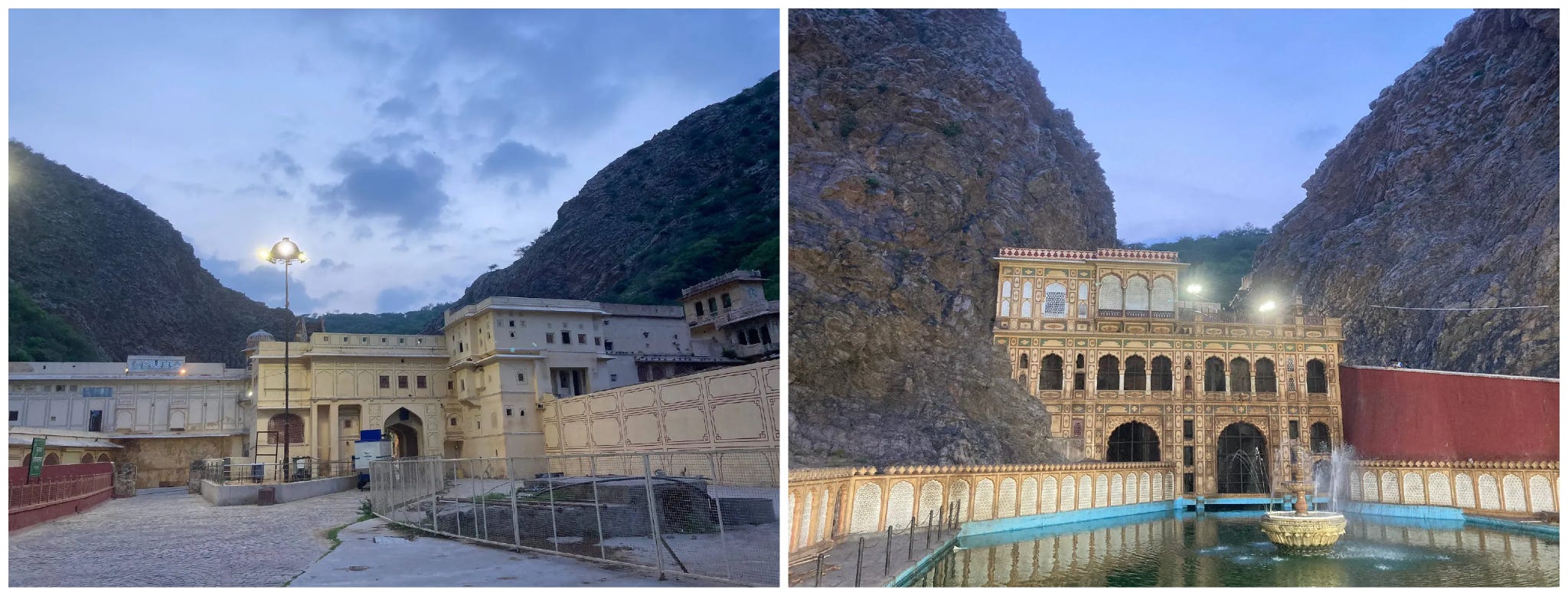
While traversing parts of Rajasthan, including Jaipur and Sikar, in the course of my fieldwork for this project, as well as in my previous peregrinations to Vrindavan, Ayodhya, Chitrakoot, Kashi, and Prayaga, especially during the Mahākumbha of 2025, I could somewhat fathom and admire the vast presence of the Rāmānandi ascetics and mendicants throughout the length and breadth of the northern plains, and much more pronouncedly in the holy cities. In the eighteenth century, the Rāmānandis were at the forefront of the militarisation of Vaiṣṇava ascetics into regiments, in the wake of various forms of threats to Vaiṣṇava religious places and communities.55 The new complex of Shri Ram Janmabhumī Temple renders homage to the great saint by naming one of its entrances ‘Jagadguru Rāmānandācārya Dwāra’. It bears witness to the significant role played by Rāmānandi ascetics56 in the history of the Rāma Janmabhumī.
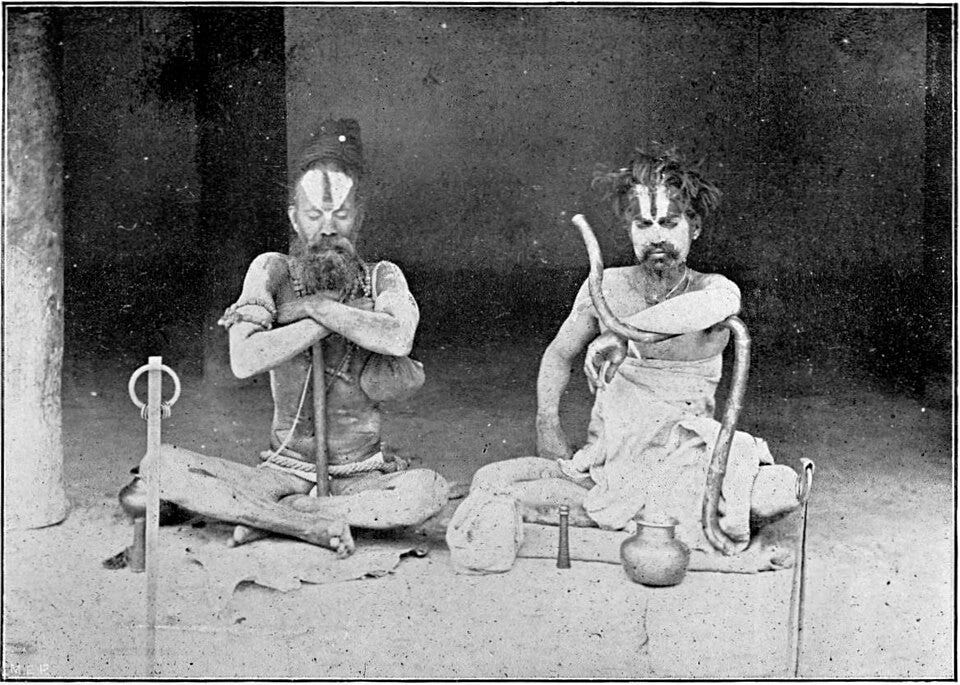
The order of ascetics founded by Swami Rāmānanda came to be known as Bairāgī, a denomination which later came to include ascetics of four major Vaiṣṇava sects. The Tazkirat-ul-Fuqra,57 an Urdu text that gives accounts of the various denominations of ‘faqirs’ (mendicants and mystics, both Muslim and Hindu) describes —
“The Bairāgīs are those who have abandoned worldly attachments and desires (bairāg meaning detachment or renunciation). They wear simple garments, often smeared with ash, or wear white or ochre-coloured clothes. They keep their minds absorbed in the devotion of the Divine (frequently Viṣṇu or Rāma) and wander from place to place visiting holy pilgrimage sites (tīrath). They maintain strict dietary rules, abstain from meat and alcohol, and subsist on simple vegetarian food or alms obtained without coercion.”58
Gorgani further describes in his ‘account of Rāmānanda, his sect, and followers’59 – "They apply a yellow tilaka on their foreheads, wear a necklace of tulsi mālā, and chant the name of Rāma. Their core belief is that God is One and Rāmacandra is his incarnation (avatāra)."
A more well-known Persian text of 17th century CE, the Dabistan-i-Mazahib or ‘School of Religions’, describes the four sects of the Bairāgīs, and mentions that “Whoever among the Hindus, Muselmans, or others, wishes, is received into their religion; none are rejected, but, on the contrary, all are invited.”60

A Living Legacy Of Unbounded Love
Reflecting on how Swami Rāmānanda is remembered in the collective memory, both sectarian followers and the polemics in academia would agree to perceive him as the pioneer of a broad, inclusive devotional stream that swayed and advantaged individuals and communities across castes, tongues, genders and geographies. Swami Rāmānanda brought about the actualisation of the principle of spiritual egalitarianism through unalloyed devotion (Bhakti) and complete self-surrender to God (Prapatti), which was also enshrined by Rāmānuja in his illustrious Sanskrit commentaries. The philosophical ‘synthesis’ of Swami Rāmānanda lies in making the Supreme Being, Para-brahman Śrī Rāma (in both His personal manifestation as well as His omnipresent being) a ‘domestic asset’ – available and accessible to all individuals — not merely in principle, but also in lived experience and everyday performance.
The vision didn’t remain confined to principles enshrined in philosophical texts, but indeed percolated in practice through numerous lineages of preceptors and saints that sprang from his followers. Of Swami Rāmānanda’s twelve prominent disciples, Raidāsa (Ravīdās) was revered as guru by not only the unprivileged castes, but also by disciples like Mīrā Bāī and queen Jhālī Bāī, both belonging to royalty in erstwhile Rajputana. While Kabīra was accepted as guru by Raja Vir Singh Baghel61 of Kashi, Sena (Saina) was accepted as their guru by the royal family of Bandhavgarh principality in Madhya Pradesh.
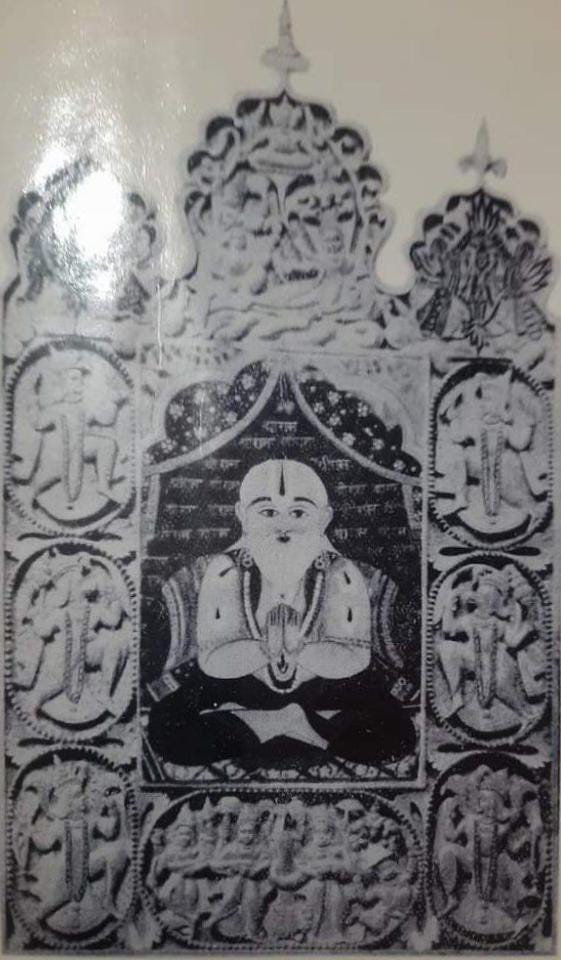
“Rāmānanda stood at the dawning of a new age of religiousness all over North India, an age in which full participation in a life of devotion was not the prerogative of the elite few, but the claim and faith of all – the illiterates, the downtrodden and the outcastes.”62 In his being converge three luminous characteristics – the distribution of pure devotion, the defence of dharma, and the emancipation of those on the periphery.
PE Burchett observes with regards to the Bairāgīs, “While contributing to the expansion of a broad Bhakti public and sensibility; they took part in a vibrant transreligious culture of song and performance; they participated in a shared grammar of asceticism and pragmatic power (embodied in charismatic saints); and they engaged in new aesthetic trends and the expansion of vernacular Hindavi beyond the oral and popular realms into the written and literary-courtly spheres.”63
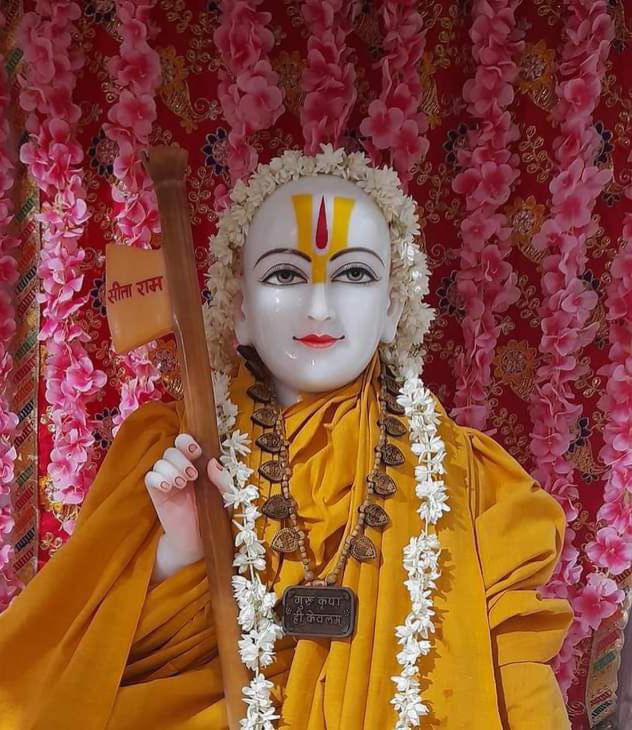
In this way, the legacy of Swami Rāmānanda and the Rāmānandi Bairāgīs is manifold. It flourishes not only in the pilgrim places and sacred nodes of the subcontinent like Ayodhya, Mathura, Prayaga or Puri. Rather, it has permeated the very veins of rural north, central and western India. Whether it be their direct physical presence, or intangible role in the lila traditions inspired by the magnum opus Ramcharitmanas, or in memory, like Tulsidas’s Hanuman Chalisa and Kabīra’s couplets. Having diffused into all four corners of the subcontinent, the Rāmānandi sect is a vibrant, indelible element of Bharat's socio-religious traditional milieu. The second sun shines still, drawing one and all into the boundless light of Bhakti.

Nitin Maan is from Delhi, India. He is currently doing a PhD in Geography from Delhi School of Economics, University of Delhi. His research revolves around the sacralisation, hydrology and conservation of Kunds in the Govardhan sacredscape. His areas of interest include sacred landscapes, TEK, pilgrimage studies and Bhakti literature.
Acknowledgements: The author is deeply grateful to Swami Harishankar Vedanti Ji, abbot of Siyaram Ki Bagichi, a modest ashram in Jaipur that houses around twenty-five elderly sadhus and young students. Despite limited resources, Maharaj Ji remains actively engaged in documenting and publishing valuable literature of the Rāmānandī sampradāya, often at his own expense. He is also involved in legal efforts concerning important Rāmānandī sites in Rajasthan.
The author visited the ashram without prior contact but Maharaj Ji generously answered his questions and engaged him in discussions on the chronology of Rāmānandi hagiographies and contemporary perceptions of the Bairāgi community. He also provided important hagiographical works and archival material for this research, while kindly arranging accommodation and meals.
The author is also grateful to Acharya Jaikant Sharma Ji, Professor in the Department of Vyākaraṇa at LBS Sanskrit University, Delhi. A scholar of the Rāmānandī tradition, he has authored a commentary on the Śrī-Vaiṣṇava-Matābja-Bhāskaraḥ. Conversations with him introduced the author to several academic works that proved useful for this research.
The author also thanks Smt. Aparna Patel Ji, a Rāmānandi from Gujarat, for sending copies of Prasaṅga Pārijāta and Kāśī Mārtaṇḍa, both of which were valuable to this study.
He is also grateful to Pramod Marathiya Ji of Jaipur, who generously accompanied him to several locations in the city during fieldwork.
Lastly, the author remains most grateful to his revered Gurudeva, who kindly initiated him into the magnanimous Śrī Rāmānandī Sampradāya.
References
Traditional Sources:
Agastya-Saṁhitā. Translated by Bhavnath Jha. Mahavir Mandir Prakashan, 2009.
Amarakoṣaḥ, by Amar Simha.
Bījaka, by Kabīra Dāsa. Vārāṇasī: Kabīravāṇī Prakāśana Kendra, 2022.
Jagadguru Śrī-Rāmānandācārya-Carita, by Svāmī Śrī Jayarāmadeva. Vrindavan: Śrī Rāmānanda Pustakālaya, 1999.
Matsya Mahāpurāṇa. Gorakhpur: Gitapress, 2020.
Pīpā Dera Nā Kījie, by Dr Navalakiśora Bhābhaḍā & Dr. Manoja Kumāra Makavānā. New Delhi: Indira Gandhi National Centre for Arts, 2024.
Prasaṅga Pārijāta, by Swami Chetandas. Translated by J.L. Gupta ‘Chaitanya’. Rishikesh: Shri Swami Ramanand Sant Ashram, 2010.
Rāmānanda kī Hindī Racanāye, by Pitambara Datt Barthwal. Kashi: Nagari Pracharini Sabha, 1956.
Skanda Purāṇa. Gorakhpur: Gitapress, 2018.
Śrī-Ācārya Vijayaḥ, by Gosvāmī Harikṛṣṇa Śāstri. Jaipur: Hansa Prakashan, 2011.
Śrī Bhaktamāla, by Nābhādāsa. With Bhakti-rasa-bodhinī Commentary by Priyādāsa. Gorakhpur: Gitapress, 2018.
Śrī Rāmānandācārya Caritam, by Swami Rāmabhadrācārya. Citrakūṭa: Śrī-Tulasī Pīṭha Saṁsthāna Nyāsa (2022).
Śrīmad-Rāmānanda-Digvijayaḥ, by Bhagavad-dāsa Brahmacārī. Jaipur: Śrī Rāmānandīya Virakta Vaiṣṇava Maṇḍala Samiti, 2018 [1984].
Śrī-Rāmānandārcana-Paddhati, Gaṇeśa Dāsa ed. Vrindavan: Śrī Rāmānanda Pustakālaya, 1999.
Śri-Vaiṣṇava-Matābja-Bhāskaraḥ, by Svāmī Rāmānandācārya. Trans. and commentary by Dr Ramadhar Sharma, ed. Chitrakoot: Jagadguru Rāmabhadrācārya Viklanga Viśvavidyālaya, 2018.
The Language of The Adi Granth: Phonetic transcription of the entire text, by Harjeet Singh Gill. Patiala: Punjabi University, [2016] 2019.
The Mahabharata of Krishna-Dwaipayana Vyasa. Vol. 4. Oriental Publishing Company, 1886.
Urdu/Persian Sources
Akhtar, Ahmad. Tazkirat-ul-Fuqra (تذكرة الفقراء). Lucknow: Fakhr-ul-Matabi, [1896] 1904. Internet Archive. https://archive.org/details/in.ernet.dli.2015.155554
Dabistan i Mazahib. Translated by David Shea and Anthony Troyer. London: Oriental Translation Fund of Great Britain and Ireland, 1843. Internet Archive.
https://archive.org/details/in.gov.ignca.35579/page/n5/mode/1up?q=Ramanand.
Foreigners’ Accounts
Tavernier Jean B. Travels in India, trans. and ed. Valentine Ball, 2 vols. (London: Macmillan and Co., 1889).
Secondary References
Agrawal, Purushottam. “In Search of Ramanand: The Guru of Kabīra and Others.” Ancient to modern (2008): 135-170.
Arnold, David, and Blackburn, Stuart, eds. Telling lives in India: Biography, autobiography, and life history. Indiana University Press, 2004.
Bakker, Hans. Ayodhya. Egbert Forsten, 1986.
Bhattacharyya, Haridas ed. The Cultural Heritage of India, Volume IV. Ramakrishna Mission Institute of Culture, 1956.
Burchett, Patton E. A Genealogy of Devotion: Bhakti, Tantra, Yoga, and Sufism in North India. Columbia University Press, 2019.
Burghart, Richard. “The Founding of the Rāmānandī Sect.” Ethnohistory (1978): 121-139.
Eck, Diana L. Banaras, city of light. Columbia University Press, 1999.
Farquhar, J. N. “The Historical Position of Ramananda.” Journal of the Royal Asiatic Society 52, no. 2 (1920): 185–192
Gupta, Divay. “Kashi Vishvanatha Kshetra in Historic Context, a Narrative landscape in Varanasi, India.” International Journal of Architectural Heritage 07, no. 02 (2024): 1-18.
Grierson, George A. “Ramanandis, Ramawats.” In Encyclopaedia of Religion and Ethics, edited by James Hastings, vol. 10, 570–571. Edinburgh: T&T Clark; New York: Charles Scribner’s Sons, 1918.
Jain, Meenakshi. Flight of Deities and Rebirth of Temples. Aryan Books International, [2019] 2025.
Jain, Meenakshi. Rama and Ayodhya. Aryan Books International, [2013] 2019.
Lorenzen, David. “Hindu Sects and Hindu Religion: Precolonial and Colonial Concepts.” in Knowing India, edited by Cynthia Talabot, 251-278. New Delhi: Yoda Press, 2011.
Lorenzen, David N. Kabīra legends and Ananta-das’s Kabīra Parachai. SUNY Press, 1991.
Majumdar, A. K. “Kashmir.” In The Delhi Sultanate, edited by R. C. Majumdar, 372–86. Vol. 6 of The History and Culture of the Indian People. Bombay: Bharatiya Vidya Bhavan, 1960.
Pinch, William R. Peasants and Monks in British India, University of California Press, 1996.
Pinch, William R. “Reinventing Ramanand: Caste and History in Gangetic India.” Modern Asian Studies 30, no. 3 (1996): 549-571.
Sastri, K. A. Nilakanta. A History of South India: From Prehistoric Times to the Fall of Vijayanagar. 4th ed. New Delhi: Oxford University Press, 1975.
Shackle, Christopher. “Survey of Literature in the Sikh Tradition.” Oxford: Oxford University Press, 2014.
Shah, Amita. Kāśī Mārtaṇḍa. Translated by Praveen Chauhan and Apurv Agarawal. Shri Swami Abhiram Parivar, 2017.
Wilson, Horace Hayman. A Sketch of the Religious Sects of the Hindus. Vol. 16. Asiatic Society, [1828] 1832.
Ayodhya had already entered “a period of Islamisation of official life” (Hans Baker, 1986a, p. 125) in 1226 AD when it became a province under the Delhi Sultanate. Persian sources, nonetheless, attest that the chieftains of the Awadh region “continued to wield considerable power and offer stiff resistance” (Meenakshi Jain, Rama and Ayodhya, p. 99).
“… By about 1400 if not before, there is clear evidence of the existence of a conscious religious identity among the followers of “Hindu dharma” … contrasted to the Muslim identity of the followers of a “Musalman” or “Turk dharma.” (Lorenzen, “Hindu Sects and Hindu Religion,” p. 272).
‘kāśyāṁ hi kāśate kāśī kāśī sarvaprakāśikā’ – Kashi shines by itself, and Kashi also illuminates everything. (Kāśī Pañcakam, by Ādi Śaṅkarācārya, verse 4)
The Atri Saṁhitā, Devala Smṛti and Vaśiṣṭha Dharmasūtra provide a variety of arrangements for purification from pollution accrued under forced circumstances, amongst others.
The mother’s name in Prasaṅga Pārijāta is given as ‘Morvī’. However the name ‘Suśīlā’ is more popular in oral memory, featuring more often, from the Agastya Saṁhitā, to contemporary Sanskrit hagiographies viz. Śrīmad-Rāmānanda-Digvijayaḥ of Bhagavad-dasa Brahmachari aka Swami Bhagwadacharya, Śri-Ācārya-Vijayaḥ of Harikrishna Shastri, Śrī Rāmānandāyanam and Jagadguru Śrī-Rāmānandācārya-Carita in Hindi of Swami Jayaramadeva. The same is the case with vernacular poems and devotional songs (bhajanas) by the contemporary Rāmānandī saint ‘Bhaktmali’ Narayana Das Ji (see Śrī Rāmānandārcana Paddhati, Vrindavan: Śrī Rāmānanda Pustakālaya, 1999, 86-90).
The presiding Viṣṇu deity of Prayāga: ‘veṇīmādhava rūpī tu bhagāṁs-tatra tiṣṭhati’ (Matsya Mahāpurāṇa 111.9b).
It is important to mention here that there is a lack of consensus amongst both hagiographers and historians regarding the exact year of birth. While circa 1300 CE (V.S. 1356 in Prasaṅga Pārijāta) is accepted by most traditionalists and by scholars like Barthwal (1956), Grierson (1918), etc, others like Farquhar (1920), William Pinch (1996), HH Wilson (1828/1832) and Purushottam Agrawal (2008) argue for circa 1400 CE as year of birth. Intriguingly, some sectarians also speculate Vikram year 1256 (1199/1200 CE) as the birth year, a strong outlier to his disciples who are dated variously between late 14th and early 16th centuries CE.
ṣaṣṭi-tīrtha-sahasrāṇi ṣaṣṭi-tīrtha-śatāni ca । māgha-māse gamiṣyanti gaṅgā-yamuna-saṅgamam ॥
“Sixty six thousand tīrthas enter the confluence of Gaṅgā and Yamunā in the month of Māgha.” (Matsya Mahāpurāṇa 107.7)
rāmānandaḥ svayaṁ rāmaḥ prādurbhūto mahītale ।
kalau loke munir-jātaḥ sarva-jīva dayā-paraḥ ॥
“Rāmānanda, who is Rāma Himself, appeared on the earth; he was born as a muni in the age of Kali out of compassion for all living beings.” (Vaiśvānara Saṁhitā, cited in Ramadhar Sharma 2018, 328)
The first half of this verse forms an indelible part of popular memory of contemporary Rāmānandīs, featuring frequently in paintings of Śrī Rāmānandācārya as well as in contemporary Rāmānandī discourses and media forms. Some scholars, however, have contended that the related sections of the Vaiśvānara Saṁhitā as well as the ‘Bhaviṣya Khaṇḍa’ chapters 131-135 attributed to Agastya Saṁhitā are possibly interpolations (see Kishore Kunal, “Preface” in Bhavnath Jha, Agastya Saṁhitā, 3-7; Purushottam Agrawal, “In Search of Ramanand: The Guru of Kabīr and Others,” 135-170), while traditional scholars like Dr Ramadhar Sharma have defended the text (see appendix IV of Ramadhar Sharma, Śrī-vaiṣṇava-matābja-bhāskaraḥ, 326-333).
Agastya Saṁhitā Bhaviṣya Khaṇḍa 132.12, published in ‘Śrī-Rāmānandārcana-Paddhati’, Vrindavan: Śrī Rāmānanda Pustakālaya (1999).
In the Hindi and Sanskrit hagiographies of Swami Jayarāmadeva and Bhagavad Das Brahmachari respectively, the name given at the time of nāmakaraṇa is ‘Rāmānanda’. Swami Bhagwadacharya [Bhagavad Das Brahmachari] contended that in both the Bhaviṣya Purāṇa and the Agastya Saṁhitā, the birth of ‘Rāmānanda’ is foretold, and the name ‘Rāmadatta’ is not to be found; therefore, the name had to be Rāmānanda. However, a verse which is attributed to the Sadāśiva Saṁhitā (subject to verification) speaks of the incarnation of, amongst others, Rāma as ‘Rāmadatta’ in Kaliyuga –
bhaviṣyanti kalau ghore jīvā hari-bahirmukhāḥ ।
rāmājñayā hanūmān vai madhvācāryaḥ prabhākaraḥ ॥
śaṅkaro śaṅkaraḥ sākṣād vyāso nārāyaṇaḥ svayam ।
śeṣo rāmānujaḥ rāmo rāmadattaḥ bhaviṣyati ॥
“In the fierce Kaliyuga, [when] people will become antagonistic to Lord Hari, Hanumān will certainly be [born as] the radiant Madhvācārya upon Rāma’s orders; Śaṅkara directly will be Śaṅkarācārya, Nārāyaṇa Himself will be Vyāsa, Śeṣa-nāga will be Rāmānuja and Rāma himself will become Rāmadatta.”
The detail of Swami Rāmānanda consuming only kheer throughout his life recurs in contemporary literatures, even featuring as the epithetical title of the novel ‘Pāyasa-pāyī’, literally trans. ‘he who consumes pāyasa [kheer]’. See डॉ० दयाकृष्ण विजयवर्गीय ‘विजय’. पायसपायी. जगद्गुरु रामानंदाचार्य स्मारक सेवा न्यास, 2008. Incidentally, the celebrated ascetic saint Kṛṣṇa Dāsa (a disciple of Anantānanda and thus second in line from Rāmānanda; founder of the highly important Galta seat of the Rāmānandī sect) also consumed only milk, thereby earning the epithet ‘Payohārī’ or ‘Payāhārī’, “he whose food is milk.” See Nābhādāsa’s Bhaktamāla, Chhapaya 38.
The auspicious dakṣiṇāvartī (clockwise) given by Veṇī Mādhava is a recurring element in the supernatural narratives of Prasaṅga Pārijāta as well as other hagiographies. A novel by Indira Swapn, named ‘Śaṅkhanāda’ (English trans. ‘Sound of the Divine Conch’) utilised this motif as its title.
The ancient Sanskrit thesaurus Amarakoṣa (circa 4th century CE) describes a Maṭha (maṭhaḥ) as ‘śiṣyānāṁ nilayaḥ’ i.e. “the residence of disciples/students.” One of the hyponyms is ‘īśvara-gṛha-viśeṣaḥ’ i.e. “a special dwelling of god.” Apte Sanskrit-English Dictionary gives the following meanings: “the hut of an ascetic, a small cell or a room; a monastery, convent; a seminary, college, place of learning; a temple.”
Swami Rāghavānanda is mentioned in Bhaktamāla chhappaya 35 –
devācāraja dutiya mahāmahimā hariyānaṁda ।
tasya rāghavānanda bhae bhaktana ko mānada ॥
pṛthvī patrāvalaṁba karī kāsī asthāī ।
cāri baran āṣrama sabahī ko bhakti dṛḍhāī ॥
tinh ke rāmānaṁda pragaṭa, biśvamaṁgala jinh bapu dharyo ।
(śrī) rāmānuja paddhati pratāpa avani amṛta hvai anusaryo ॥
“Second [from] Devācārya was Haryānanda who abounded in greatness. His [disciple] Rāghavānanda happened to honour devotees greatly. Having covered the entire land, he settled permanently in Kashi and reinforced bhakti among [people of] all the four varṇas and āśramas. After him appeared Rāmānanda, who accepted a body for the welfare of the world. The splendour of ‘Rāmānuja-paddhati’ [thus] descended like nectar on the earth.”
Matsya Mahāpurāṇa 185.68 (Gorakhpur: Gitapress). For the legend of the deity’s origin, see Skanda Purāṇa’s Kāśī Khaṇḍa Uttarārdha Chapter 60 (Gorakhpur: Gitapress).
While Tavernier doesn’t mention, Valentine Ball has estimated the year of Tavernier’s visit to Banaras as 1665. See Tavernier Jean B. Travels in India, trans. and ed. Valentine Ball, Vol II, Chapter XIII (London: Macmillan and Co., 1889).
Tavernier, Jean B. Travels in India, 231-232.
Meenakshi Jain, Flight of Deities and Rebirth of Temples, 92.
Jain recollects the series of iconoclastic invasions that Varanasi witnessed, beginning with the first invasion in 1033 by the troops of Ghaznavi’s son, followed by attacks during Alauddin Khilji’s reign (early 14th century), whereupon the city endured wave after wave of attacks. Numerous sites held holy were destroyed and mosques erected in their place. When Sikandar Lodi ordered the demolition of all temples at Varanasi in 1494 CE, the sacred complex of Panchganga Ghat was razed to rubble. No temples were built for at least eighty years; people consoled themselves by paying homage to temple ruins (Ibid., 91-92).
The last and most devastating destruction occurred at the orders of Aurangzeb. A grandiose mosque was insolently erected on the foundations of Bindu Madhava temple, as also over the temple of Vishwanath, to make the sites ‘permanently closed to Hindus’ and to give to them ‘continuous humiliation’ (Ibid. 103-104). The city of the Puranic mahatmyas had been completely obliterated (Eck, Diana L. India A Sacred Geography, 84).
Around the late sixteenth century, the site was grandly reconsecrated by Man Singh of Amber, only to be demolished less than a hundred years later on the orders of Aurangzeb in 1669. It is very likely that Tavernier’s descriptions of temple and Vedic school, both said by him to be built by Mirza Raja Jai Singh, were of the precincts of the erstwhile Śrī Maṭha (Divay Gupta 2024, 1-18) of the Rāmānandīs who considerably influenced the religious engagements of the Amber royalty [from Prithviraj’s time onwards] on account of Galta becoming the seat of the Kacchavahas’ preceptors (PE Burchett 2019, 108). While the rest of the structures were destroyed along with Bindu Madhava, less than two years after Jai Singh’s demise, some structures survived possibly on grounds of Amber’s protection or patronisation.
While verses 150-151 of the Śrī-vaiṣṇava-matābja-bhāskara make mention of ‘Pañcāyudha’, that is, five divine weapons, a non-specification of their names has provided room for multiple interpretations and viewpoints as to which five are to be included. While texts like Rāma Paṭala and Siddhānta Paṭala, in vogue amongst the Tyāgī division of Bairāgī renunciates mention the branding of Śaṅkha-cakra and Dhanuṣa-bāṇa, the Ācāryas of the esoteric (‘Rasika’) sub-tradition of the Rāmānandīs have interpreted differently. For instance, Dr Ramadhar Sharma in his commentary interprets the ‘pañcāyudhas’ as dhanuṣa (bow), bāṇa (arrow), tarakaśa (quiver), gadā (mace) and khaḍga (dagger).
The popular verse from the ‘Nārada Pāncarātra’ corpus that mentions the five sacraments of the Vaiṣṇavas, goes as following –
tāpaḥ puṇḍraṁ tathā nāma mantro mālā ca pañcamaḥ ।
amī hi pañca-saṁskārāḥ paramaikānti-hetavaḥ ॥
While the Prasaṅga Pārijāta doesn’t delve into the details of the nature of the Sanyāsa, Swami Rāmānanda is generally visualised as a traditional Tridaṇḍī Sanyāsī by the majority of Rāmānandīs today and is described likewise in narrations of Śrīmad-Rāmānanda-Digvijayaḥ, Śrī-Ācārya-Vijayaḥ and Jagadguru Śrī-Rāmānandācārya Carita. Yet another group of Rāmānandīs, the Tyāgī ascetics, visualise him as an ascetic with matted locks and Bairāgī attire instead, basing their opinion on the promulgation of the Bairāgī order by Swami Rāmānanda.
See Lorenzen, David N. Kabīra legends and Ananta-das’s Kabir Parachai. SUNY Press, 1991.
According to the Dabistan i Mazahib,”Kabīra, a weaver by birth, celebrated among those Hindus who professed their belief in the unity of God, was a Váiragi” (David Shea 1843, 187). It also narrates the anecdote of his initiation from Swami Rāmānanda on the ghat of Kashi (Ibid, 187-189).
Śrī-Rāma-pūrva-tāpanīya Upaniṣad, in Upaniṣad Aṅka, Gorakhpur: Gitapress, pp. 551-563.
Agastya Saṁhitā chapters 7-8.
Śrī-Rāma-uttara-tāpanīya Upaniṣad, in Upaniṣad Aṅka, Gorakhpur: Gitapress, pp. 564-572.
Ang 695, Guru Granth Sahib (translated by author):
dhūpa dīpa ghṛta sāji āratī ॥ vārane jāu kamalā patī ॥1॥
maṃgalā hari maṃgalā ॥ nita maṃgalu rājā rāma rāi ko ॥1॥ rahāu ॥
ūtamu dīarā niramala bātī ॥ tuhīṃ naraṃjanu kamalā pātī ॥2॥
rāmā bhagati rāmānaṃdu jānai ॥ pūrana paramānaṃdu bakhānai ॥3॥
madana mūrati bhai tāri gobiṃde ॥ sainu bhaṇai bhaju paramānaṃde ॥4॥2॥
Islamic rite of circumcision.
Around the same century, Swami Vidyāraṅya of the Śṛngerī Maṭha guided the return of Harihara and Bukka to dharma and inspired the founding of the Vijayanagara empire (Sastri, A History of South India, 228), and the contemporary Sultan Zain-ul-Abidin of Kashmir, better known by the epithet Bud-shah, is said to have adopted a conciliatory policy allowing for voluntary return of forcibly converted individuals back to Hinduism (Majumdar, “Kashmir,” 6:379–80).
Bhaviṣya Purāṇa Parva III Khaṇḍa IV 21.52-53 (as quoted by Bhagwadacharya 19.) :
mlecchāste vaiṣṇavāścāsan rāmānanda-prabhāvataḥ। saṁyoginaśca te jñeyā ayodhyāyāṁ babhūvire॥
kaṇṭhe ca tulasīmālā jihvā rāmamayī kṛtā। bhāle triśūla cihnaṁ ca śveta raktaṁ tadā’bhavat॥
It must be noted, however, that in the Bhaviṣya Purāṇa version, the purificatory rites were performed by the disciples of Swami Rāmānanda in Sikandar Lodi’s time.
Pīpā Dera Nā Kījie, 47.
The description is based on the narrations of Prasaṅga Pārijāta. While ‘Śrī-Ācārya-Vijayaḥ’ lists places like Chittor, Pushkar, Ujjain, Sindh, Panchnad, Kashmir, Nepal in addition to the above descriptions, Bhagwadacharya’s Śrīmad-Rāmānanda-Digvijayaḥ only mentions Gagron, Raivataka (Girnar), Gujarat, Maharashtra and Mysore as stops on the ‘triumphal tour’.
Gaṅgāsāgara finds mention in the Tīrtha-yātrā-parva of the Mahābhārata (Mb III.107-109). The Kapila temple functions to this day, and an annual Gangasagar Mela is held around Makar Sankranti.
The shrine of Somanātha was destroyed and reconsecrated somewhere between 1325 CE and 1351 CE, before the next destruction in 1469 CE (Meenakshi Jain, Flight of Deities and Rebirth of Temples, p. 193).
The episode of the discourse of ‘Śrī-vaiṣṇava-matābja-bhāskara is absent in the Prasaṅga Pārijāta and Śrīmad-Rāmānanda-Digvijayaḥ, but appears in Swami Srī Jayaramadev’s Jagadguru Śrī-Rāmānandācārya Carita and Harikrishna Shastri’s Śrī-Ācārya-Vijayaḥ, and also in the novel Kāśī Mārtaṇḍa by Amita Shah.
PE Burchett, A Genealogy of Devotion, 2019
Śrī-Vaiṣṇava-Matābja-Bhāskaraḥ 102.
Śrī Vaiṣṇava Matābja Bhāskaraḥ, 109.
utkṛṣṭa varṇair-api vaisnavair janair nikṛṣṭa varṇaḥ sa-tadīya sevane ।
tathānusartavya itīṣyate budhaiḥ śāstrairvidheye vidhigocaraiḥ paraiḥ ॥
“As ordained in śāstra, it is wanted by learned men, diligent in religious actions that God-devoted persons (Śrī Vaiṣṇava-s) belonging to inferior caste be served the same way as the prominent of superior caste Vaiṣṇava people are served by persons belonging to inferior caste” (Translation by Ramadhar Sharma 2018, p. 212).
Pitambar Datt Barthwal, Rāmānanda kī Hindī Racanāyeṁ, p. 7.
Bhagavad-dasa Brahmachari (Swami Bhagwadacharya) in Śrīmad-Rāmānanda-Digvijayaḥ proposes 1470 CE as the year of departure.
Priyādāsa of the Gauḍīya Vaiṣṇava tradition composed the Bhakti-rasa-bodhinī commentary on the Bhaktamāla in Galta, after being instructed “in a divine vision” by Nābhādāsa.
Anantadāsa remembers his Guru paramparā in 35.25-28a of the Pīpā Paricayī (Winand M. Callewaert, The Hagiographies of Anantadās: The Bhakti Poets of North India, 280-281).
cāri saṃpradā bhītari āvai so bhagatāṃ hari kai mani bhāṃvai |
sadā kulīna kahāvai soī mukati nahi tau agati na hoī ||
hari rāṣai bāṃnā kī lājā tākau kahā karai jamarājā |
rāmānaṃda kau aṃnatānaṃdū sadā pragaṭa jyauṃ pūrana caṃdū ||
tākau kṛṣnadāsu adhikārī sabu koī jānai dūdhādhārī |
tākau agra agra kau premū le niṃbahyau sumirana kau nemū ||
agara kī sīṣa binodī pāī tākī dāsa anaṃtahī āī |
David Lorenzen, “Hindu Sects and Hindu Religion: Precolonial and Colonial Concepts,” in Knowing India, ed. Cynthia Talabot (Yoda Press, 2011), pp. 259-260.
Ranjeeta Dutta, From Hagiographies to Biographies, p. 20.
Arnold and Blackburn, (eds) (2004), Telling Lives in India: Biography, Autobiography, and Life History, pp. 1–23.
Novetzke (2008), pp. 27-41, in Ranjeeta Dutta, From Hagiographies to Biographies, pp. 22.
Prasaṅga Pārijāta, Aṣṭapadi 108, abridged translation.
Śrī Rāmānandācārya Caritam, by Swami Rāmabhadrācārya. Citrakūṭa: Śrī-Tulasī Pīṭha Saṁsthāna Nyāsa (2022).
In Sabad 77(4) of Bījaka, Kabīra mentions Swami Rāmānanda – ‘rāmānanda rāma rasa māte, kahaiṁ kabīra hama kahi kahi thāke’ (p. 96) – "Rāmānanda is intoxicated with the elixir of Rāma. Says Kabīra, I am weary with repeating this." The references in the compositions of Sena and Pīpā have already been included by me previously.
I came across the text in the annual Jayantī melā (fair) of Guru Raidāsa at his ‘birthplace’ in Seer Govardhanpur, Varanasi during my academic pursuit at BHU in 2023-4.
“Where shall I go? The music and the festivity are in my own house,
My heart does not wish to move, my mind has folded its wings and is still.
One day, my heart was filled to overflowing, and I had an inclination to go with sandal and other perfumes to offer my worship to Brahman.
But the guru (teacher) revealed that Brahman was in my own heart.
Wherever I go, I see only water and stones (worshipped); but it is Thou who hast filled them all with Thy presence.
They all seek Thee in vain among the Vedas. If Thou art not to be found here, we must go and seek Thee there.
My own true guru, Thou hast put an end to all my failures and illusions.
Blessed art Thou. I Ramananda is lost in his Master, Brahman; it is the word of the guru that destroys all the million bonds of action.” (Adi Granth Sahib Ang 10; translation in Haridas Bhattacharyya, The Cultural Heritage of India, Volume IV, p. 379)
Pauri 13 and 15-17 of Vaar 10. Accessed online.
Bhaktamāla, 36 –
anantānanda kabīra sukhā surasurā padmāvatī naraharī
pīpā bhāvānanda raidāsa dhanā sena surasur kī gharaharī
auroṁ śiṣya praśiṣya eka te eka ujāgara
jaga maṅgala ādhāra bhakti dasadhā ke āgara
bahuta kāla vapu dhāri ke, praṇata janana ko pāra diyo
śrī rāmānanda raghunātha jyoṁ dutiya setu jaga taraṇa kiyo
See William Pinch, Peasants and Monks in British India (1996).
See Patton E Burchett, A Genealogy of Devotion (2019).
An excerpt from a text by the same name was published in the 1937 Viseṣa Aṅka [special edition] of Gitapress’s Kalyana magazine, titled ‘Saṅta Aṅka’. While the cited passage is strikingly different from the contents of Gorgani’s descriptions, it also attributes the authorship to Maulana Rashiduddin in 1415 CE. It is difficult to say whether this is a different book, because any named ‘Tazkirat-ul-Fuqra’ by the purported author is not known.
“Section-1: Summary of Contents” in Ahmed Akhtar Gorgani, Tazkirat-ul-Fuqra, 1905 [1896]. Transliterated using Google Gemini.
"Part II: ‘Accounts of the Ascetics and Saints of the Hindu Community" ("Hissa Do'am: Fuqara-e Ahl-e Hindoo sahib-e silsila ka tazkira") in Ibid. Transliterated using Google Gemini.
Dabistan i Mazahib. Translated by David Shea. London: Oriental Translation Fund of Great Britain and Ireland, (1843,) p. 185.
See Lorenzen, David N. Kabīra legends and Ananta-das’s Kabīra Parachai. SUNY Press, 1991.
Diana L Eck, Banaras: City of Light. Penguin (2016), p. 86.
PE Burchett, A Genealogy of Devotion, p. 89.
Finally read something erudite
Fine read