

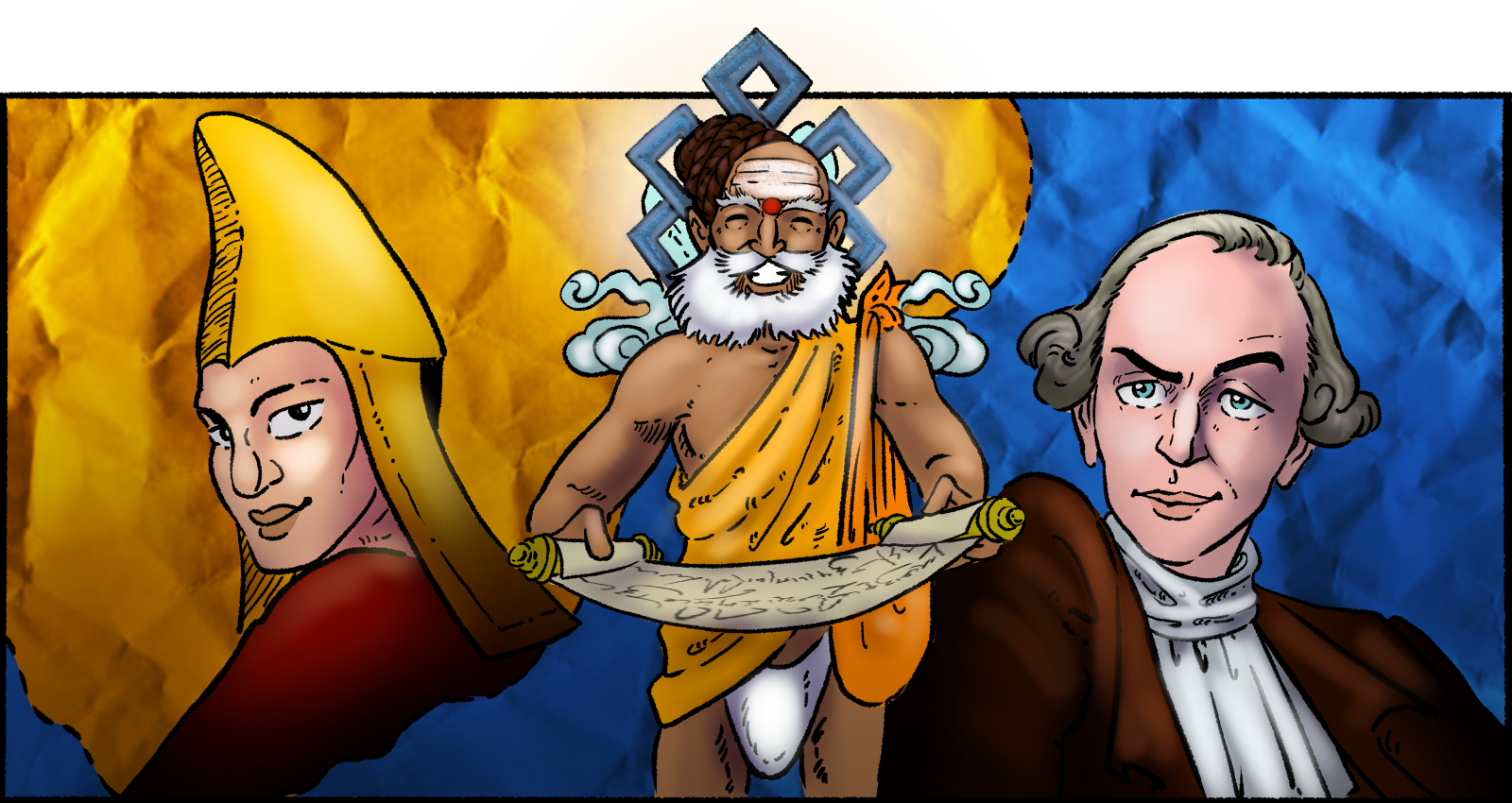
A Gosain Walks into the Council
Warren Hastings, the first Governor-General of Bengal, was a very worried man in the year 1774. While the English East India Company (henceforth EIC) had successfully established its military control over Bengal through the Battle of Buxar in 1764, and legitimized it through the grant of the ‘Diwani’ by Mughal Emperor Shah Alam II in 1765,1 there were several challenges still lying ahead in the path of British expansion in India. Tensions with Mysore, Awadh and the Marathas were recurrent, and the prospect of war with all of them was looming on the horizon.2 News from the American colonies on the other side of the Atlantic was not welcoming either, with the colonists defying British authority through the Boston Tea Party of 1773. Besides harming the legitimacy of the British Parliament, this was a damaging blow to the financial health of the EIC as well,3 for reasons which we shall soon discover.
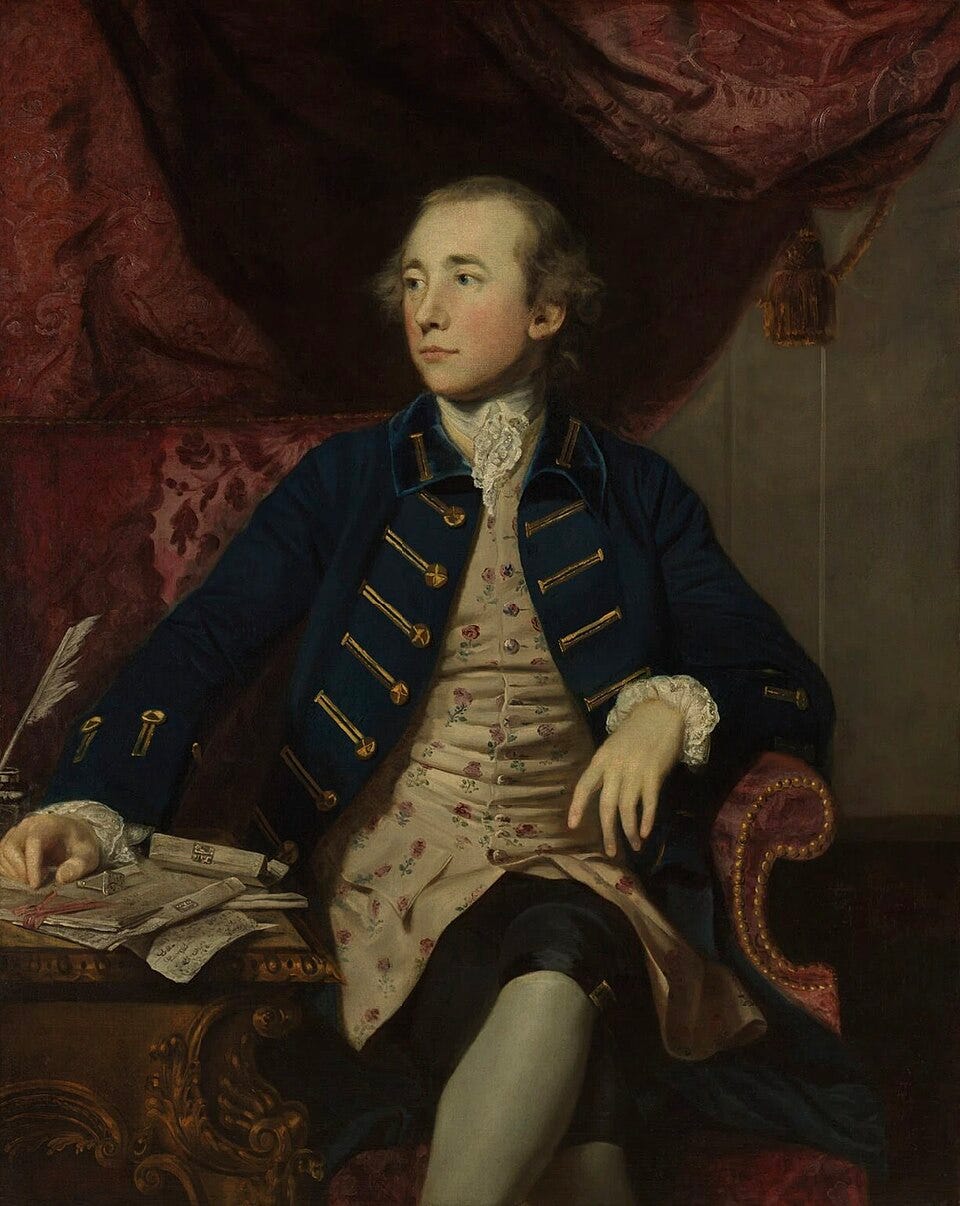

On 29th March, 1774, however, Hastings was to receive news which was not directly related to any of these developments. Much to his pleasant surprise, a ‘Hindoostanee pilgrim’ named ‘Porungheer Gossein’ (Purangir Gosain) met him in Council and delivered a letter from the highest authority in Tibet at that time, the Panchen Lama.4 This letter was to change the course of history, for it paved the way for not just the establishment of diplomatic relations between British India and Tibet, but laid the foundations for the future Himalayan policy of the British Raj; which continues to have significant repercussions till this day in the form of Sino-Indian tensions over border disputes.
But why was this letter written, and what was it all about? Why was a Hindu monk, a Gosain, carrying letters for a Buddhist Lama from Tibet?
A Kingdom in Crisis
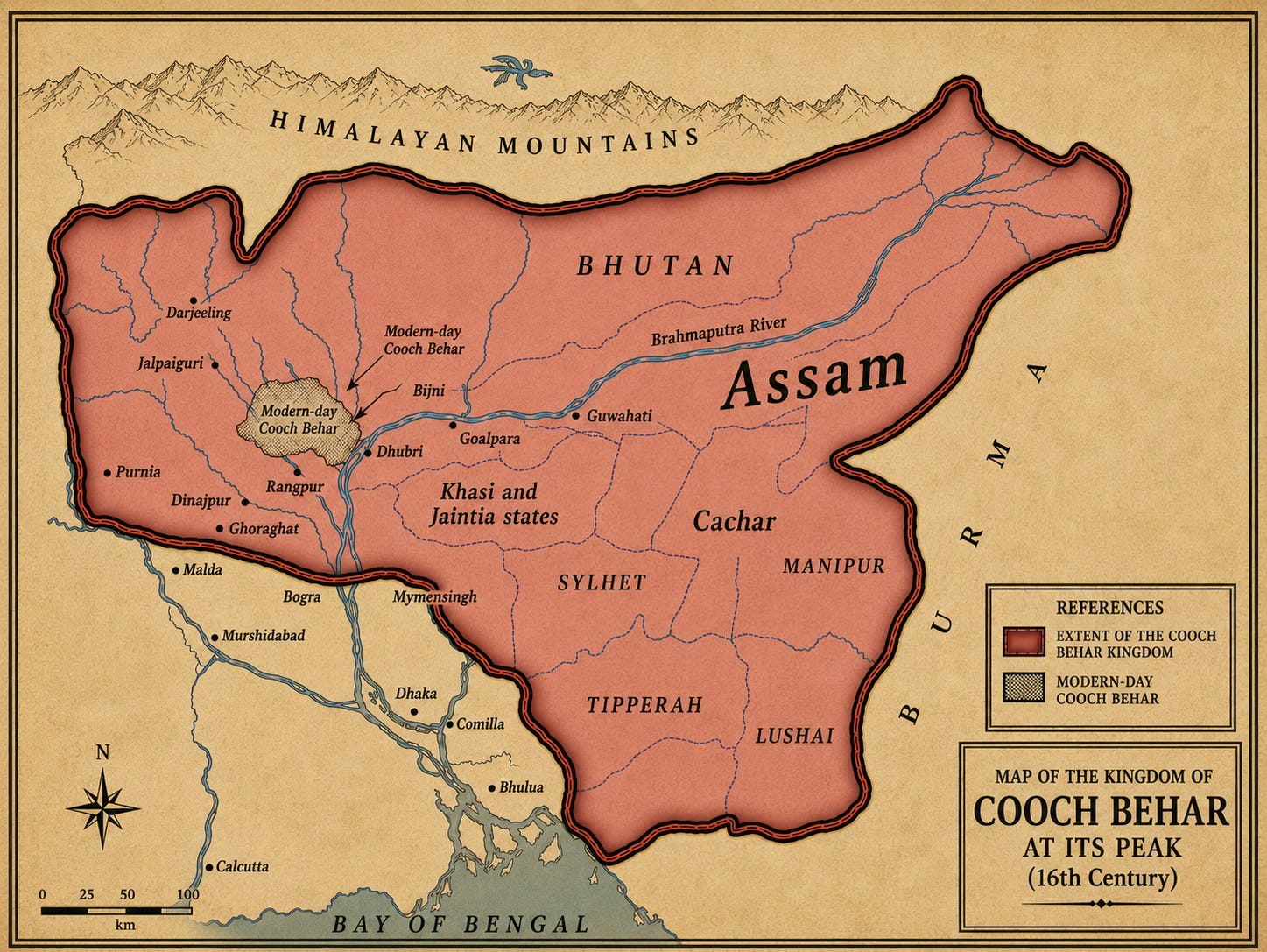
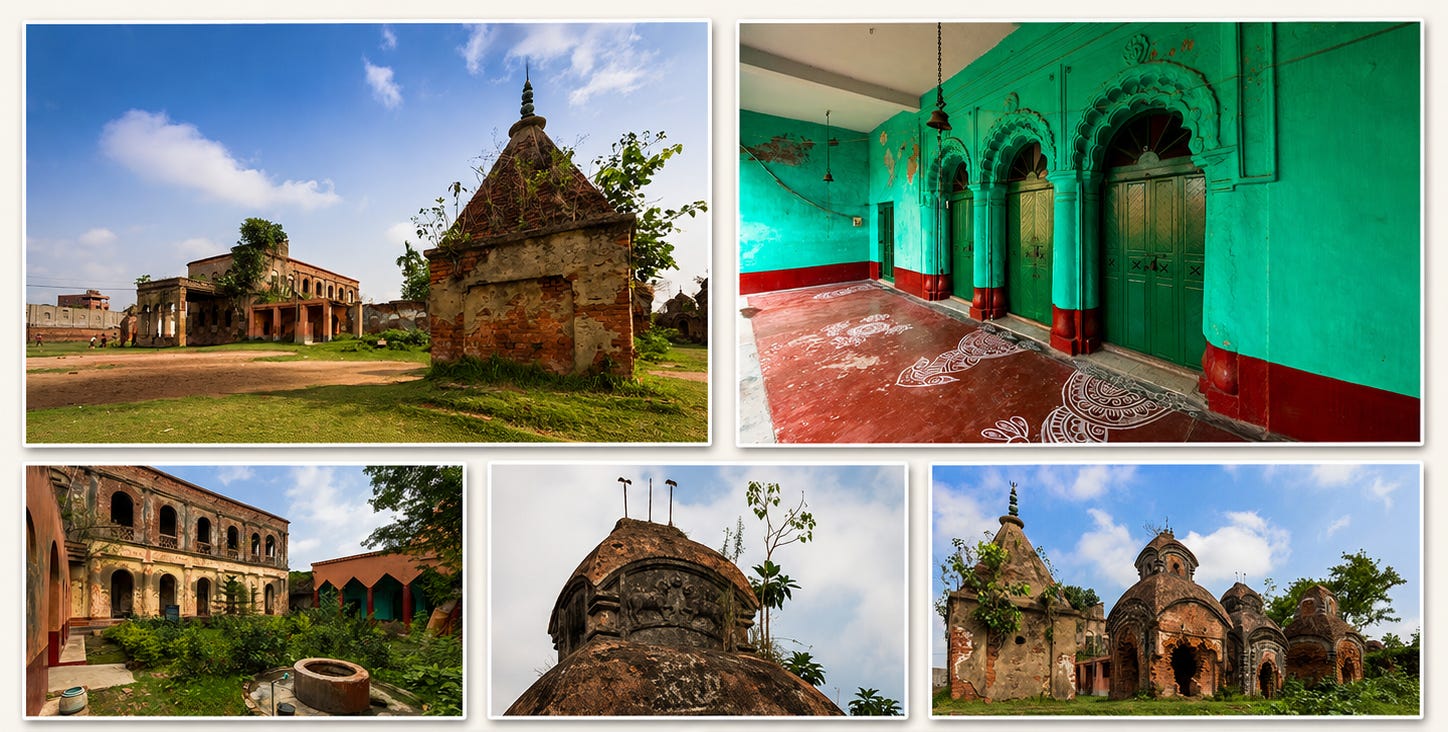
Cooch Behar, a district currently situated in the extreme north-eastern corner of Bengal in the foothills of the Himalayas, was once a considerable kingdom with an enviable historical legacy. Its founder was Vishwa Singha, the son of a Mech chief and his Koch wife, who established his sway over a vast portion of territory in North-Eastern India – from the foothills of Bhutan to the Karatoya river in the south, from the eastern portions of the Nepalese Terai in the west to the Garo Hills in the east.5 His two sons — Nara Narayan and Shukla Dhwaj (popularly known as Chilarai) — took Cooch Behar to its greatest height. They not only defeated the Afghan Sultanates of Bengal repeatedly and protected the frontiers of the state, they also expanded it by defeating the rulers of the Ahom, Tripuri and Jaintia kingdoms.6 The rise of the Cooch Behar kingdom in the 16th century was a major political development which shook Eastern and North Eastern India, forcing all major powers in the region, including the mighty Mughal Empire, to take notice.
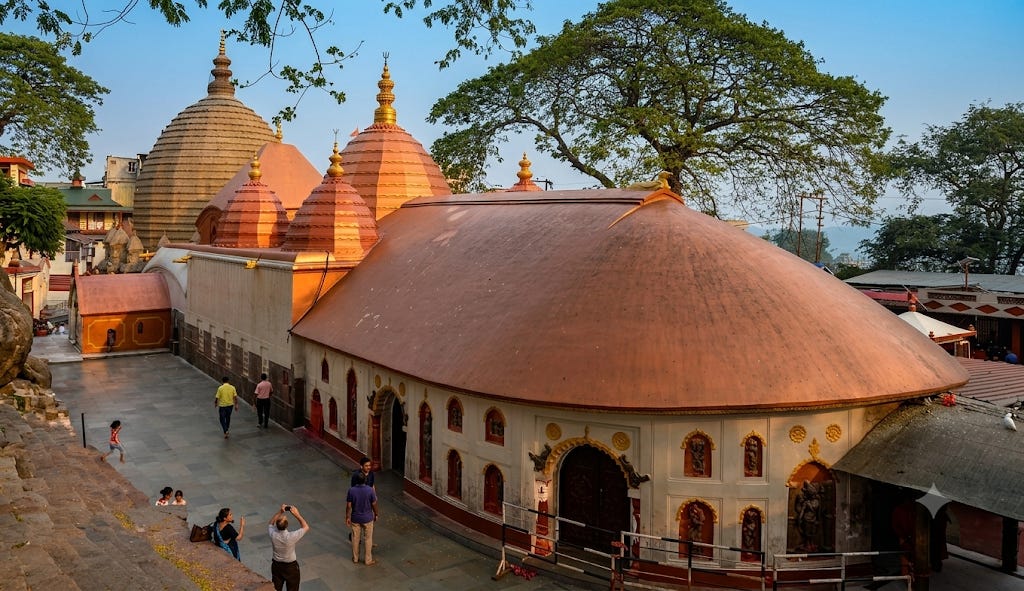
By the 18th Century, however, this once mighty dynasty was merely a shadow of its former self. Most of its territory had been lost due to the expansion of the Mughal Empire from the south and the Ahom State from the east.7 This decline had occurred over the course of the 17th Century, the period in which Bhutan emerged as a militarily and politically unified state under the leadership of Zhabdrung Ngawang Namgyal -- venerated and officially recognized as Bhutan’s founding father.8 As Cooch Behar descended into political chaos due to internecine rivalry among different factions of the ruling family, Bhutan saw an opportunity and exploited the situation by offering support to one faction against the other. For example, in the 1730s, when the incumbent and childless ruler Upendra Narayan (c. 1714-63 CE) refused to announce the name of his nephew Dina Narayan as the future king, Dina Narayan allied with the Nawab of Murshidabad and conspired to take over the kingdom. Upendra was able to thwart this conspiracy and the Nawab’s military, only through the help rendered by the Bhutanese army.9

It is quite evident that the rulers of Cooch Behar had become helplessly dependent upon Bhutan in the late 17th and 18th Century for their own defence, and they repaid their debt to Bhutan through substantial territorial concessions in what is now known as the ‘Duars’, roughly corresponding to the Alipurduar and Jalpaiguri districts in today’s West Bengal. Bhutan, therefore, did not just territorially expand; it made Cooch Behar its vassal state. A Bhutanese representative was attached to the Cooch Behar court with a military escort for ostensibly diplomatic purposes, but he actually functioned as an instrument of Bhutan to crush any challenge to Bhutan’s power in Cooch Behar.10
Things came to a head in 1770 CE, when the Raja of Cooch Behar, Dhairjendra Narayan (1765-70, 75-83 CE), had his brother and minister, Ram Narayan, assassinated. Ram Narayan was a trusted ally of Bhutan in the Cooch Behar court, and therefore Bhutan decided to punish the Raja. The Bhutanese forces captured Dhairjendra Narayan along with some of his other ministers. He was taken to Bhutan and imprisoned, and another member of the family, Rajendra Narayan, was coronated as Raja.11 In 1772 CE, even this ruler passed away, and when time came for the installation of a new king, there was a complete breakdown of relations between the two states. While Bhutan favoured the installation of a distant cousin of the deceased king, named Brijedra Narayan, who was in Bhutanese custody and would thereby function effectively as a Bhutanese puppet; the royal family favoured the coronation of Dhairjendra’s son, Dharendra Narayan (1772-75 CE), as the next Raja of Cooch Behar. When the royal family ignored Bhutan and proceeded to implement its wish, a massive Bhutanese army invaded the Cooch Behar kingdom in 1772 CE. The kingdom was captured and a puppet ruler installed on the throne; with the Bhutanese commander acting as the real authority behind the throne. The royal family had to flee Bhutan and take refuge in adjacent Rangpur, which was British-controlled territory. They sought the help of the British for expelling the Bhutanese.12
The Fall of Cooch Behar
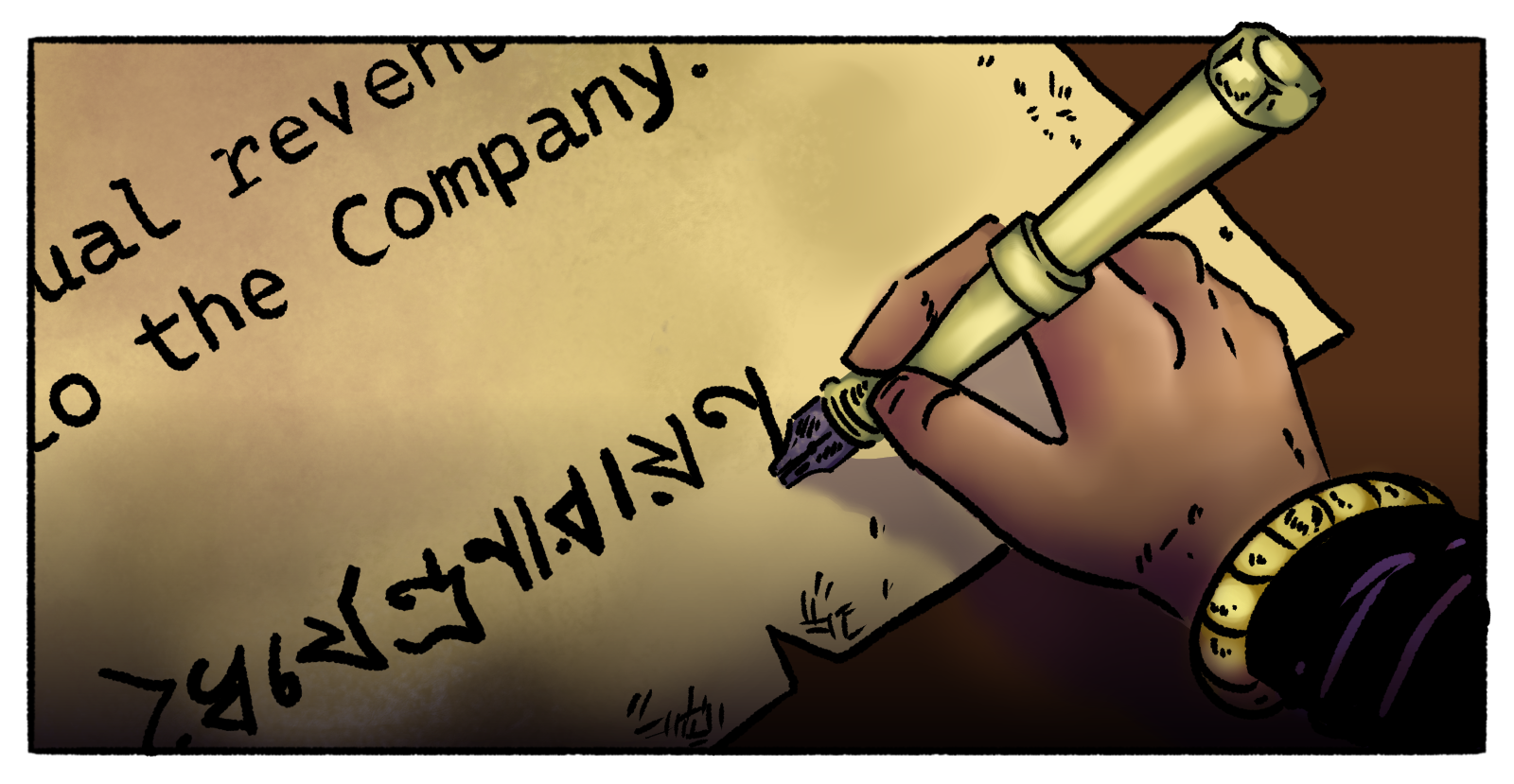
The British, following their conquest of Bengal in 1757, had been looking for an opportunity to expand their commercial interests. The Himalayas, as we shall see in the subsequent section, became extremely crucial for the EIC given its vibrant trade and the connectivity it promised with Tibet and China. As a region located in the foothills of the Himalayas, therefore, Cooch Behar became critical to the pursuit of the EIC’s Himalayan policy; this was especially true given Bhutan’s involvement with the conflict. The British hoped that by helping Cooch Behar they might get to open a diplomatic channel with the Himalayan polities like Bhutan and Tibet. Therefore, after a prolonged negotiation, the Anglo-Cooch Behar Treaty was concluded in 1773 CE. As per this treaty, Cooch Behar acknowledged the paramountcy of British power and agreed to fund the British military expedition to evict the Bhutanese. Cooch Behar also agreed to pledge half of its revenues, in perpetuity, to the EIC. In return, the British promised to undertake the responsibility for defending Cooch Behar anytime called upon to do so by the Raja, provided he paid for such future expeditions. Therefore, this treaty ended up making Cooch Behar a subsidiary power, or a protectorate of British India.13
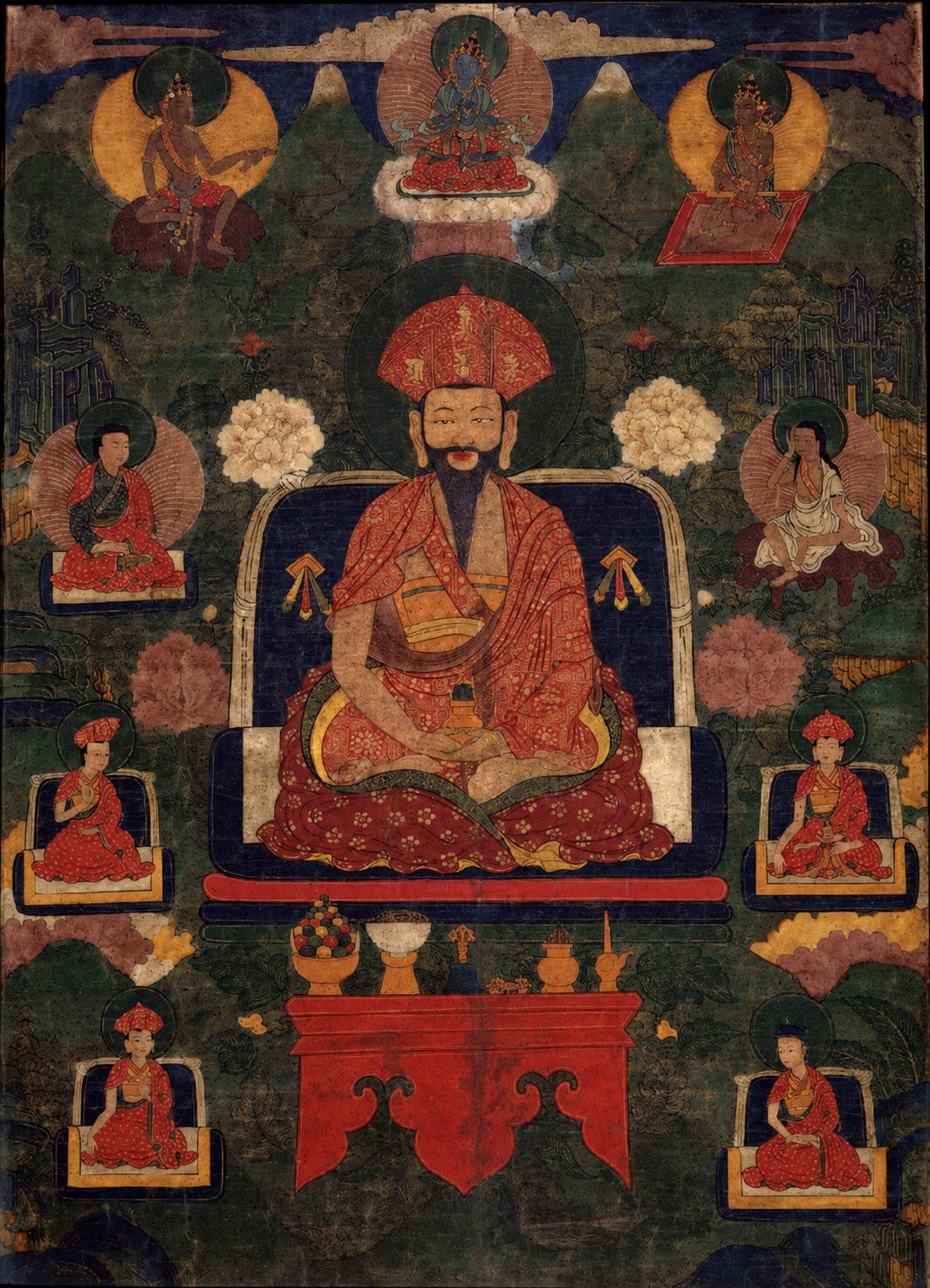
Warren Hastings sent a company of troops under the command of Captain Jones to expel the Bhutanese from Cooch Behar. The ensuing conflict, which is now known as the Anglo-Bhutan War of 1773-74, resulted in a crushing defeat for the Bhutanese,14 who were then forced to rope in the Tibetan Government to mediate in the dispute. The Third Panchen Lama of the Tashilhunpo monastery at Shigatse, who was known to the British as ‘Teshoo Lama’, was the senior-most authority and the Regent in Tibet back then – given Dalai Lama’s minor age.
Named Lobsang Palden Yeshe (1738- 1780 CE),15 this remarkable individual was known for his extensive trade operations and widespread intelligence and diplomatic networks. Quite eager to open up relations with the new and ascending power in India, while also trying to curb their influence in the Himalayan backyard of Tibet, the Panchen Lama wrote to Hastings on behalf of the Bhutanese. Through this letter, which was conveyed to the British by Purangir Gosain, the Panchen Lama agreed with the British view on Bhutan’s conduct and mentioned that he had reprimanded the rulers of Bhutan for the invasion. At the same time, he also sought some reprieve for Bhutan and indicated to the British in a subtle way that Tibet would not tolerate any further British encroachment upon Bhutan’s territory, particularly in the Hills. He presented himself as a peacemaker or arbitrator between both the parties.16
Through this letter, Warren Hastings saw a chance to implement his own ambitious policy. Therefore, at the Tibetan request, he decided to treat the Bhutanese with ‘leniency’. Following this, a treaty was negotiated between Bhutan and the EIC on 25 April, 1774. Under its terms, all lands belonging to Bhutan, which had been conquered by the British during the war, were returned to Bhutan. Bhutan was required to release Dhairyendra Narayan, the former Raja of Cooch Behar. Bhutan also agreed to not encroach upon British territory, or territory under British protection. Finally, the treaty also called for trade to be re-established with the Bhutanese.17
Monks, Merchants, and Mountains
The British desire to open up commercial relations with Bhutan, and thereby with Tibet, can be rightly understood as the driver of its diplomatic and military intervention in the dispute between Cooch Behar and Bhutan. However, without an understanding of this trade and its connections with diplomacy and religion in the first place, we will never be able to comprehend the British efforts to craft its Himalayan policy along such lines.
Cooch Behar and Bhutan enjoyed close relations of trade, diplomacy, and culture in the pre-colonial period. In the 18th century, there are reports of a grand annual fair taking place in Rangpur (now in Bangladesh), where Bhutanese traders came in caravans to trade with Bengal. The Duars or hill passes, in the foothills of the Himalayas, were used as commercial highways. This fair took place usually in the months of January-April, when it was conducive for the Bhutanese to travel to and from the hills due to the hospitable climate. The Bhutanese imported cotton and silk textiles, spices, tobacco, indigo, dried fish, betel leaf, and areca nuts from Bengal, and exported to Bengal horses, musk, yak tails, gold dust, Tibetan wool, Chinese silk and even silver.18
As can be evident from the list of the commodities that Bhutan exported to Bengal, the products were primarily Tibetan and hence, Bhutan was a crucial carrier of Tibetan trade during this period. This gave rise to a triangular trade between Tibet, Bhutan and Bengal, which was primarily conducted through the current-day Kalimpong District. Tibetan merchants from Lhasa, Shigatse, Gyantse and Phari exchanged products like sheep, ponies, wax, soda, blankets, Chinese tea, salt, wool, musk and yak tails for the Indian products, primarily cotton and silk textiles, which the Bhutanese brought from the plains of Rangpur and Cooch Behar.19
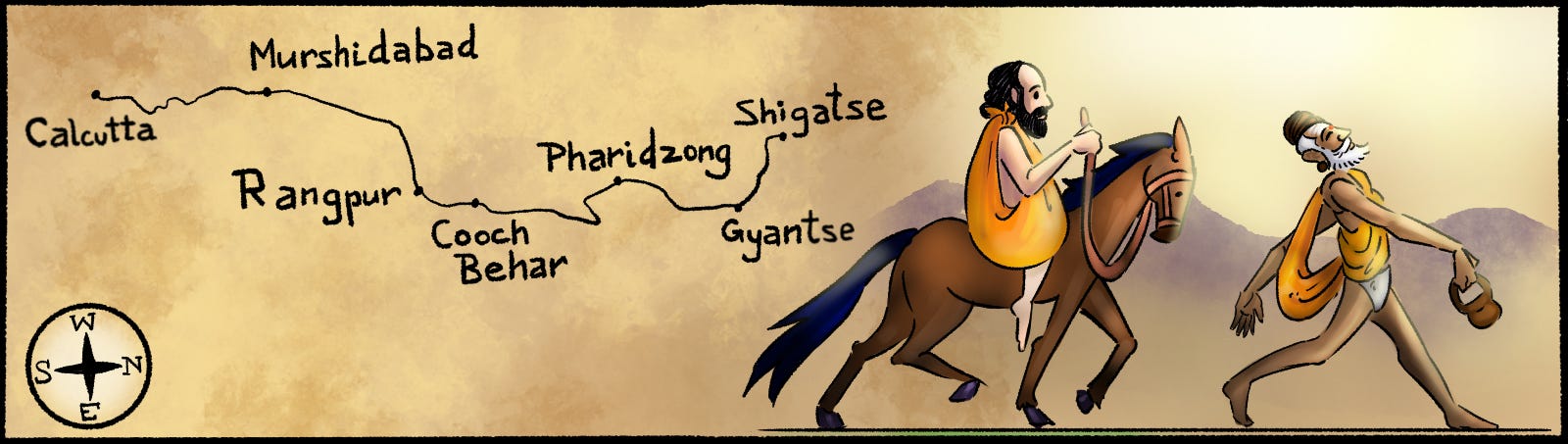
Such trade relations of Bhutan, both with Tibet and Cooch Behar, were closely connected to diplomacy. For example, in 1690, Prince Rupa Narayan (1693-1714 CE) of Cooch Behar visited Bhutan and was officially received by the 4th Temporal ruler of Bhutan, Tenzin Rabgye, and on this occasion, presents comprising gold, silver, silk and horses were exchanged as a sign of goodwill.20 Bhutanese monks also went to Tibet regularly in search of the reincarnated soul of their spiritual leader, the Zhabdrung or Dharma Raja.21 Such occasions involved trading with the Buddhist monasteries of Tibet, and a colonial official, named Francis Buchanan-Hamilton, speaks of a caravan sent every year by the Deb Raja of Bhutan to Lhasa by which goods to the value of thirty to forty thousand Rupees, chiefly cloth, pearls, and corals from Bengal, were exchanged for tea.22 This tea, in turn, was procured by Tibet from China. In the market town of Xining, on the western frontier of China, Tibetans exchanged their own and Indian products, as listed above, with Chinese tea, silk and porcelain.23 There was a popular culture of tea drinking in Bhutan and Tibet as testified by contemporary British observers.24
This example of Bhutanese trade and diplomacy also shows how religion was connected to the process. Shigatse in Tibet, which is the site of the famous monastery of Tashilhunpo and is also the seat of the Panchen Lama, the second highest religious authority in Tibet after the Dalai Lama, was known for its vibrant trade. It served as a major centre of the Trans-Himalayan trade because of its favourable location, with roads from here connecting Lhasa (the Tibetan capital) with Punakha (the Bhutanese capital) and even the Kerong Valley (Nepal). It was known for its fine bazaar which saw the active presence of merchants from China, Tibet, Bhutan, Central Asia, Nepal, Afghanistan and even Kashmir.25
Similarly, in Cooch Behar, temples and festivals functioned as conduits of trade. For example, during the Shiv Ratri Festival of February/March, a fair was organized in Jalpesh, where the Shiva temple of Jalpeshwar is located. Traders from across North Bengal and Bhutan gathered in the fair and exchanged their commodities, the Bhutanese being particularly known for bringing their ponies, yak tails, blankets, and silver knives for trade.26
Given the presence of Tibetan Buddhist monasteries as active participants in this trade, and the critical role played by Shigatse as a trading entrepot, it was no wonder that one of the protagonists of our story – Lobsang Palden Yeshe (1738-80 CE), the 6th Panchen Lama of Tibet – took an active interest in it. The trade was important to the Panchen Lama not just for the revenue it yielded to him; it also gave him an incentive and a conduit to conduct diplomacy with several polities. For example, he was in active correspondence with Chait Singh, the ruler of Varanasi, with whom he maintained diplomatic channels via two Gosain monks, named Gosain Kishenpuri and Sobha Ram.
The Panchen Lama was interested in the Buddhist holy site of Bodh Gaya and had a commercial interest; besides, he wanted to gain information about the new political developments in India, like the rise of the British power. Chait Singh was equally eager to balance both the British and the Gorkhas to survive politically, and reap dividends from the pilgrim and commercial traffic.27 Singh’s rebellion against the British in 1781, which resulted in the British losing control over the Varanasi region for some time, reveals his political acumen in the face of adversity.28 We witness the same diplomatic skills in the Panchen Lama, who was adept in conducting diplomacy with both the British and the Chinese Qing Empire.
The Secret Lives of Hindu Monks
On the Indian side, the Hindu Gosain monks closely paralleled the role played by Buddhist monasteries in this trans-Himalayan trade. Widely known for going on pilgrimages to sites across the subcontinent, especially during ritual occasions like Kumbh Mela, the Gosain monks were not mere spiritual mendicants. As part of the wider network of Dasnamis who are more popularly known as Naga Sanyasis,29 they carried out extensive trade and commerce during their pilgrimages.30 Their extensive travels and contacts, moreover, gave them knowledge about different societies and polities – which could be utilized for purposes of both political and military intelligence, as well as for diplomatic negotiations.
GW Forrest, British official and historian, who edited three volumes of documents related to the foreign policy of the early colonial state, described the Sanyasis in similar terms as follows:
“The history of this (Sanyasis) people are curious. They inhabit or rather possess, the country lying south of the hills of Tibbet, from Cabul to China. They go mostly naked. They have neither towns, houses nor families but rove continually from place to place, recruiting their numbers with the healthiest children they can steal in the countries through which they pass. Thus, they are the stoutest and most active men in India. Many are merchants. They are all pilgrims and held by all castes of Gentoos in great veneration.”31
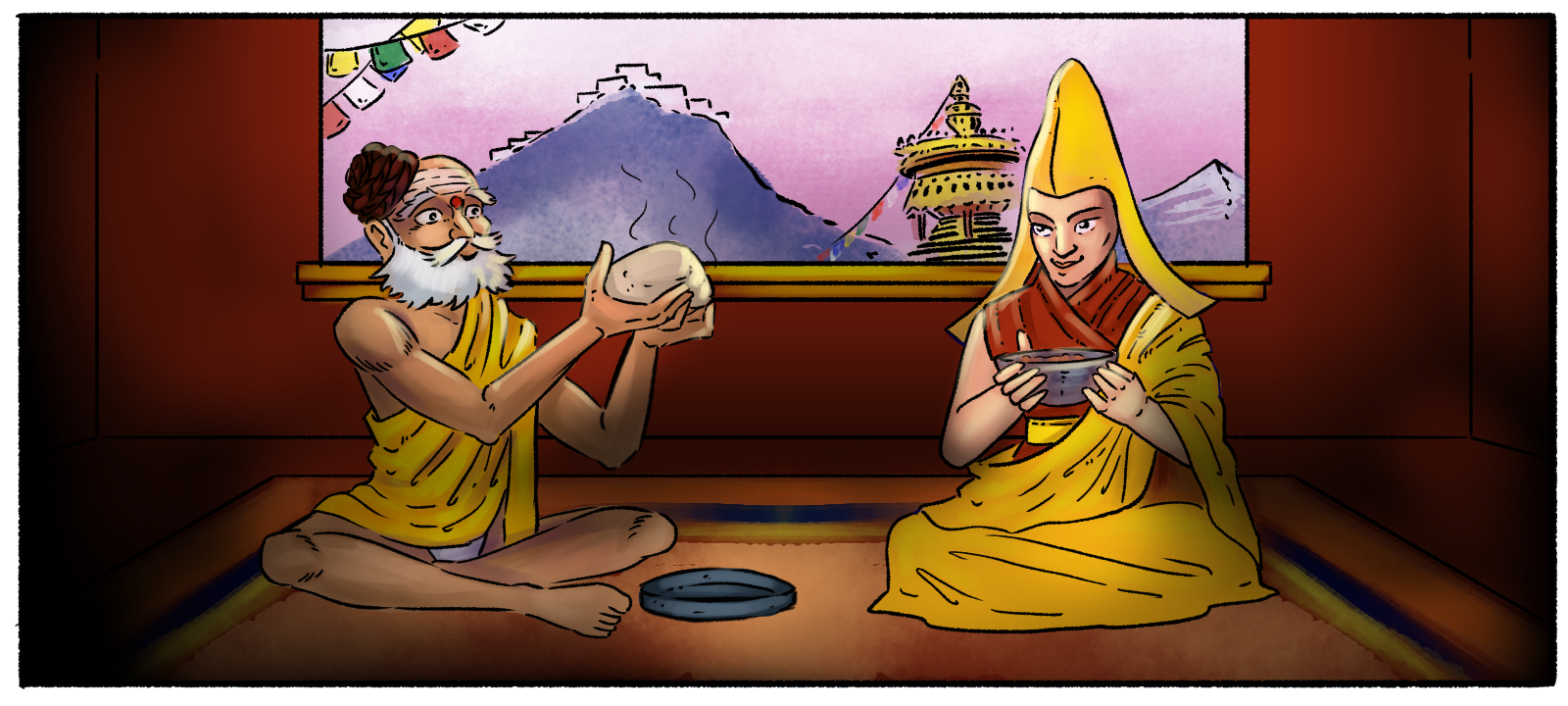
The Tibetan monastic heads, like the Dalai Lama and the Panchen Lama of Shigatse, recognized the immense potential of the Gosains and lavishly granted them hospitality. When the British initiated contact with the Tibetans, for example, they saw that “no less than 300 Hindoos, Goseins, and Sunniasses” were fed daily by the Panchen Lama.32 Therefore, if the British were to establish commercial relations with Tibet and China, they had to resort to the help of Gosains and the Lamas who could be the only crucial intermediaries in such affairs.
The Rise of Purangir Gosain
The British were aware of the Trans-Himalayan trade from the moment they set foot in the Indian subcontinent. The EIC perceived it as an alternative source of revenue to redress the adverse balance of the China trade.33 The increase in consumption of tea in Britain from 100 lbs in 166434 to 22 million lbs by 1800,35 and the lack of any demand in China for British products which were being manufactured in greater quantities due to the Industrial Revolution, resulted in a massive outflow of silver to pay for this Chinese tea.36 The EIC, which had a monopoly over the China trade, realized that to prevent the outflow of silver they could either come up with a product that the Chinese needed, or, they could gain the silver from other sources. A need was also felt for establishing direct diplomatic relations with the Imperial Court in Peking (current-day Beijing) to negotiate favourable trade concessions at the port of Canton. Access to the Trans-Himalayan trade and the interior markets of China could be a catalyst to both these processes.37
This realisation convinced the Court of Directors of the EIC of the need for opening some kind of commercial and diplomatic relation with the hill states which lay on Bengal’s northern frontier. In 1771, the Court of Directors approved EIC’s plan for participating in the Trans-Himalayan trade and suggested ways through which the markets in places like Northern Bengal and Assam could be utilized to find a market for British products, like broadcloth, copper, iron, lead, etc., in Bhutan and Tibet.38
Purangir Gosain was one of the few individuals who could enable the British to implement this program. His life provides an insight into the activities and nature of Sanyasis in 18th Century India. As his name indicates, he was initiated into the Giri sect of Dasnami Sanyasis, who also are known by the honorific Gosain;39 and some historians have argued that he probably came somewhere from the Gangetic Plains and was initiated into the order at Joshi Math in present-day Uttarakhand.40 He probably became acquainted with the Panchen Lama through his pilgrimage and trading activities in Tibet, because of which, he was chosen as the emissary through whom the Panchen Lama wrote the letter to Warren Hastings. Purangir not only fulfilled his mission, but subsequently guided the Bogle (1774-75), Hamilton (1776-77) and Turner (1783-84) Missions to Bhutan and Tibet. These missions were both diplomatic and commercial in nature, for the EIC hoped to not just establish a secure frontier with its Himalayan neighbours but to also expand commercial opportunities by trading with them. No one could have been better in guiding such missions other than a Gosain, who possessed these diplomatic and trading connections. Commenting on Purangir Gosain’s abilities, Samuel Turner, who was appointed to lead the 1783-84 Mission to Tibet, made the following observations:
“Motives of religious duty, which, among the order of Goseins more especially, attaches peculiar respect to every kind and degree of penance, having occasionally led Poorungheer among the different tribes of Tartars, he had acquired, during his residence amongst them, a very competent knowledge of their manners, and of their language, which he spoke with apparent ease; and by the exemplary regularity of conduct he had uniformly preserved in his intercourse with the inhabitants of these regions, I found that he had strongly recommended himself to their notice, and obtained the favour of all their chiefs.”41
Purangir’s success was so phenomenal that he even accompanied the Panchen Lama in 1779-80 to Beijing, in order to make representations on behalf of the British to the Chinese Emperor Qianlong;42 and he led a commercial mission to Tibet in 1785 as a British envoy in his own right.43 The amount of trust that he gathered from both sides is evident in the fact that when the British gave land to the Tibetans near Calcutta for construction of a monastery and dormitory for Buddhist traders and pilgrims coming to India, the responsibility of maintenance of the property was vested in Purangir Gosain.44 Till his death in 1795, which occurred during a raid on the monastery by a band of dacoits, Purangir remained dedicated to the diplomatic and commercial responsibilities that he was entrusted with by both the Tibetans and the British.45
The First Briton in Tibet
The achievement of the successive missions which were sent by Warren Hastings to Tibet were modest but nevertheless significant. The objective of these missions was to open trade and communications with Bhutan, and through it, if possible, with Lhasa. In the process, these Missions also ended up revealing much about the geography and society of the Himalayas to the Europeans, many of whom were not even sure about the exact location of Tibet and its contours. George Bogle’s Mission, which set out for Tibet in May 1774, and reached the Panchen Lama’s palace in December 1774, was the most remarkable from this perspective.
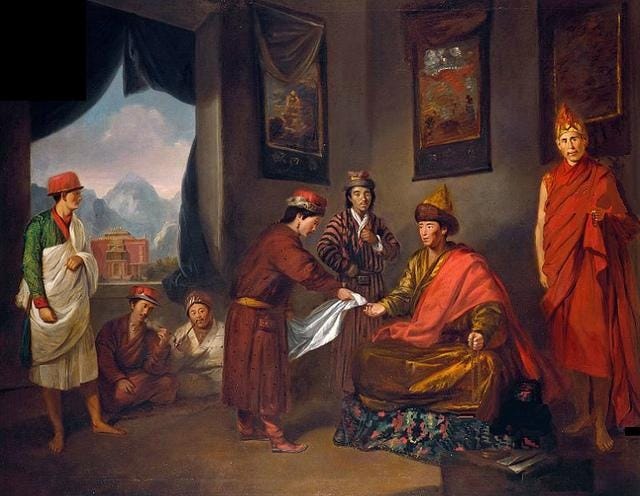

Though other Europeans had been to Tibet, this was arguably the first interaction of the British with Tibet. Bogle remained in Tibet for five months. The Lama was interested in all that Bogle had to tell of the outside world, especially about the rise of British power in India and the scientific and technical developments of Europe. Bogle, in turn, was impressed by the sanctity and wisdom of the Lama, particularly his keen knowledge of political affairs and trade. Building this relationship was the greatest achievement of Bogle’s mission.46 The Panchen Lama’s mediation was crucial in reviving the Indo-Tibetan trade, particularly in terms of convincing the Bhutanese to effectively play their role as intermediaries. As a result of this mission, a commercial treaty was signed between EIC and Bhutan in 1775 CE, allowing Indian merchants to freely travel through Bhutan while moving from Bengal to Tibet, and vice versa. As an additional concession to Bhutan, the EIC promised that no European merchants will be allowed to enter Bhutan.47
Bogle’s Mission and the new commercial treaty, therefore, ignited a warm phase in Anglo-Bhutanese and Anglo-Tibetan relations. The rapport which Bogle had established with the Panchen Lama of Tibet and the Deb Raja of Bhutan pleased Hastings, and he was determined to sustain the momentum. This was evident in the grant of land to the Tibetans near Calcutta, which was placed in charge of Purangir Gosain as we have already discussed. In 1779, Bogle was sent to Shigatse for a second time, not so much in the immediate hope of improving Indo-Tibetan trade than to exploit the relationship existing between the Panchen Lama and the Emperor of China. The Panchen Lama tried to intercede on behalf of the British with the Chinese Emperor during his visit to China next year, with Purangir as a representative of the EIC. However, the Panchen Lama died in China in 1780, and the following year Bogle, whose friendship with the Panchen Lama had given Hastings hope that this would open the door to Lhasa, also died.48
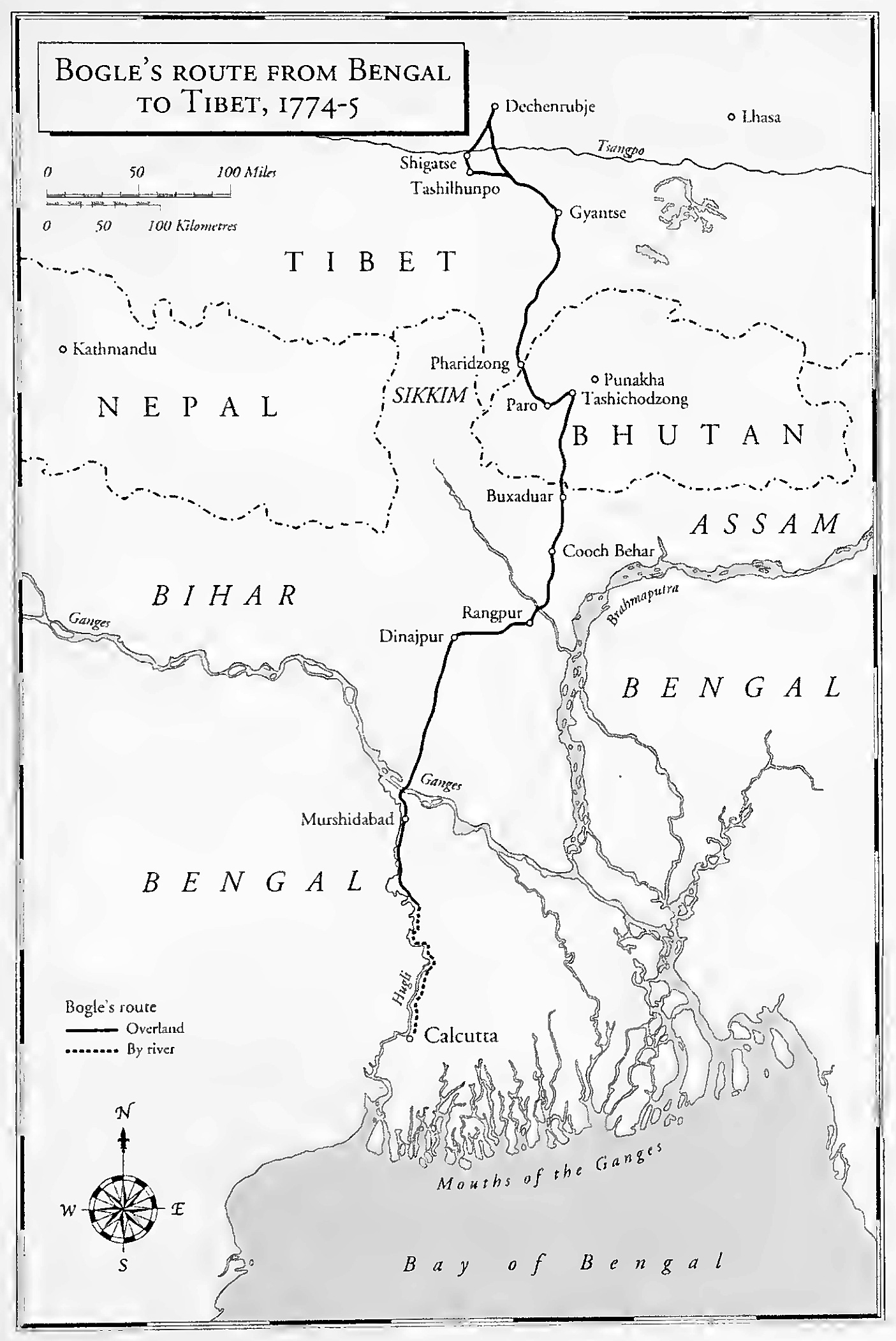
Despite the loss of an experienced man like Bogle, Hastings’ policy towards the Himalayan states did not radically change. In 1783, on the occasion of the installation of the new Panchen Lama, Samuel Turner was despatched to Shigatse, along with Purangir Gosain, and entrusted to carry the good wishes of the Company.49 On his return, and acting on his advice, Hastings circulated an advertisement inviting Indian merchants to join in an ‘adventure’ in trade with Tibet through Bhutan. The party of merchants were asked to assemble in Rangpur in February 1785, with goods likely to find a suitable market in Tibet. In 1785 the ‘adventure’ took place under the leadership of Purangir Gosain, and from it a reasonably profitable trade resulted. By the time the merchants and Purangir Gosain returned to India to report on the success of their venture, Hastings had already left for England.50
Even after the departure of Hastings, the EIC did not give up its attempts of establishing a commercial and diplomatic relationship with Tibet. The possibility for opening up direct contacts with China was increasing gradually, and this is evident from the fact that in 1789 there was a proposal to send Purangir Gosain to China with instructions for “obtaining either the seed or plant of the Tea, with promise of a suitable reward in case of success in procuring the proper kind and delivering it in a state of vegetation to the Chief at Rungpoor, and if possible, with a native practised in the cultivation.”51
And the Doors Closed…
Unfortunately, these developments were impeded by the Tibet-Gurkha War of 1788-92. The war led to Chinese power expanding in the Himalayas, after the Tibetans appealed to Peking for help.52 The Tibetans had initially appealed to the EIC for help, keeping in mind the promises of friendship and cooperation that had been made by the previous British Missions, but the incumbent Governor-General, Lord Cornwallis, refused to be dragged into a potential Himalayan war for fear of antagonizing the Gurkhas.53 The consequences of these geopolitical developments were to the disadvantage of British diplomacy. The Chinese were able to defeat Nepal and make it their tributary.54 Moreover, the Chinese suspected the British of having helped the Gurkhas while the Tibetans resented the lack of help from the British side. The Chinese also managed to establish a series of military posts along the Himalayas, thereby causing a decisive shift in the political alignment of the Himalayan states, including Bhutan.55
As a result of these developments, the Indo-Tibetan trade came to a complete halt. Suspicious of British intentions, the Chinese blocked the passage of Indian goods and travellers through the Himalayan passes which were now under Chinese control. Even the Hindu Gosains, who had been so active in the Trans-Himalayan trade and enjoyed much respect from the Buddhist establishment, were seen as British spies and thereby barred from entering Tibet.56

Though the early efforts of the EIC at establishing commercial relations with Tibet failed due to such developments, the Missions and, most importantly, the actions of Purangir Gosain himself, continued to remain invaluable for the future formulation of the British Raj’s policy on the Himalayas. Without having access to critical information on the geography, society and even politics of these regions through local intermediation, the British could never have ‘explored’ the Himalayas.
━━━━⊱⋆⊰━━━━
Sukrit Banerjee is from Kolkata, West Bengal, India. He is currently pursuing PhD in Modern History from Jawaharlal Nehru University, New Delhi. His research focuses on the process of colonial border making and frontier policy in the Eastern Himalayas from 1772-1947.
Bibliography
Primary Sources (Unpublished)
National Archives of India (NAI), External Affairs, 1864, File No. 198, ‘Letter from Ashley Eden, late Envoy to Bhutan, to HM Durand, Secretary to Govt. of India, Foreign Dept.’, 20th July, 1864.
NAI, Bengal Public Consultation No. 17 of 13 Jan. 1790, enclosing Lt.-Col. R. Kyd to E. Hay, 21st Dec. 1789.
West Bengal State Archives, Govt. of Bengal, Revenue Department, August 1868, Pro. No. 96.
Primary Sources (Published)
Munshi Joynath Ghosh, Rajopakhyan or The History of Kooch Behar, Translated by R Robinson, Baptist Mission Press, Calcutta, 1874.
CU Aitchison, A Collection of Treaties, Engagements and Sanads: Relating to India and Neighbouring Countries, Vol. 2, Office of the Superintendent of Government Printing, Calcutta, 1929.
CR Markham (Ed.), Narratives of the Mission of George Bogle to Tibet, Trubner and Company, London, 1876.
RH Phillimore (Ed.), Historical Records of the Survey of India, Vol. I (18th Century), Surveyor General of India, Dehradun, 1945.
GW Forrest (Ed.), Selections from the Despatches, Letters and other State Papers preserved in the Foreign Department of the Govt. of India (1772-1785), Vol. I, Superintendent of Government Printing, Calcutta, 1890.
Kishen Kant Bose, An Account of Bootan (1816), Translated by D Scott, in Political Missions to Bootan, Calcutta Secretariat Press, Calcutta, 1865.
Samuel Turner, An Account of an Embassy to the Court of Teshoo Lama in Tibet, W Bulmer and Co., London, 1800.
John F Gruning, Eastern Bengal and Assam District Gazetteers: Jalpaiguri, Pioneer Press, Allahabad, 1911.
Secondary Sources
Sekhar Bandyopadhyay, From Plassey to Partition and After: A History of Modern India (2nd Edition), Orient Blackswan, 2015.
Nick Robins, The East India Company: The World’s Most Powerful Corporation, Pluto Press, 2012.
Karma Phuntsho, The History of Bhutan, Penguin Random House, 2013.
Luciano Petech, ‘The Missions of Bogle and Turner According to the Tibetan Texts’, Toung Pao (Brill), Vol. 39, No. 1, 1950.
GD Bysack, ‘Notes on a Buddhist Monastery at Bhot Bagan in Howrah’, Journal of the Asiatic Society of Bengal, Issue No. 1, 1890.
Alastair Lamb, Britain and Chinese Central Asia: The Road to Lhasa, 1767-1905, Routledge and Kegan Paul, London, 1960.
Roy Moxham, A Brief History of Tea: The Extraordinary Story of the World’s Favourite Drink, Constable and Robinson, London, 2003.
Jadunath Sarkar, A History of Dasnami Naga Sanyasis, Sri Panchayati Akhara Mahanirvani, Allahabad.
Bernard S. Cohn, “The Role of the Gosains in the Economy of Eighteenth and Nineteenth Century Upper India,” The Indian Economic and Social History Review, Vol. 1, Issue No. 4, 1964.
Françoise Pommaret, ‘Ancient Trade Partners: Bhutan, Cooch Bihar and Assam (17th-19th Centuries)’, Journal Asiatique, Vol. 287, 1999.
Sekhar Bandyopadhyay, From Plassey to Partition and After: A History of Modern India (2nd Edition), Orient Blackswan, 2015, pp. 31-33, 33-35.
Ibid, pp. 36-41.
Nick Robins, The East India Company: The World’s Most Powerful Corporation, Pluto Press, 2012, pp. 132-136.
National Archives of India (henceforth NAI), External Affairs, 1864, File No. 198, ‘Letter from Ashley Eden, late Envoy to Bhutan, to HM Durand, Secretary to Govt. of India, Foreign Dept.’, 20th July, 1864, pp. 1-2.
Munshi Joynath Ghosh, Rajopakhyan or The History of Kooch Behar, Translated by R Robinson, Baptist Mission Press, Calcutta, 1874, pp. pp. 12-14, 24-25.
Ibid, pp. 36-38.
Ibid, pp. 53-54, 56.
Karma Phuntsho, The History of Bhutan, Penguin Random House, 2013, pp. 168-214.
Munshi Joynath Ghosh, Rajopakhyan, pp. 68-70.
Ibid.
Ibid, pp. 82-84.
NAI, External Affairs, 1864, File No. 198, Eden to Durand, 20th July, 1864, p. 1.
CU Aitchison, A Collection of Treaties, Engagements and Sanads: Relating to India and Neighbouring Countries, Vol. 2, Office of the Superintendent of Government Printing, Calcutta, 1929, p. 308.
NAI, External Affairs, 1864, File No. 198, Eden to Durand, p. 1.
Luciano Petech, ‘The Missions of Bogle and Turner According to the Tibetan Texts’, Toung Pao (Brill), Vol. 39, No. 1, 1950, p. 330.
NAI, External Affairs, 1864, File No. 198, Eden to Durand, p. 2-3.
CU Aitchison, A Collection of Treaties, Engagements and Sanads, Vol.14, p. 89-90.
Kishen Kant Bose, An Account of Bootan (1816), Translated by D Scott, in Political Missions to Bootan, Calcutta Secretariat Press, Calcutta, 1865, p. 198.
West Bengal State Archives (henceforth WBSA), Govt. of Bengal, Revenue Department, August 1868, Pro. No. 96,
Françoise Pommaret, ‘Ancient Trade Partners: Bhutan, Cooch Bihar and Assam (17th-19th Centuries)’, Journal Asiatique, Vol. 287, 1999, p. 4.
Karma Phuntsho, The History of Bhutan, pp. 209-211.
NAI, External Affairs, 1864, File No. 198, Eden to Durand, 20th July 1864, p. 96.
Samuel Turner, An Account of an Embassy to the Court of Teshoo Lama in Tibet, W Bulmer and Co., London, 1800, p. 373.
Ibid, p. 232.
West Bengal State Archives (henceforth WBSA), Govt. of Bengal, Revenue Department, August 1868, Pro. 96.
John F Gruning, Eastern Bengal and Assam District Gazetteers: Jalpaiguri, Pioneer Press, Allahabad, 1911, p. 28, 29, 112.
Luciano Petech, “The Missions of Bogle and Turner According to the Tibetan Texts,” T’oung Pao, Vol. 39, Issue No. 4, p. 337.
For more details on this rebellion, see Warren Hastings, ‘A Narrative of the Insurrection which happened in the Zemeedary of Banaris in the month of August 1781’, CE College Press, Roorkee, 1853.
Jadunath Sarkar, A History of Dasnami Naga Sanyasis, Sri Panchayati Akhara Mahanirvani, Allahabad, pp. 53-57.
Bernard S. Cohn, “The Role of the Gosains in the Economy of Eighteenth and Nineteenth Century Upper India,” The Indian Economic and Social History Review, Vol. 1, Issue No. 4, 1964, p. 181.
GW Forrest, (Ed)., Selections from the Despatches, Letters and other State Papers preserved in the Foreign Department of the Govt. of India (1772-1785), Vol. I, Superintendent of Government Printing, Calcutta, 1890, p. xi.
Samuel Turner, An Account of an Embassy to the Court of Teshoo Lama in Tibet, pp. 330-331.
Alastair Lamb, Britain and Chinese Central Asia: The Road to Lhasa, 1767-1905, Routledge and Kegan Paul, London, 1960, p. 6.
Roy Moxham, A Brief History of Tea: The Extraordinary Story of the World’s Favourite Drink, Constable and Robinson, London, 2003, p. 19
Ibid, p. 25,
Ibid.
Samuel Turner, An Account of an Embassy to the Court of the Teshoo Lama, pp. xii-xiii.
RH Phillimore, Historical Records of the Survey of India, Vol. I (18th Century), Surveyor General of India, Dehradun, 1945, pp. 73-74.
Jadunath Sarkar, A History of Dasnami Naga Sanyasis, pp. 54-57.
GD Bysack, ‘Notes on a Buddhist Monastery at Bhot Bagan in Howrah’, Journal of the Asiatic Society of Bengal, Issue No. 1, 1890, p. 87.
Samuel Turner, An Account of an Embassy to the Court of Teshoo Lama in Tibet, p. 38.
Ibid, p. vi.
Ibid, p. vi.
Ibid, p. 269.
GD Bysack, “Notes on a Buddhist Monastery”, p. 87.
CR Markham (Ed.), Narratives of the Mission of George Bogle to Tibet, Trubner and Company, London, 1876, pp. 6-9.
Ibid, pp.184-185.
Samuel Turner, An Account of an Embassy to the Court of the Teshoo Lama, pp. xv-xvi.
Ibid, p. 1-2.
Ibid, pp. 419-433.
NAI, Bengal Public Consultation No. 17 of 13 Jan. 1790, enclosing Lt.-Col. R. Kyd to E. Hay, 21st Dec. 1789.
Samuel Turner, An Account of an Embassy to the Court of Teshoo Lama of Tibet, pp. 437-441.
Alastair Lamb, British and Chinese Central Asia, p. 24.
Samuel Turner, An Account of an Embassy to the Court of Teshoo Lama of Tibet, pp. 437-441.
Ibid, pp. 440-441.
Ibid, p. 442.