

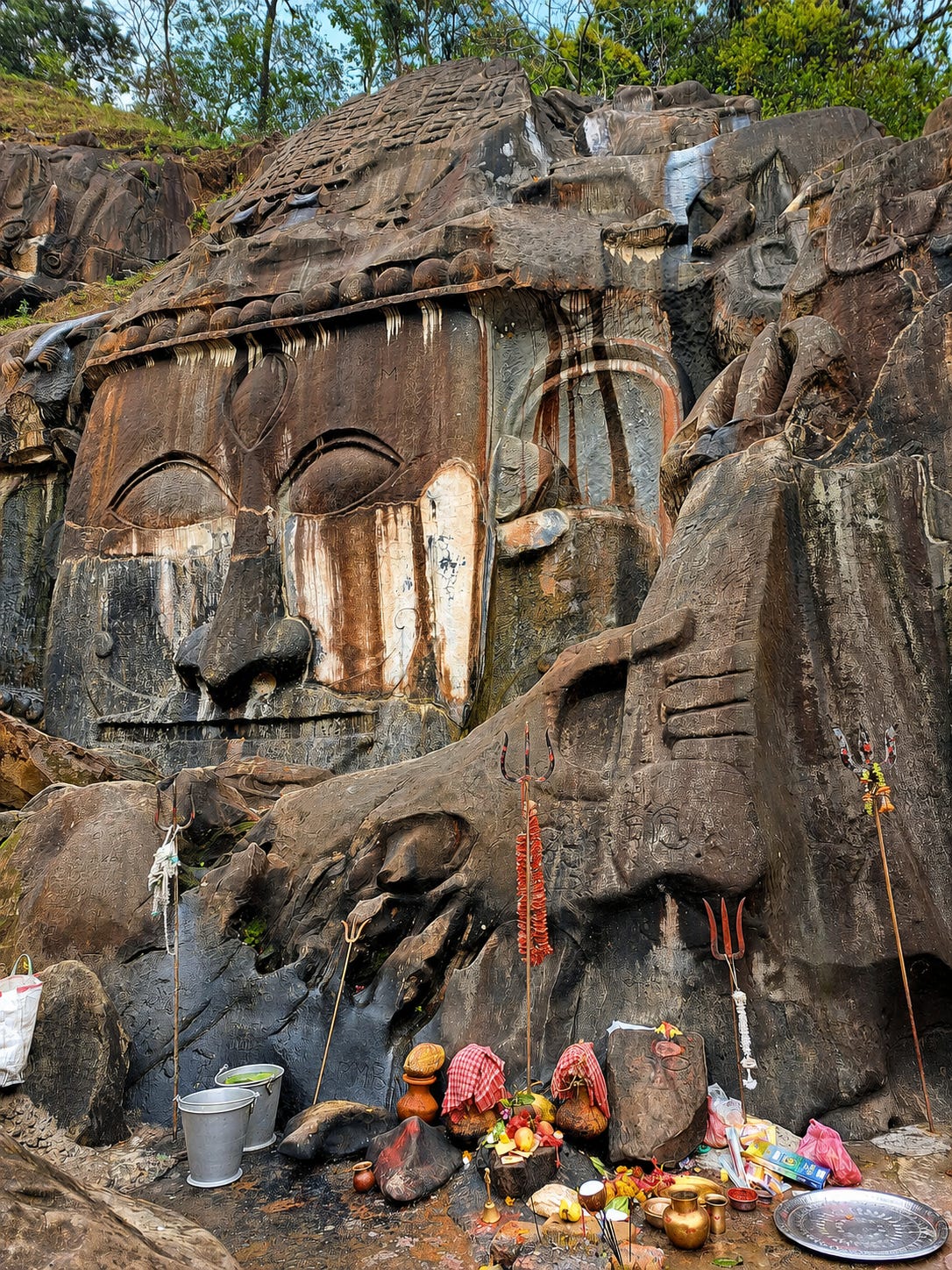
I remember that when I was a small kid, I used to narrate a brief account of Rāmāyaṇa for all the guests who came to our home. My mother narrated it to me once, and it became an inherited memory. A long civilisational memory that has stayed with me since then in multiple ways and practices. As individual memory acts as a guide for the individual, civilisational memories are a compendium of experiences and realisations from hundreds of millions of people who have lived before us. They reach us as generational lessons and (in our case) rituals that have filtered through the cruel sieve of the past. Eminent scholar Vidyaniwas Mishra notes that the characters in Itihāsa-Purāṇa narratives are not merely historical figures; rather, they become ‘Bhāva Puruṣa-s’ for eternity. They live among us, for we do not celebrate the birthdays of Rāma and Kṛṣṇa. Rāma and Kṛṣṇa are born every Rāmanavamī and Janmāṣṭamī. What does this mean? Let me explain this with the help of an experience of mine in Ayodhya.
I was in Ayodhya for a week during the Rāmajanmabhūmī Prāṇa-Pratiśṭhā with my suhṛid, Pushkar Raj. In the Kanak Bhawan Temple, my fellow traveller asked (more like told) me, “Do you know that Rāma jī’s court used to be held here?” An elderly man dressed in a dhoti, passing by, remarked, correcting him with a calm demeanour. “His court is still held here. Rāma still resides here.” The gentleman disappeared in the crowd. I even wrote a research paper to make sense of this experience. But that does not concern us now. The long memory of Rāma as the king of Ayodhya and his journeys has served many purposes for the Indian people. However, none of these purposes has allowed homogenisation of that long memory. The Rāmāyaṇa has been told and retold in countless recensions and varying deśa-kālas.
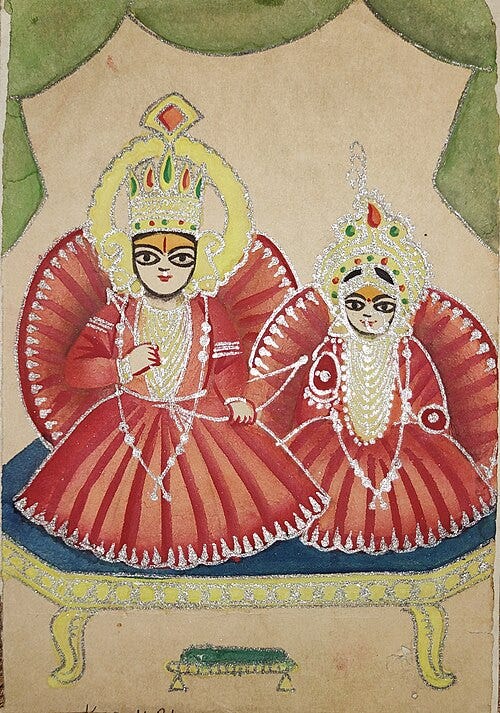

Itihāsa-Purāṇa tradition is a living entity that thrives on memory, allied with the cultural apparatus of tīrtha (pilgrimage), art forms, etc., rather than plain nostalgia without cultural continuity. Hence, the tradition did not facilitate monolithic utopian visions like those of the contemporary Western historiographies. Monolithic ideologies breed nostalgia. Nostalgia breeds pangs of separation which many a times result in systemic violence. The subject starts to look for permanent solutions in a utopian future rather than in her/his own deśa-kāla-paristhitī (spatial-temporal contextualities). I may be generalising too much, but please bear with me. These statements may ring some bells…
Adam and Eve were expelled from the Garden of Eden. Now the Son of God, who died for our sins, will come again for the judgement day, and the believers will go to eternal heaven. (The same story, with a few variations, applies to Islam.)
The march of civilisation from a primitive society to the capitalist system has put the “noble savage” in chains. The socialist system (like the second coming of Christ) will facilitate a permanent change, ushering in an eternal communist society (heaven on earth).
Every kind of erasure, cultural or ecological, is justified in the name of a utopian future. This has been a feature, rather than a bug, of contemporary Western historiography. An aspirational future (coupled with a specific narrative of the past which justifies it) which no one can decipher but the theory or the theology. The march of history becomes the God on whose altar every ideal, tradition and god can be sacrificed. Historiography, in contemporary India, also seems to be constrained by the chains of the same worldview. Hence, in today’s world of normative crossroads, the study of the Indian pasts with a novel, yet grounded, approach becomes indispensable. We need a systemic solution to a systemic problem.
However hard to believe, given the contemporary ideological desecration of history as a discipline in India, writing about the past is a responsible enterprise. Kalhaṇa, in his 12th century work Rājataramgiṇī, compares a poet-creator (historian) with Prajāpatī (the Cosmic Creator) because “Who else but the kavi-prajāpatīm, who are skilled in producing beautiful creations, are capable of bringing the past times back before the eyes of men?” Kalhaṇa was a 12th-century Kashmiri historian and poet, one of the earliest and most significant historical chronicles of the Indian subcontinent, documenting the rulers and history of Kashmir from ancient times to his own era. Kalhana notes that time devours everything, and the only force capable of defeating time is the memory preserved by the poet-historian. But works of such importance demand particular qualifications of the one who undertakes them. Kalhaṇa explains:
“That noble-minded poet alone is worthy of praise whose word, like that of a judge, remains free from attachment and aversion (rāga-dveṣa) while recounting the reality of the past (bhūtārtha-kathane).”
Historical study in India needs to be brought out of the silos of emotional and modern political contexts. It needs fieldwork-based research corroborated by popular memory as well as primary sources. Acharya Hazari Prasad Dwivedi shares an interesting anecdote that points to a prominent feature of traditional Indian historical sense-making: the tendency to assimilate the unfamiliar into known mythic narrative. This feature may aid in the attainment of the four Puruṣārthas, but it is a serious impediment to the study of history. Al-Beruni had noted the same tendency centuries earlier. In his essay Purānī Pothiyā̃, Dwivedi narrates:
Sir William Jones sent an impression (a copy) of Ashoka’s inscriptions to the then governor of Banaras, asking that he have it read by some pandit there. One pandit read out the inscription, declaring it to be a record of Yudhishthira’s secret exile, and even prepared a forged manuscript in the old scripts. For a long time that forged manuscript misled scholars.
We need to recognise and document memory as it exists in India, in its own idiom and cultural world. Ours is not an antiquarian endeavour, for, whether visible or not, the past survives in the present. Memory ensures that the past has not passed. It lives on as rituals, journeys, stories, gatherings, habits, writings, art forms, beliefs, and language. It exists as an entity which is as true or as mystic as the phenomenon of time. The essays/research articles on history we wish to publish would not merely be chronological accounts of dry historical facts. They may include them, but they are not constrained by the shackles of deśa-kāla alienating historicism. Grounded as they are in a living tradition, such narratives might be called ever-contemporary – sanātana.
This initiative is not an orgy of pain, alienation, anger, hatred and revenge. It is surely difficult to overcome the pain of loss that cultural colonialism endures, but not impossible. In an academic visit to Cape Town (RSA) a few years back, I noticed something revelatory. In the International Conference on Indigenous Knowledge Systems, the African participants, while reading a paper, reciting a poem or singing a song, were very passionate about the whole affair. They were making loud ‘humm’ noises whenever some painful experience of cultural loss was narrated. They were singing songs of cultural pain together. It was an amazing experience. At first, I felt a bit disappointed at the academic situation back in India. Why aren’t we that passionate? Why don’t we feel such uncontrollable bursts of pain? Why do we not sing songs of cultural loss in our academic events? I guess I know the answer now.
It was my last evening in Cape Town. While sitting on the slopes of Signal Hill during sunset, with Table Mountain and the Lion’s Head peak to my left and the vast horizon of the oceanic convergence of the Indian Ocean and Atlantic Ocean straight ahead, I started reading an essay by Nirmal Verma. I was alone on that spot of the hill. Some teens were sitting some 50 metres down to the left on the slope. The sun was setting on the western horizon slowly. It was a heavenly experience. I wanted to catch a glimpse of the sun while it touched the sea. There was time. I was going through the pages while catching glimpses of the panoramic view in between. Verma wrote that the cultures that are one with nature think in terms of symbols and myths, and the cultures that alienate ecology think in concepts and theories. It struck an epiphany.
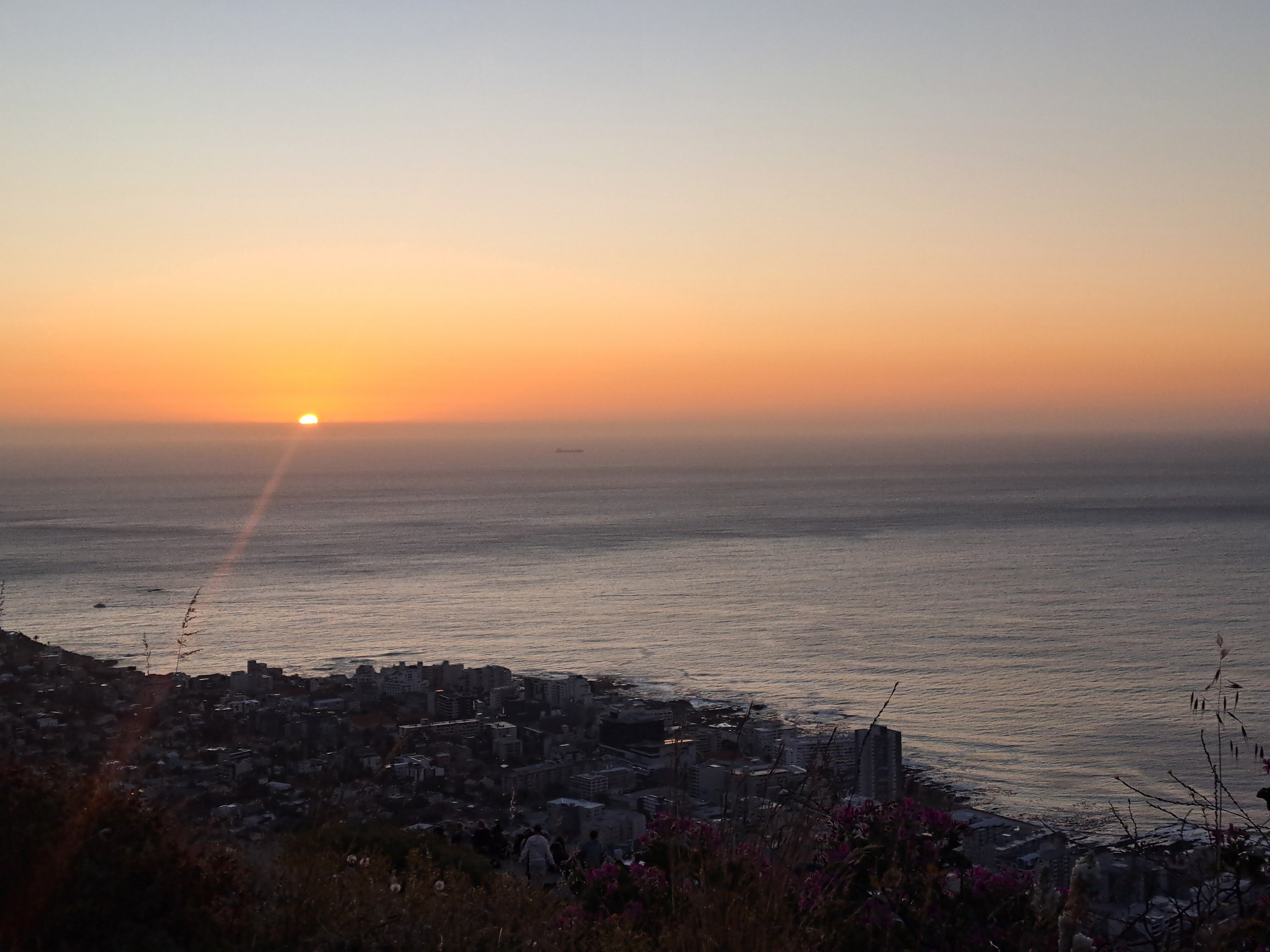
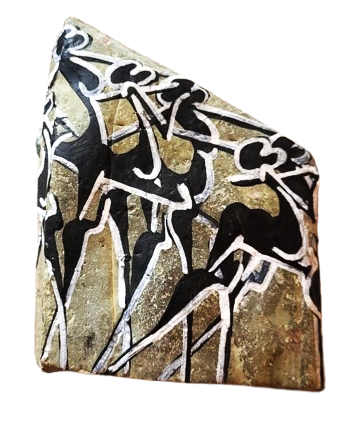
Between the Lion’s Head and the ocean was the affluent, upscale suburb of Camps Bay – the den of Western modernity. The sun sets there. Interestingly, Table Mountain and the adjoining Lion’s Head have been sacred spaces for the indigenous people of the southern tip of Africa – the Khoisan tribes. They were uprooted and exploited by the Dutch and the later British colonisers. There survives a negligible trace of their culture. Their symbolism survives as artefacts like the stone paintings Natalie does and sells outside the old Parliament building. She says she learnt the art form from her grandfather. She even narrated that there are sacred water bodies on the top of the Table Mountain range that very few people know about. A negligible number of Khoisan people are allowed to visit there. You need a special permit to do so. Natalie had that permit. Nonetheless, the native culture was gasping for breath. Western modernity remained the only true God.
Hence, barring a few scholars, most of the participants in the conference were presenting theories and concepts to make sense of colonisation and decolonisation. There were no stories, no gods, and no aspirations (other than the political ones). They were sad because they had lost something which they knew they would never get back. It was an emotion grounded in nostalgia. The same is not true for the Indian situation. Here, the culture is not lost. We are a wounded civilisation, as enunciated by Naipaul, for sure. But we are living. From Amarnath to Kanyakumari, and from Hinglaj to Tipureshwari, India still speaks in myths and symbols. Modernity is not the only God. It is one among many. This is why we do not witness such strong emotional outbursts in our IKS events or traditional settings. The continuity of tradition gives assurance and calmness to the practitioner.
However, that does not mean that there is no work to be done. There is rampant cultural erasure and misrepresentation in Indian academia and popular media regarding our pasts. The Long Memory is thus the active documentation of the ongoing transmission of our civilisational consciousness. The juxtaposition of these two words is deliberate. ‘Long’ signifies the deep antiquity and the unbroken continuum of the Bharatiya civilisation, which stands in stark contrast to the ‘short memory’ of modern political timelines, electoral cycles, or alienating historicism. Furthermore, we consciously choose the word ‘Memory’ (Smṛti) over ‘History’ (Itihāsa in the purely empirical, modern sense). Modern history often preoccupies itself with the dead, archived past (a past that has definitively passed). Memory, however, is lived, embodied, and inherited. It is the conscious retention of a civilisation’s soul across aeons. Sanātanam Punarnavaḥ.
The Long Memory is a Substack platform recovering India’s understudied histories and historical epistemes. Most historical writing is either too academic to reach general readers or too polemical to inform them. We aim for the middle: rigorous research into neglected chapters of India’s past, written with depth but made for the lay reader. Academic rigour and good writing belong together. Emerging Indian historians need the craze for methodological and analytical rigour like a James Prinsep, in addition to sahṛdayatā for Indian traditions like an Ananda K. Coomaraswamy and empathic criticality for its peoples (living and dead) like a Dharmapal. We aim to bring about a long-awaited change in Indian historical scholarship.
Placing memory at the centre of this enterprise is not a modern imposition on the tradition. The tradition begins there. Consider how the canon is arranged: beside śruti, ‘that which is heard’, sits smṛti, ‘that which is remembered’. The eternal is kept alive in time by the whole remembered body of Dharmaśāstra, Itihāsa and Purāṇa. To say ‘tradition’ is already to say ‘memory’. This project understands that what holds for ātman holds for a civilisation as well. A people is not freed by becoming something new. It is freed by remembering what it never stopped being. The Long Memory is an intellectual initiative designed to fill the gap in rigorous, accessible scholarship devoted to recovering India’s forgotten or neglected narratives. It serves as a serious platform for emerging scholars committed to investigating history through context-sensitive lenses. The name ‘long memory’ is a reminder that despite colonial disturbances and reconstructions, the native genius lives on.
For India, decolonisation cannot necessarily mean revivalism. We want the readers and writers of ‘The Long Memory’ to be part of a journey of recognition, of Pratyabhijñā (self-recognition). “Upon regaining memory”, proclaims the Chāndogya Upanishad (7.26.2), “there is complete liberation.” In Bhagavadgītā (10.34), Kṛṣṇa names memory among His own splendours – smṛtir medhā dhṛtiḥ kṣamā – counting it with fame, speech and intelligence as a glory of the divine. We are legatees of a living civilisation, of living memories. We understand that a culture is lived, hence preserved, and not the other way around. The recognition of the memories that still live, of the traditions and spaces that have continued despite all barbaric desecrations, is our sole prerogative. This project is a celebration of the living memory, not a bereavement of the dead past. Why celebrate? Because Rāma still resides here. We need the eye to see him.
━━━━⊱⋆⊰━━━━
Arjun Anand is from Dharamshala, India. He is an early career researcher who holds a Doctorate degree from Jawaharlal Nehru University. His research interests encompass (but is not limited to) contemporary Indian intellectual history, political theory, Hindi Literature and Itihāsa-Purāņa. He is the Associate Editor of ‘The Long Memory’ Project.