

The Sandstorm And The Saint
I grew up in a small town in Bhadohi in eastern Uttar Pradesh, which has a Mazar dedicated to Syed Salar Masud (popularly known as Ghazi Mian), a medieval Muslim warrior saint, said to be the nephew of the Islamic invader Mahmud Ghazni. Interestingly enough, he is worshipped by Hindus and Muslims alike. Unconcerned about the legend or history, we as children associated Ghazi Mian primarily with the largest annual summer mela of our locality, which accompanied his Urs celebrations (death anniversary). A mela for which preparations would start months ago, from laying bamboo barricades marking the boundaries of the Mela ground, erecting stalls, to setting up various Jhoola components, which we children argued were even loftier and bigger than the previous year, though they were all the same. This slow pace through which the month-long mela preparations went kept us hooked and eagerly waiting.
The final announcement of the start of the multi-day Jeth (summer) Mela for us was not to be done by some official statement, but by the coming up of a sandstorm, which was neither the first nor the last of such storms of the season, but we anyway insisted it to be unique, given the storm was said to be caused by a deo/demon as an act of reverence towards the Ghazi. The mela attracted a multitude of people across communal and caste lines: from pilgrims to non-pilgrims, from sellers of all sorts of goods to buyers of what was sold, from sorcerer-cum ritual healers to pickpockets. Of all things sold and bought, the ones that attracted us children apart from Jhoolas were Nankhatai biscuits, watermelons, and a special type of cardboard trumpet or Bhompus, as we called it, which was eagerly sought after by us and equally disgusting to grown-ups because of the almost deafening and understandably irritating sound that it produced. Ghazi Mian, for us children, was synonymous with this experience of the Mela.
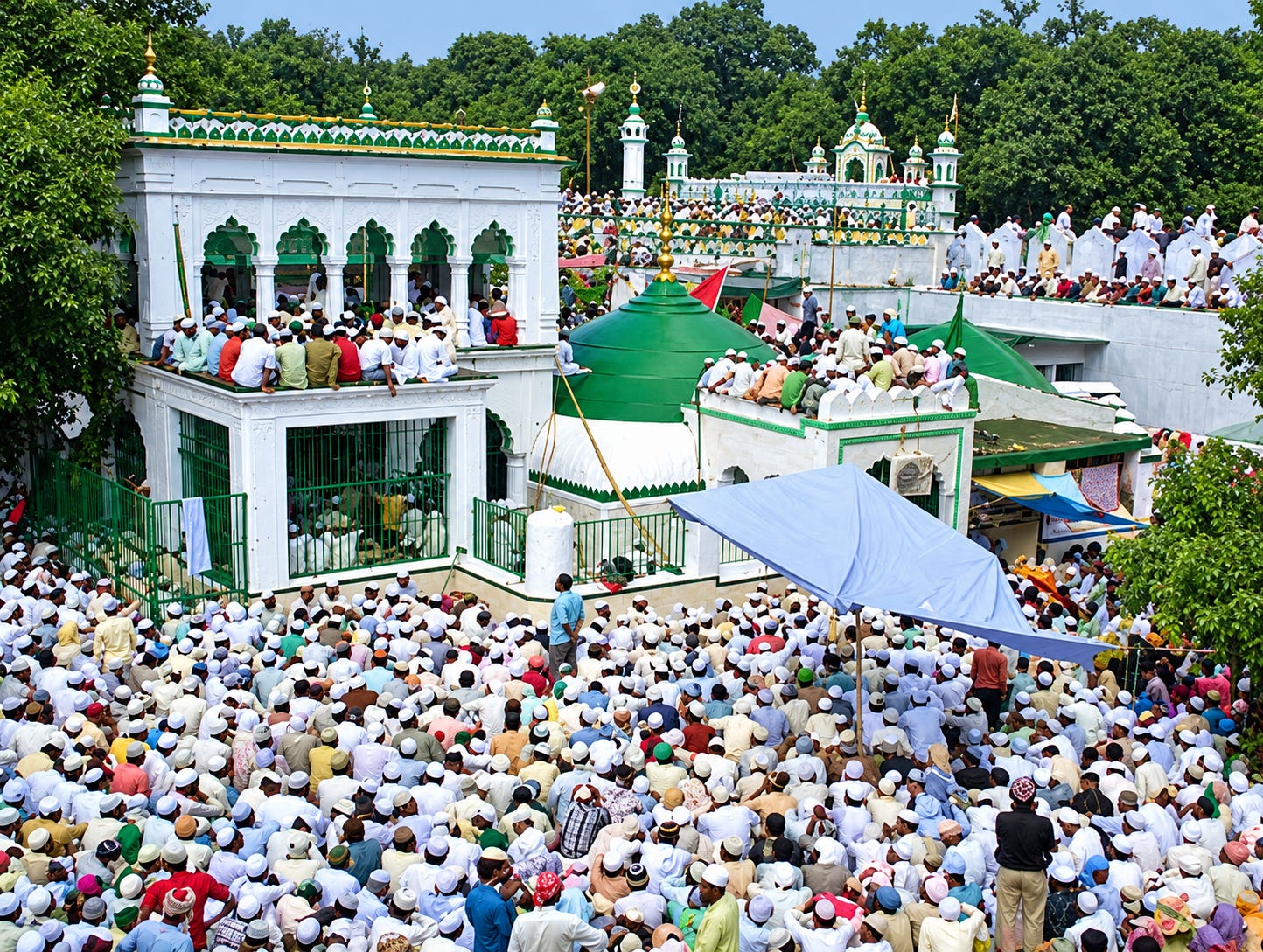
Such memories appear not to be unique to our locality, given Ghazi Mian dargahs spread across multiple locations in eastern Uttar Pradesh, with the prime and the biggest being at Bahraich. However, of late there appears to be an increasing attempt by the Uttar Pradesh government to halt the organisation of the Mela, citing various reasons, from concerns arising from law and order situations, unmet legalities, to possible terrorist attacks and communal tensions.1 Covid provided the background for the initial restrictions on the Mela; post-Covid, the organisation of the Mela restarted but only to be restricted again at various locations, including in Bahraich in 2025 and 2026, citing similar administrative concerns.2 While official concerns against the ban on the organisation of the Mela are open to be debated, some critics have highlighted the politically motivated and ideological nature of such restrictions. Given the current chief minister of the state, Yogi Adityanath has made public his aversion to the figure of the Ghazi as symbolising an Islamic onslaught.3
In the background of my childhood experience of the Ghazi Mian mela, these political moves at first appeared puzzling. However, I soon realised that a hasty reading of such political acts as external and alien to the social processes leading to the construction, diffusion, and consolidation of the Ghazi Mian tradition would be simplistic. It would prevent us from answering the multitude of questions that the worship tradition of Ghazi Mian raises. Whether it is about its origin, nature, functional location, social base, or the reasons behind its popularity amongst Hindus and Muslims alike, in search of answers to such questions, I started my journey to the shrine in Bahraich.
En Route To Bahraich
I started from Delhi on a late evening bus to Bahraich. Eager to untangle the complexities of the Ghazi tradition, I was almost praying to meet a fellow passenger native to Bahraich. And not surprisingly, as the bus was destined for Bahraich, the person sitting next to me was Anwar(name changed), a native of the region. Excited, I took the first step, and with the initial introduction about our whereabouts, I darted a question about Ghazi Mian. To my disappointment, he was far less interested, or maybe I was way too excited about the topic. And with a rather cold tone, he answered in affirmation of visiting the shrine ‘earlier’, and took out his mobile to scroll through Insta reels on speaker. I do accept the blame for eavesdropping, but when the private is too loud, it is qualified to be treated as public. His feed mostly consisted of old Bollywood songs, clips of Pakistani Urdu soaps, and small Islamic shorts. One particular reel which caught my attention featured a maulavi shouting through his throat something which went like “tadaat ki Baat mat kro, tumko jitna jindgi se mohabbat hai, utna hame maut se hai” (Don’t talk about numbers, as much as you love life, that much we love death). Understandably, the provocation was directed towards the present power politics, but what interested me was the theology and psychology of death in Islam; after all, I was there to research about a Ghazi (a warrior who dies fighting for Islam)!
The centrality of death in Islam can be gauged from the fact that this life is said to be a preparation for the hereafter. The hereafter consists of two levels, the final being known as Akhirat or the final judgment, when the actual allotment of heaven and hell is done. The time between human death and Akhirat is known as Barzakh. During Barzakh, the human body stands separated from its soul. While the body rests in the grave, subject to peace or torments, the soul is said to reside in a temporary realm, where closeness to Allah depends on one’s deeds in past life. A ghazi, being someone who died for Islam, is promised special privileges and is guaranteed closeness to Allah, including the power of intercession on behalf of others. In popular understanding, such a state bestows special power (Baraka) on the ‘living-dead’, ranging from healing to control over malevolent spirits. The popular devotion to the warrior saint Ghazi Mian emanates from a similar theological logic.
Defeated At The Dargah
I reached Bahraich early in the morning. After checking in at my hotel at the Chawani Chowk, I straightaway drifted towards the Dargah road. The city of Bahraich is modest in its appeal, if not visually dead. The broad central road from the Chawani Chowk to the Dargah was flanked by various small shops selling materials of daily utility. However, what actually brought some life to the city was the clamouring of e-rickshaw drivers for passengers. I was snatched and won by one such driver and was made to sit in the rickshaw as if he already knew where I was headed. The passengers seated in front of me were a middle-aged Hindu couple with two children accompanying them. They looked distressed, and the reason was not hard to locate. Both their children’s skin was covered with bleeding rashes. On enquiring, they informed me that they were visiting here from Ayodhya district. Despite repeated visits to the doctors, the children’s skin failed to show any improvement. Defeated, they are visiting the Ghazi Mian dargah hoping for a cure. The dargah and its water are famed to have various magical and healing properties. Stories about infertile women receiving the boon of sons, the blind getting their sight, and lepers being cured of leprosy have extended the Ghazi’s popularity across the wide region amongst the distressed and the defeated.
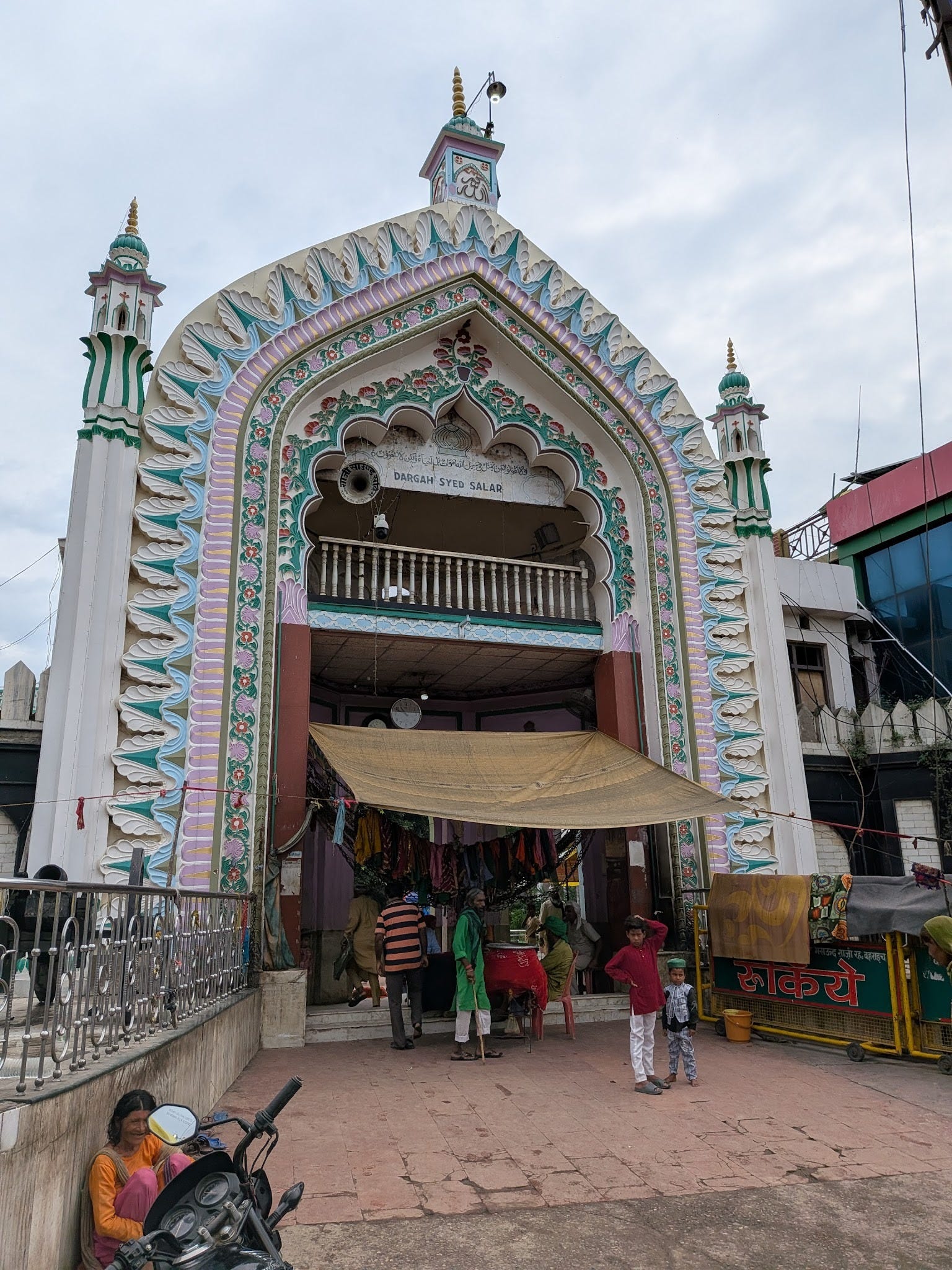
This was evident as we reached the small street leading to the Zanzeer darwaza of the Dargah. Lepers, blind, disabled, and beggars were everywhere, so were pilgrims. The sides of the street were occupied by various shops, while below them was overflowing sewer water. The stench coming from the sewerage appeared to be in a diplomatic competition with the fragrance of itra (perfume) and jalebis being sold in the shops. Some shops were vibrantly decorated with merchandise related to the shrine kept for sale. From green Islamic flags, red chaddars with the Kalma imprinted on them, white flower beds and posters of the dargah complex, to extremely intriguing articles consisting of small metal artefacts and small clips of paper with different Quranic verses and images of jinns being engraved on them. These were sold for the purpose of curing almost everything, from spirit possession and black magic to skin diseases. The articles appeared to announce the popular reception of the Ghazi and his dargah. Meanwhile, the broad participation was further reflected by one of the restaurant’s boards, which was eager to welcome the ‘Suddha shakahari’ (Pure Vegetarian) devotees of the Ghazi.
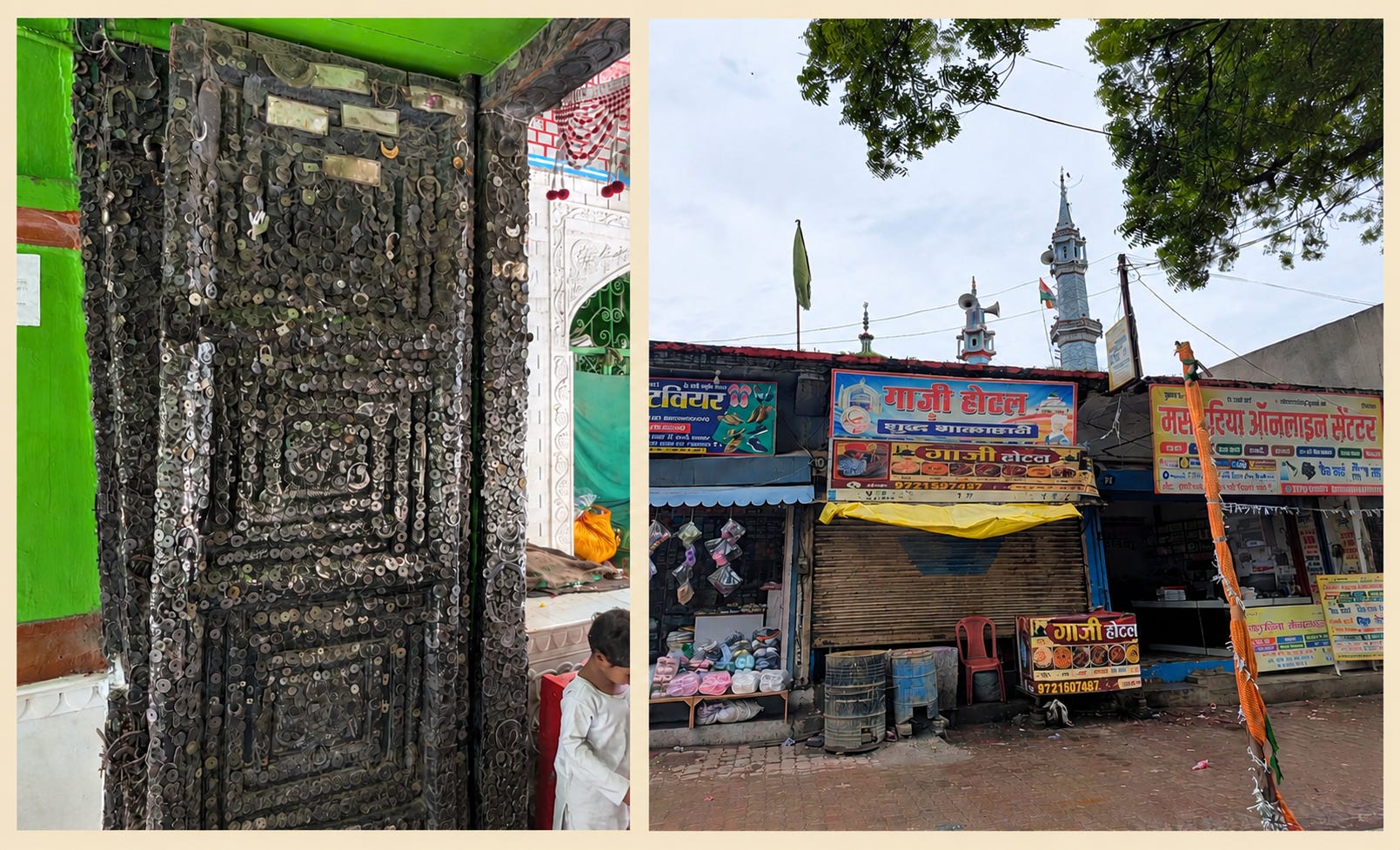
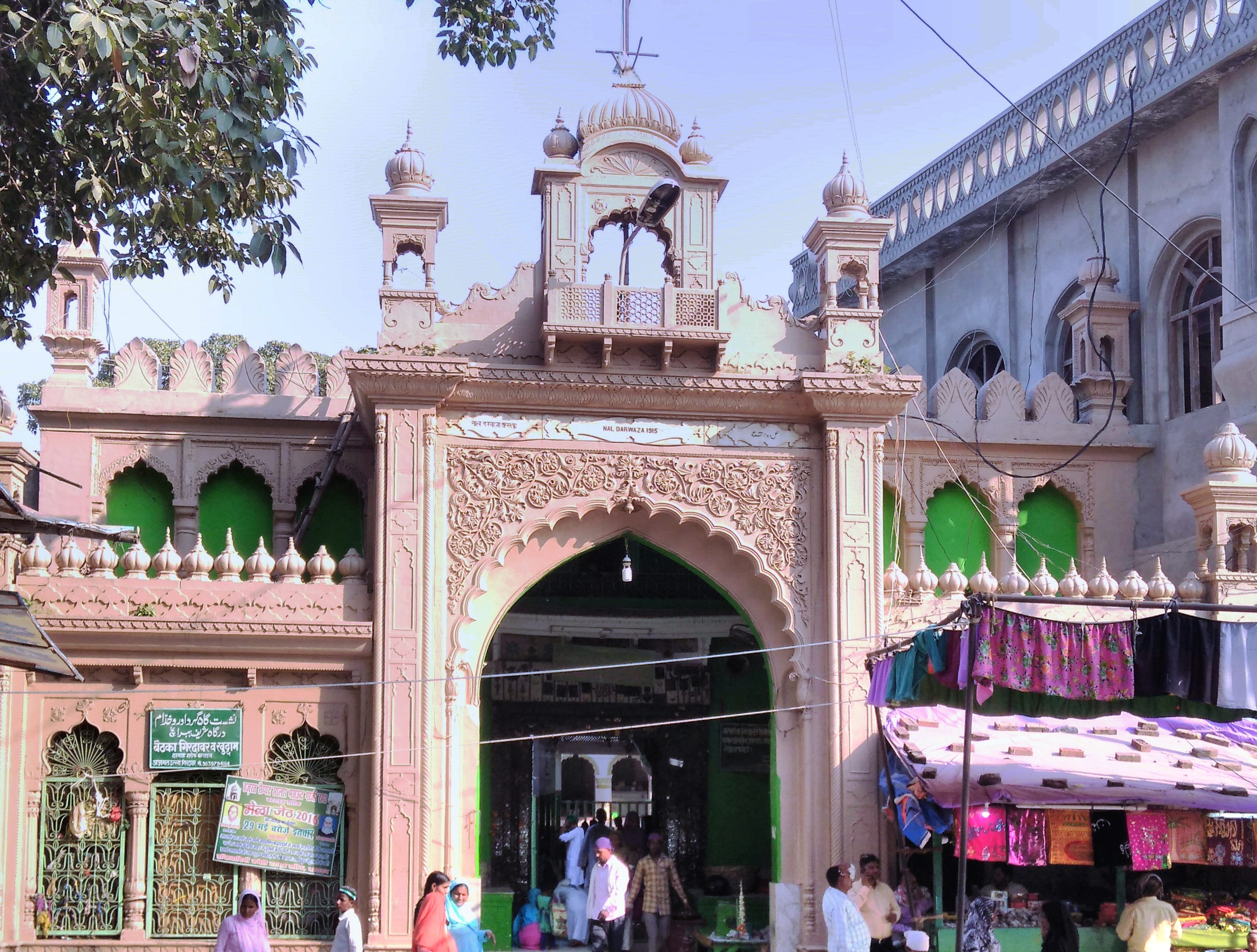
Moving away from the Zanzeer darwaza towards the Naal darwaza leading to the Dargah, I came to witness what can be thought of as the ultimate performance of defeat: losing the human self to non-human entities, Jinns in our case. In Islam, Jinns are a special category of beings created by Allah for his worship, but owing to their jealousy of humans, they have gone astray, a few into the service of Satan, who are mischievously involved in taking possession of human individuals to the harm of the latter. While the logic behind the iron janjeer is said to be that it has the capability of keeping spirits at bay, the Jinns at Bahraich appeared to have been particularly powerful. In front of the Naal Darwaza, tens of women (curiously, only women!), some in burqas and others not, were in a state of ecstatic trance, howling and moving their bodies frantically as if they were being crushed from inside. I had witnessed spirit possession earlier in a temple in Himachal Pradesh, and was interested to see if I could differentiate between the possession of a Hindu spirit from that of a Muslim one. But before I could conclude, I was politely asked not to block the gate, possibly because I was obstructing the Baraka coming from the side of the Dargah. The Naal Darwaza, studded with countless coins and metal strips nailed to it, stands as witness to the fidelity of belief in Ghazi’s power. It has become a custom to nail small metal Naals (horseshoes) or coins after fulfilment of a past wish.
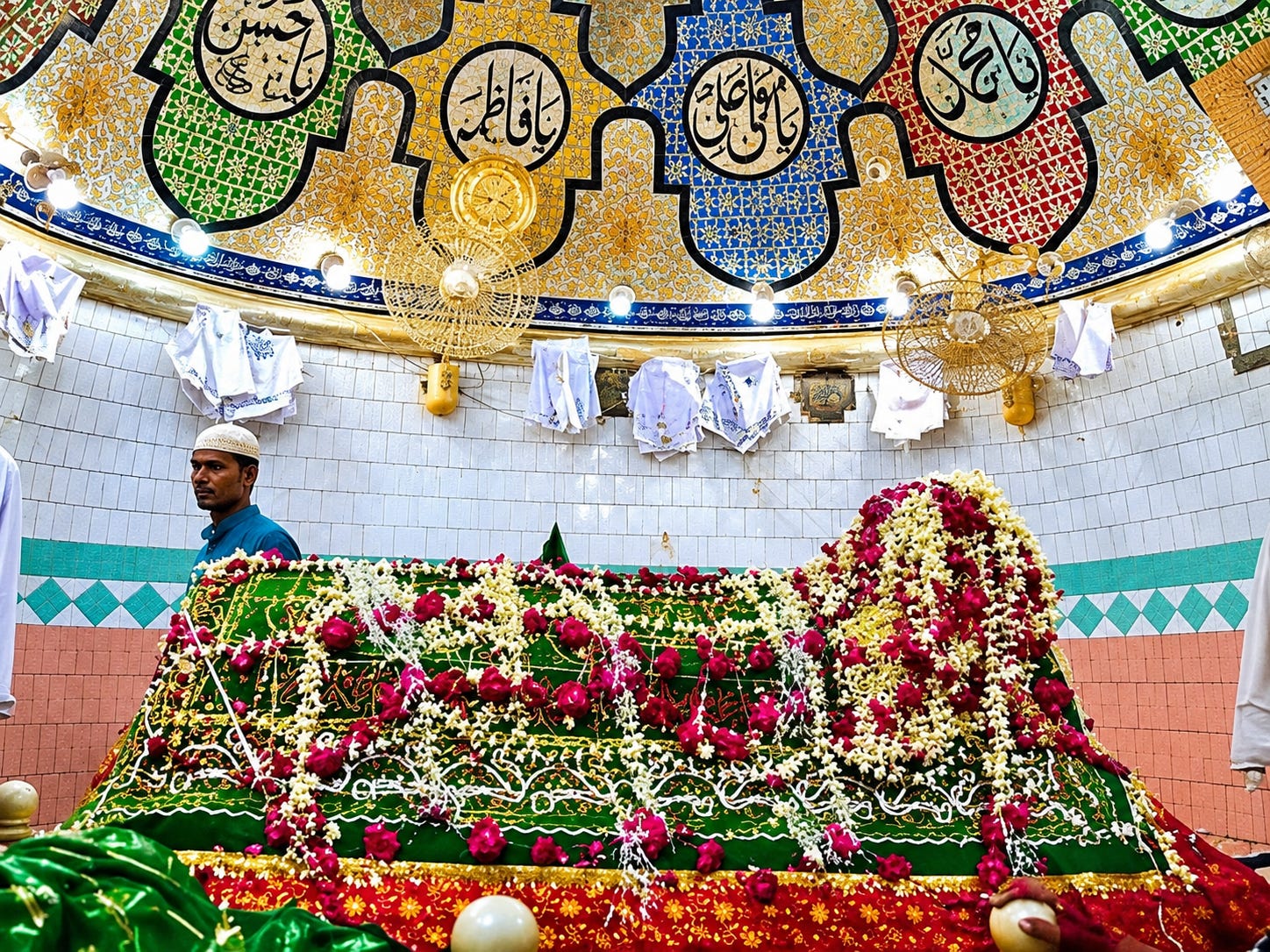
Passing through the darwaza, I reached the Dargah complex proper. To my surprise, and in contrast to medieval monuments, the abode of the deity of the defeated was remarkably unimposing in character, as if purposefully designed to be so. Inside was a hall-chamber, surrounded by a mosque and small rooms, the fourth side open to the Dargah sanctum of the celebrated Ghazi. The inlet was through a narrow door, made even narrower due to the rush of the pilgrims. The small chamber housed a disproportionately tall grave, covered with flowers and colourful chadars constantly poured by incoming devotees struggling against each other to kiss, rub, or at least touch the grave of the Ghazi. The rush, humidity, and excessive fragrance of Itra made the inside of the chamber feel overpowering, but the crowd of devotees was kind enough to push me towards the hall facing the sanctum. Coming out of the narrow sanctum to a somewhat open space already made me feel blessed.
The ambience was ritually charged, and the entire space of the Dargah appeared potent with divine power, with devotees lighting diyas, incense, offering sweetmeats, engaging ritually with the power of the Ghazi, which extended to writing petition letters addressed to the Ghazi. Compiled and attached to the grill shutter separating the inside of the dargah (and some tied just above the grave of the Ghazi). While reading one such letter addressed to the Ghazi baba, asking him to relieve the petitioner from bura saaya (evil spirit), I realised I was being eyed by a caretaker of the dargah. Realising that my curiosity was under suspicion, I went to talk to him. Knowing about my interest made him relieved, but then my further questions did tense him again. On the question of whether Hindus are coming to the Dargah as before, he did appear somewhat distressed, but replied with “jisko yakin hai wo to aa hi ra hai” (Whoever has faith still comes). And he wasn’t fully wrong, as the crowd had limited but no dearth of sari-clad, bindi- and sindoor-donning women accompanying hijab/burqa-clad devotees. The dargah complex, apart from housing the grave of the Ghazi, has multiple graves, some labelled, others not. But all of them are said to be related to the Ghazi, either as his lover, friends, or companions. The exit from the inner complex of the Dargah led to an open space, occupied by devotees, some possessed by the jinns, moving frantically, others by the rhythm of the Qawwali being performed, and more others lining up to buy the Ghazi Miyan’s “Gushla ka pani” (bathwater of the saint’s grave) being sold as some sort of a panacea. As a board in the background proudly proclaims both in Urdu and Hindi-
“The blind get eyes, the leper gets a healthy body, the barren gets offspring – healing is obtained by making them drink this water. Whatever the disease may be, healing is obtained by making them drink this water.”
Eihan Ka Itihas (“History” Of This Place)
The time spent exploring the Dargah revealed the nature of the popular interaction with the Ghazi. The Ghazi is worshipped particularly for his wish-fulfilling powers, a power which extends to the realm of the supernatural, with abilities to cure all sorts of ailments. However, a lot of questions were still left unanswered, whether it is about the ultimate source of the Ghazi’s power, the reason for the transformation of a warrior of Islam into an object of popular devotion, or the reason behind its popularity amongst Indian Muslim converts and Hindus. Contemplating such questions, I decided to leave the Dargah for my hotel. Exhausted as I was, I booked a rickshaw; however, this time, the driver was more inquisitive than I was about my visit. After the initial conversation, I asked about the reason why people visit the Dargah in large numbers, including Hindus. He replied by telling me that “Eihan ka Itihas bahut purana hai” (The history of this place is very old). Labelling Ghazi Mian as an ‘aatankwadi’ (terrorist) and ‘akranta’ (aggressor), he went on to narrate his version of the story about the miraculous sun temple and its healing kund, for whose protection Maharaja Suheldev killed Ghazi Mian but was later defeated by the invading Muslim armies. He further added that the graves stretching from Jarwal to Bahraich belong to the same army of Ghazis slain by Suheldev. While not directly addressing my questions, Sunil Pal(name changed) did hint for me to look into the sources which I have been consciously ignoring: history!
The Making Of The Ghazi Mian
Though the association of Ghazi Mian with the figure of Mahmud of Ghazni dates him to the 11th century, contemporary sources are silent about any such figure. The earliest evidence of such a figure comes from a short suggestion from the 13th century, in a work of Amir Khusrau.4 However, his association with Mahmud Ghazni’s expedition to India only comes later. In Tarikh-i-Ferozshahi, a 14th-century work, historian Ziauddin Barani describes Salar as one of the heroes of Mahmud’s Indian campaign, while in Akbarnama Salar Masud is said to be connected by blood with Mahmud Ghazni.5
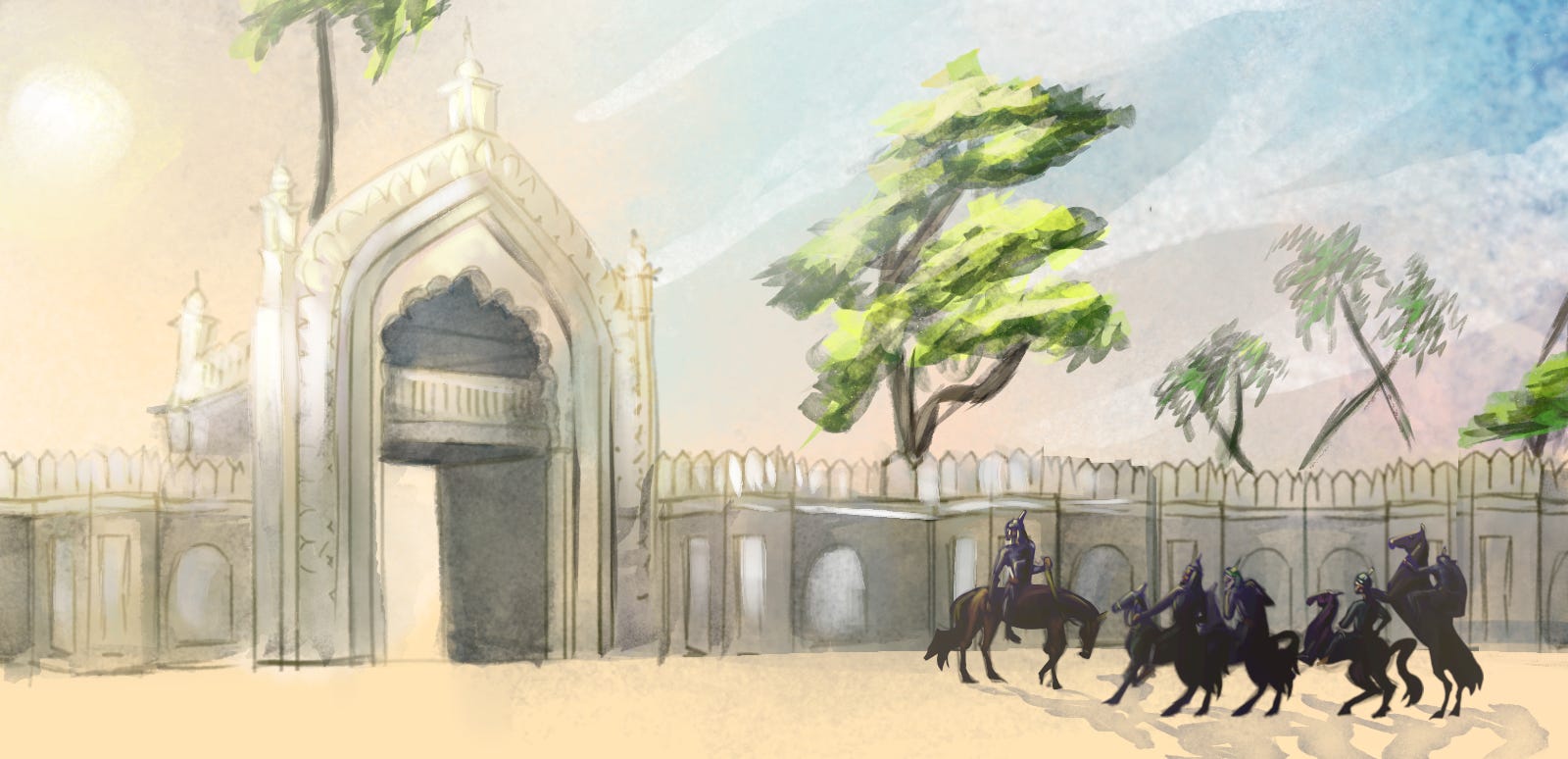
By this time, the cult associated with Mian appears to have already achieved a considerable following, attracting the attention of even Sultans of Delhi. Hence, sources of the period inform us of both Muhammad Bin Tughlaq and Firoz Shah Tughlaq patronising the Dargah of Ghazi Mian. Firoz Shah Tughlaq went to the extent of making a pilgrimage to the Dargah and getting his head shaved like a recluse.6 Even in later times, Muslim royals continued to patronise the Dargah. Mughal Emperor Akbar is also said to have patronised the Dargah, a royal tradition continued by the Nawabs of Awadh.7 However, apart from these individual acts of royal engagement with the Ghazi cult, and some clues about the popular nature of the cult of Ghazi consisting of making pilgrimage to the Dargah with colourful flags and decorated spears, the historical sources of the early period are silent on the historical character of the Ghazi.
The Ghazi Of The Sufis
The clearest literary articulation of this happens only in the seventeenth century, during the time period of Mughal ruler Jahangir, in the text Mirat-i-Masudi, written by Abdur Rahman Chisti in Persian.8 It is the earliest full account in the form of a hagiography unconcerned with historical accuracy that attempts to provide genealogical legitimacy for the tradition of Ghazi Mian by reimagining it within the fold of mainstream Sufi Islam.
It contains five Dastan, or stories, the first four dedicated to the life and the last to the afterlife of Ghazi Mian. The first Dastan deals with the father of Ghazi Mian, Salar Sahu, and his mother, Sitr-i-Mu`alla, who is said to be the sister of Mahmud of Ghazni. Interestingly, this account sets up the reason and justification for the Ghaznavid invasions of India and narrates how the local Hindu rajas of Ajmer were harassing and threatening to kill Muslims of Ajmer. To curb such a threat, Mahmud Ghazni was forced to appoint Salar Sahu, who led an expedition and succeeded in conquering Ajmer. Eventually, Masud (i.e., Ghazi Mian) was born to Salar Sahu in Ajmer, who grew to be a favourite of Mahmud of Ghazni. Having established a direct link of Ghazi Mian to Mahmud, the second Dastan further links Ghazi Mian to Ghazni’s infamous Somnath expedition.
Having destroyed the Somnath temple, the sultan reached Ghazni and threw the idol of Somnath at the gate of Jama’ Masjid so that the Muslims might tread upon it on their way to the mosque.9 Such news, we are told, disturbed the unbelievers (Hindus) who, through the Wazir Maimandi, wanted to bargain back the idol in place of twice the amount of gold. While initially agreeing under the influence of the Wazir, Ghazi Mian argued against such a decision as he reasoned to Mahmud that it might win him a title of idol seller on the Judgement Day, and asked the Sultan to give the idol into his custody instead and let the unbelievers directly deal with him.10 Having invited the unbelievers, Ghazi Mian made sure that they were welcomed with sandalwood paste and betel leaf, which they readily applied as tika and ate the paan. However, only to be later informed that their beloved idol was crushed and mixed into the tika they applied on their forehead, and into the Chunam of the betel leaf they just ate!11 Such an act of Ghazi Mian invited enmity from the Wazir, leading to Mian’s departure from the court of Ghazni to the regions of the Hind with a large band of his followers.
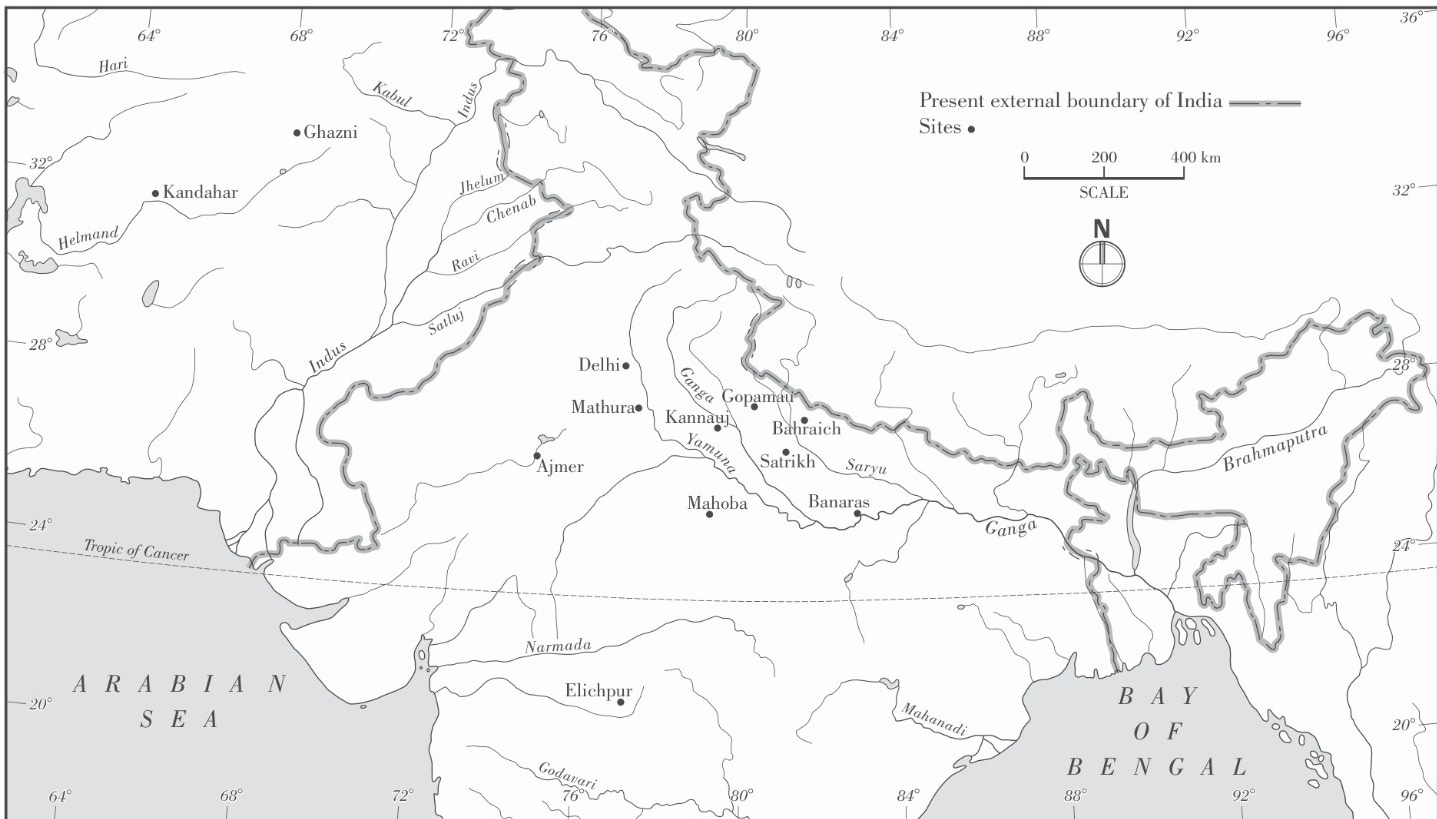
The fourth Dastan is dedicated to Ghazi’s expedition in Bahraich, which also led to his death. The chapter extols the particular likeness of Masud to Bahraich, particularly the area which has the Surajkund and a temple dedicated to Surya (Balarakh), which he desired to be routed out. Rai Sehrdev and Rai Bhardev had gathered many kings of the Hind together, and skirmishes between their armies and that of the Ghazi continued for many days, leading to the death of many men on both sides. Having revealed his state of eventual martyrdom through a gnostic vision, Masud became engrossed in the completion of this final goal of uniting with God. Standing on the battlefield filled with the dead and injured spread all across, Ghazi’s commitment to martyrdom multiplied. On June 15th, 1033 AD, as the Mirat informs us, Masud died of an arrow struck in his neck, eventually being buried under the Mahua tree on the banks of Surajkund where his Dargah stands today. From that day, the Mirat narrates that the pilgrimage of that place by the unbelievers ceased and the mine of unbelief was enlightened with the light of Islam.12
The Mirat attempts to construct a Ghazi of the Sufis for a literate audience by providing scriptural legitimacy and accepted vocabulary in conjunction with the limits of conventional but contested boundaries of Islam, both for the cult and its custodians. For such a purpose, the linkages with the figure of Mahmud of Ghazni and his famed iconoclasm at Somnath are emphasised, which can be read as modes through which legitimation was sought. However, such linkages are not restricted to drawing legitimation alone. But rather, the cult of Ghazi Mian appears to act as a conduit through which the potency and power of Mahmud’s invasion or the Islamic subjugation of India is ritually channelled and utilised. Hence, even in folk retellings sung by a class of Muslim minstrels known as Dafalis, and targeted toward a popular native audience, the Ghazi’s association with Mahmud, his iconoclasm, and the political subjugation of the subcontinent is never forgotten, and through these retellings it is ritually re-enacted.
How Many Gods Drowned In The Ganga?
The Ghazi of the Dafalis only differs from that of Mirat in the sense of the characters and the setting of stories through which it operates. The world of the Mirat works at a functional plane which aims to situate the cult of Ghazi in a more purist Islamic framework. The ballads imagine the Ghazi to inhabit a native and much more familiar world just like his native devotees, but through his character that very world becomes increasingly debased and distanced. It Indianises the Turk to Islamise the Indian. The Ghazi, hence, is not simply being domesticated to the native setting only for purposes of integration into the shared, everyday social fabric of North Indian peasant life as suggested by Shahid Amin,13 but through the selective domestication of the Ghazi, the alienation of the self is facilitated from itself and made susceptible to the construction of a new self.
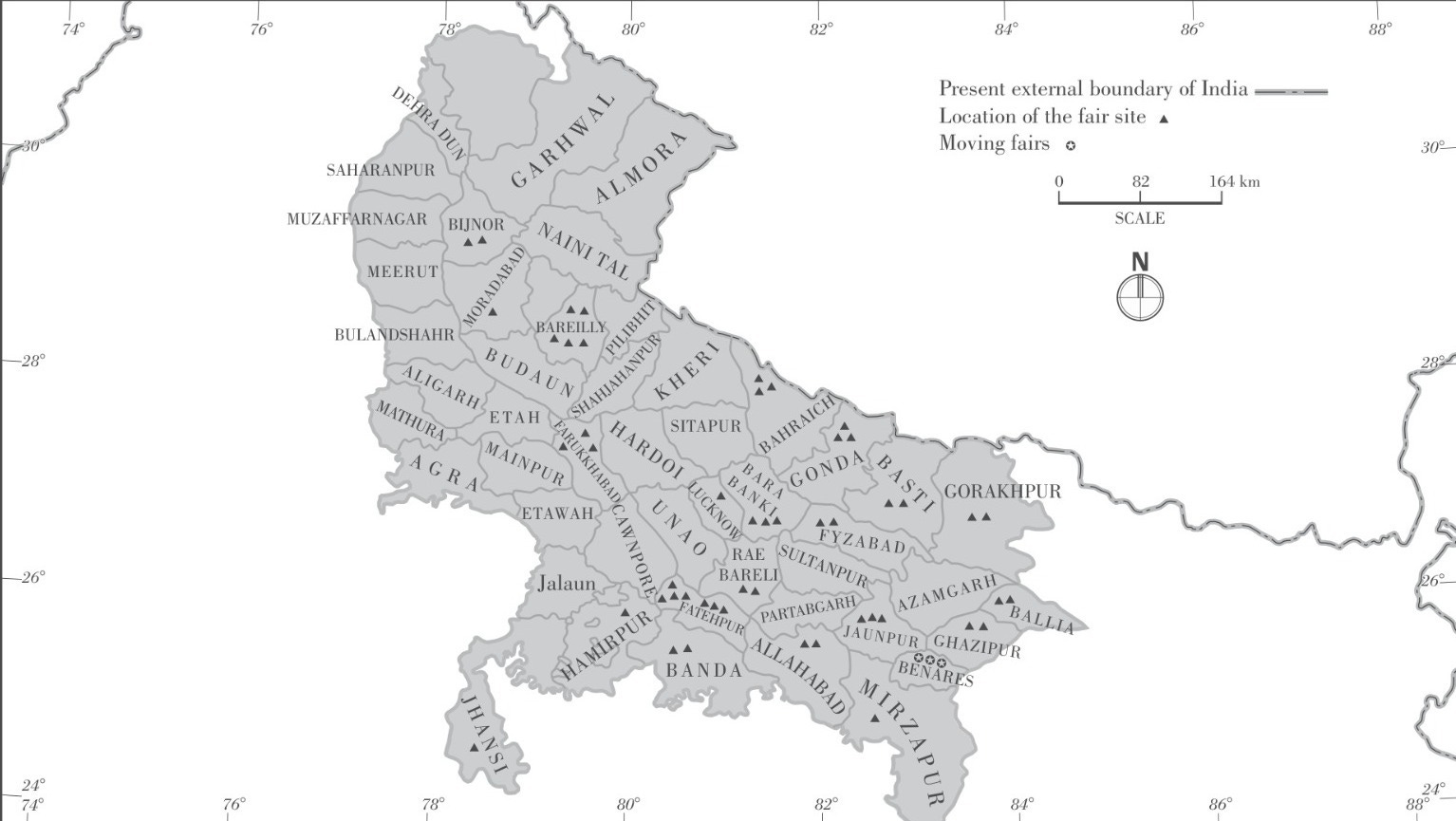
The ballads recorded by R. Greeven in the 19th century in Benares, though centred around a Turk Ghazi, are located in a world of Ramayana, Veda, Ganga, Lakshmi, Sarda, Tulsi, Sati, Brahmins, Gau, Gwalas, Nais, Telis, Malis, Lanka, Kashi, etc., much like the native devotees of the Ghazi.14 Two episodes are particularly important for our purpose. Interestingly, in the first, the famed idol of Somnath (Shobnath of the ballad) is located in Varanasi, under the protection of the unbelieving king Banar. The king is portrayed as particularly devilish and morally corrupt, who sacrifices Muslims to the idol of Somnath, and later on the advice of his Brahmin consultant, parades his women naked in front of the Muslim army.
“Kafir beghairat sabhon ne aurat apni pahunchaya, Behaya khare kihin aurat ke, nange madarzad tahlaya!”15
(“All the shameless infidels brought their women forward, the immodest ones stood their women up and paraded them naked, as they were born”)16
The news of the sacrifice of innocent muslims enrages Ghazi Mian, who is forced to launch an attack on Varanasi from Ghazni. After subduing Somnath, Ghazi made Somnath read the Kalima ( the Islamic profession of faith)! King Banar was killed subsequently, while the Hindu devatas of Benares, be it Benimadhav, Bisesvar, Dasasumer, Durga, and Hindu priests, fled in fear of the Turks. The ballad proclaims grimly:
“Kitana deota ban men bhage, Kitna Ganga me dube marmar”17
(“How many gods fled into the forest, how many drowned, dying, in the Ganga”)
The second episode around the wedding day of the Ghazi is the most celebrated story of the Ghazi. The ballad imagines Ghazi as a typical North Indian groom, getting ready for his wedding to Zohra Bibi, who’s a Syedini from the village of Rudauli (brought up in a house of Telis in some versions). The date of his wedding is decided by a Brahmin, while the preparations and surrounding rituals consist of the applying of ubtan (turmeric-sandal paste applied before a wedding), the donning of a silken thread across the wrist, the setting up of a marwa (wedding canopy), getting bathed by a barber (nai), and the singing of mangal (auspicious) songs. Until the news is brought by Jasu (Jashoda/Yashoda), the Gwalan (milkmaid), that King Sohaldal has taken away the cows and has slaughtered the cowherds. This enrages Ghazi Mian, who is reminded of his “din Islam ka” (the faith of Islam),18 and charges against Sohaldal in the battlefield to rescue cows and spread “din Nabi ka” (the faith of the Prophet).19 Eventually, Sohaldal is killed, and the cows are rescued. However, Ghazi Mian is martyred too on his wedding day.
The Indianised-Turk Ghazi then operates in the world of natives (of the Mahua tree and Paan), forges alliances with sections of the natives (Gwalas, Telis), acts in certain ways held as meaningful to the natives (Gauraksha/cow-protection), but at the same time subdues and destroys the larger structures which provide coherence to the world of the natives. The ambiguity introduced in the character of the Ghazi, making him partially Turk and partially Indic, facilitates the natives to identify with the Ghazi and actively disassociate from the larger Indic world, which is subject to the Ghazi’s onslaught and humiliation for its projected moral decadence. Carrying within it explicit moral justification of Islamic invasions and accompanying destruction.
The gods of the natives are humiliated as powerless, with temples and idols destroyed; the king is projected as immoral and hence, justifiably defeated, while the priests are projected as cunning and fearful. The native is then left with the old moral compass in a significantly altered terrain, and is made to navigate a new power order, which is as much political as it is divine. In such a context, a new divine hierarchy of Allah, Paigambar, Pir, Ghazi, a new ritual apparatus of Quran, Namaz, Hajj, and a new sacred geography of Mecca, Ajmer, Bahraich comes to the rescue. The large-scale indigenous conversion to Islam in the region significantly owes its success to the domestication-induced alienation brought about by the Ghazi cult amongst other factors, ultimately leading to the reconfiguration of identities.
Domination Becomes Devotion
The rise of the deity of the defeated, hence, occurred in the context of victory. The subjugation of the subcontinent by successive waves of Islamic conquests not only altered the political landscape but also transformed its cultural constituents for the rest of history. This transformation was not confined to the active destruction of built spaces; it extended to far more diffuse dimensions, whose presence could only be felt passively over a long duration. Political domination was thus translated into cultural experience. A need was felt to constitute new identities, to rethink referential categories, to reimagine agency, to defend certain old practices while distancing from others.
The cult of Ghazi Mian is an important site through which Islam’s political hegemony was culturally translated and ritually experienced in the subcontinent. Its clearest manifestation lies in the imaginary, which links the character of the Ghazi Mian with that of Mahmud of Ghazni. Ghazni emerged as emblematic of Islamic political subjugation of the subcontinent, and through the linking of Ghazi Mian with the figure of Mahmud, an attempt was made not just to derive legitimacy for the cult but also ritual power.
After all, Ghazi Mian is not the only Pir who derives his potency through an alleged genealogical association with Mahmud. An inscription from Vadodara, Gujarat, dating to no later than the 15th century informs us of one Amir Tahir, another alleged nephew of Mahmud Ghazni, who died fighting the infidels along with his retinue, came to be worshipped as a pir (saint), and Muslims were encouraged to pray at his grave to be blessed both here and in the hereafter.20 Similarly, a ballad recorded in the 19th century from Patan, Gujarat, associated with the shrine of Saint Mangrol Shah located in Prabhas-Patan, links him to Mahmud of Ghazni, as he is said to have invited and aided Ghazni in his invasion of India.21 Hence, Ghazni’s figure was not just symbolically employed to claim political legitimacy, but also came to be appropriated for purposes of channelling the religious and ritual potency of the Islamic invasions of India, as these were not simply seen as political events but rather were perceived as possessing deep religious symbolism and meaning amongst Muslim communities in India.
The Subaltern Deity Of Immediate Needs
The reason why certain non-Muslim communities in India came to associate with such traditions can be partially explained by drawing similar logic which ties political power with ritual potency. This is best expressed in some of the Sabar Mantras, where Mahmud of Ghazni is mentioned. These Mantras are localised magical incantations in vernacular languages, particularly popular amongst marginalised communities, and are concerned with providing direct remedies to this-worldly problems by invoking perceived supernatural powers. The reference to Mahmud of Ghazni in some of the mantras showcases that the figure of Mahmud came to be perceived as having supernatural powers within the subaltern consciousness.
“Bismillahir-Rahimanirrahim
Seta ghoda setapalan, tapar chadhe Mahmud sultan
Kamru-desh ka koda chalave
Gadh Ghazni ka kotval kahave…”22
The relationship between Subalternity and religiosity is more than the binary of either being subject to domination or possessing elements of challenging that domination. Subaltern religiosity in some cases expresses a great affinity for power to consciously and actively relate to it and to control it through symbolic and ritual means for immediate material necessities. Violent, untimely, or heroic death in Indian folk traditions was already understood as potent with ritual power, expressed in the worship traditions of Hero Stones and Bir Babas.23
The establishment of Muslim political hegemony in the subcontinent provided Islamic cultural markers and figures, particularly tombs of the dead, with potency imbued with power. This, coupled with the nature of non-monotheistic, fluid religiosity of the subcontinent, where immediate secular necessities and pragmatism guided ritual practice more than identitarian confinements, made subaltern and marginalised groups particularly susceptible to cults like that of Ghazi Mian, which came to encapsulate Islamic political hegemony, a process which may or may not involve selective amnesia on the part of non-Muslim communities.
Hence, even when the Hindus worship Ghazi Mian, his Muslim identity (Mussulmani Deotar) is not forgotten.24 So the making of the cult of Ghazi Mian and its popularity cannot be understood as divorced from Muslim political hegemony of the subcontinent. Its rise is not instead of Islamic political hegemony and violence, but rather is partially because of Islamic political hegemony and violence that enabled it. However, the logic of making contains in itself the logic of unmaking. If power produced the cult of the Ghazi, the erosion of that power has the force to unmake the very cult that it produced.
When Empires Die, So Do Their Saints
The making of the cult of Ghazi Mian extended over several centuries, and its unmaking is similarly a continuing process, which has stories, politics, and complexities of its own. But to briefly summarise, the advent of the British in the Indian subcontinent and the eventual establishment of colonial power apparatus altered the political landscape of the subcontinent. Muslim political hegemony, which was already under strain during the late-medieval period in various regions of the Indian subcontinent, was completely shattered. The impact of such a transformation was not limited to the political domain but also extended to the cultural domain. This created space and possibility for the emergence of subdued voices and modes of being.
This, accompanied by colonial policy interventions such as census, electoral politics, and the diffusion of Western and modern ideas and the consequent rise of Western-educated elites, further altered and actively intervened in the cultural landscape. Its impact in the domain of religion was monumental. Religious identity came to be narrowly defined, while religious practices were scrutinised to confirm the assumed essentials of specific religions by various revivalist/reformist groups of the period. This had serious repercussions for the cult of Ghazi Mian.
The Shrine Disowned?
Both Muslim and Hindu revivalist/reformist groups came to contest the cult of Ghazi Mian. However, the Muslim critique of the cult of Ghazi appears to have been embedded within the Islamic self-understanding. Colonialism provided the stimulus, and not necessarily the logic. Hence, even in medieval times, Sultan Sikandar Lodi (1481-1517) tried to ban the festival of spears associated with Masud in his territory owing to his orthodoxy.25 Moreover, the writing of the Mirat, in one way, appears to be an answer to the orthodox critiques of the cult of Ghazi as being innovation/bid’ah, as it narrates a story of an invisible hand striking a Mulla dead for raising an objection against the cult.26 Even Mughal ruler Aurangzeb is said to have attempted to close the Dargah for its supposedly un-Islamic practices.27 These were long before Syed Mahmud Hasan, an appointed receiver to the shrine in 1942, banned through an order the practice of prostration at the grave of the Ghazi in the Colonial period.28 Shah Waliullah, the prominent Sunni Islamic scholar of the 18th century, famously stated -
“Everyone who goes to Ajmer, or to the tomb of Salar Mas‘ud or similar place because of a need which he wants to be fulfilled is a sinner who commits a sin greater than murder or adultery.
Is he not like those who call to Lat and ‘Uzza?29 Only we cannot call them infidels because there is no clear text in the Koran on this particular matter”.30
In fact, it is this ambiguity with respect to popular cults, such as that of Ghazi, with respect to Quranic injunctions, that has facilitated Islamic expansion in the subcontinent, making the possibility of dialectics of localisation/absorption and homogenisation operate simultaneously, scripturally and historically tilted more in favour of the latter.
Hindu revivalist/reformist groups, such as the Arya Samaj, perceived the cult as being a product of past Muslim violence and deception, and actively participated in the process of its deconstruction through public meetings and circulation of propaganda materials.31 The very associations which once provided power and popularity to the cult of the Ghazi became subject to critique and scrutiny. Ghazi’s association with Mahmud, involvement in desecration and iconoclasm, and claims of protecting cows and boon-giving capabilities were actively challenged. At the same time, the much-demonised opponent of the Ghazi, Sehrdev of the Mirat and Sohaldal of the ballad, came to be identified and appropriated as Suheldev, the native Hindu ruler who stood against the Muslim invader Ghazi Mian.
The Rise Of Suheldev
In 1940, a local school teacher and poet named Guru Sahay Dikshit composed a poem titled ‘Sri Suhal Bavani’ on Suheldev, which became extremely popular and further helped in diffusing Suheldev’s heroic figure.32 Just after partition in 1950, a movement was launched by Hindu groups such as Arya Samaj, Ram Rajya Parishad, and Hindu Mahasabha for the installation of a memorial for Raja Suheldev. As part of the movement, a fair was planned in Jittora. However, citing possible communal frenzy, an appeal was made by Khwaja Khalil Ahmed Shah of the Dargah committee to the district administration, and section 144 was imposed. This instigated local Hindu residents of Jittora to break the imposition, and slogans such as ‘Suheldev jaga hai, Saiyad Salar bhaga hai’ (Suheldev has awakened, Saiyad Salar has fled) were raised.33
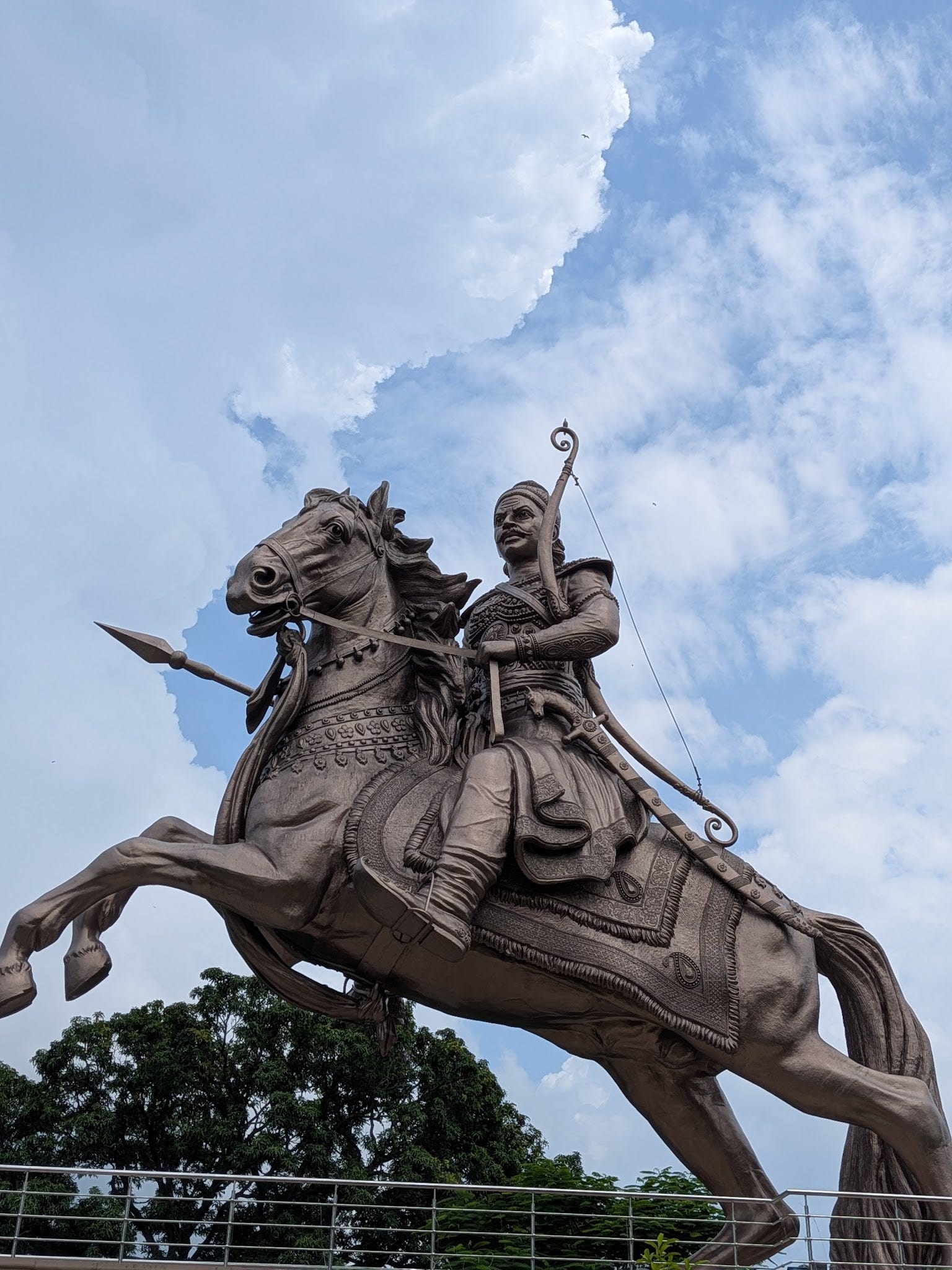
A satyagraha was launched against the imposition of section 144 by Hindu groups of Bahraich, which came to gather support of even local congressmen. Around 2000 people were sent to jail. Subsequently, a curfew was reinstated by the government. Taking advantage of this, local congressmen organised a big rally at Jittora to inaugurate the fair and the memorial of Suheldev. In this programme, a painting of Suheldev was installed at Jittora, which became the first icon of Suheldev. A local raja of Prayagpur donated 500 bighas of land and the Jittora lake to the Suheldev Smarak Samiti. Later, a statue of Suheldev based on the basis of the painting was constructed, and a temple dedicated to Suheldev was established.34
The impact of the changed political landscape and power dynamics is such that, while Hindu groups actively reduce Ghazi to his association with Mahmud Ghazni and iconoclasm, Muslim devotees of the Ghazi appear to rescue the figure of the Ghazi from such associations,35 which were once the subject of celebration both in the Mirat and the ballads.
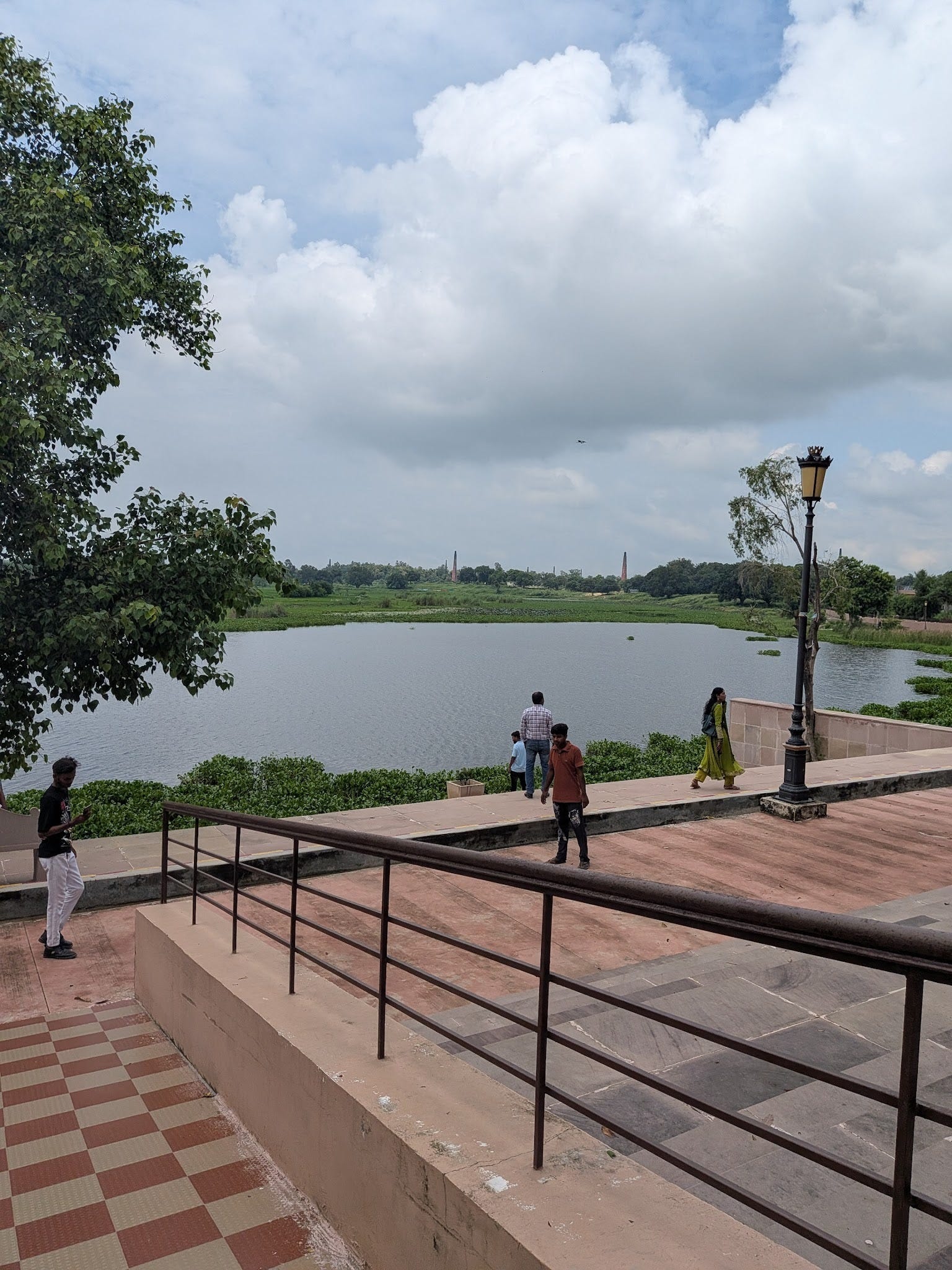
In this changed political climate, when you enter Bahraich, you are not welcomed with posters of the Ghazi and his dargah, but with proud posters of Raja Suheldev riding a horse placed at prominent chowks of the city. Suheldev is everywhere in Bahraich. Political posters celebrate him, social associations proclaim him, along with a dedicated temple and a park for him. While the foundation of a temple was already laid early in the 1950s, the park, situated next to the Jittora/Chittaura lake (the supposed lake where the battle of Bahraich was fought between Hindu and Muslim forces), was recently developed and beautified, along with an imposing statue of Suheldev, digitally inaugurated by Prime Minister Narendra Modi in 2021,36 and officially unveiled by the Chief Minister of Uttar Pradesh, Yogi Adityanath, in 2025.37 This spot has come to be developed as one of the prime locations of Bahraich, not as a sacred centre but as a local tourist attraction which invites local families for picnics, couples for wedding photography, and youth to make reels.
The afterlife of Suheldev has been remarkable. From a much-maligned and defeated minor character of Mirat and ballads, Suheldev has come to attract a special devotion from Hindus conscious of their defeated past. The subaltern communities which once were said to be associated with the Ghazi have discarded him in favour of Suheldev, who has come to represent aspirations of the defeated. The social identity of Suheldev is ambiguous; he has been variously labelled as a Kshatriya, Pasi, Bhar, Bhar Tharu, Rajbhar, and even Jain.38 This social ambiguity, however, has made the figure of Suheldev particularly effective, as multiple claims also guarantee wide acceptability.
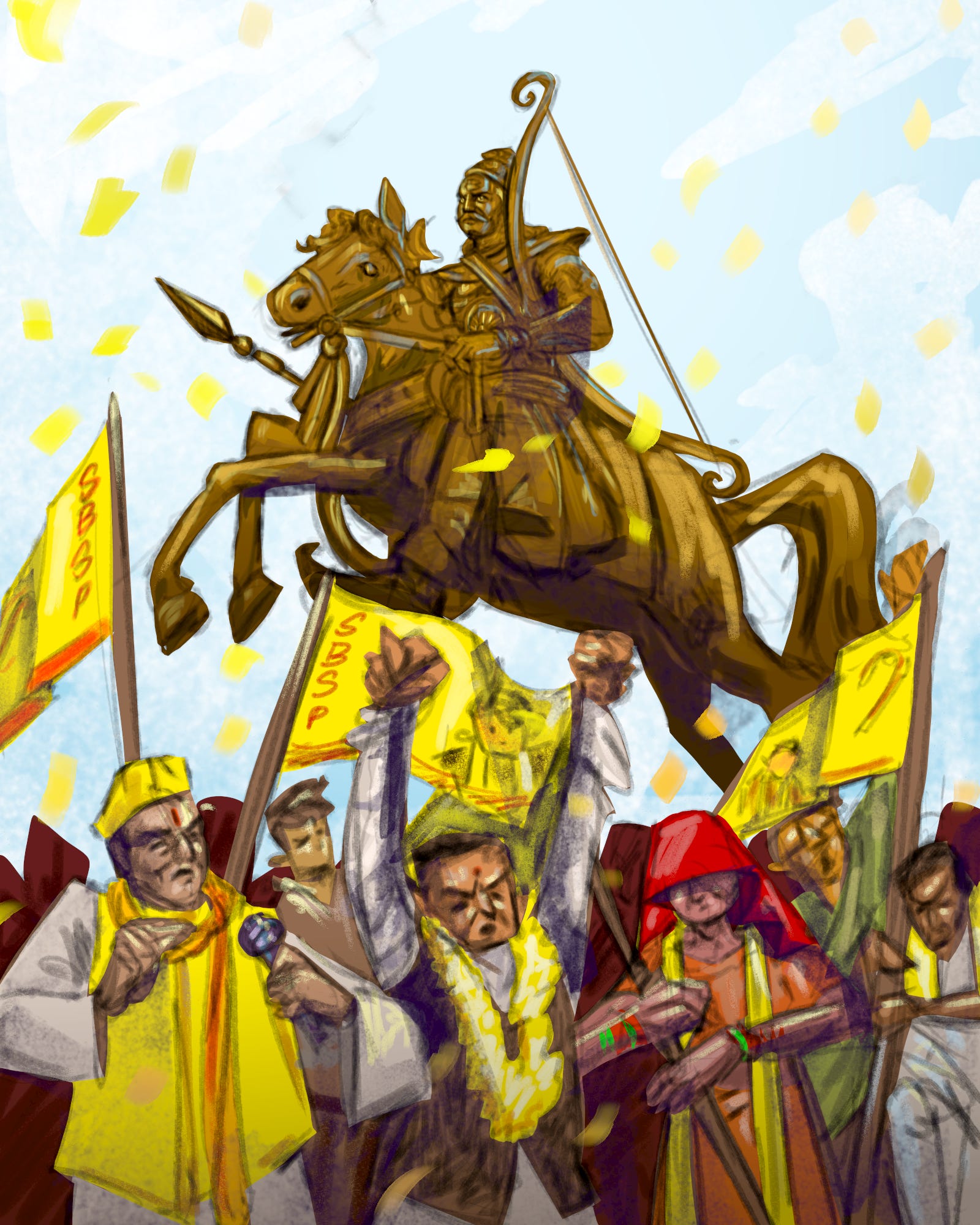
The Muslim missionaries and minstrels, through invented stories, had domesticated the Turk Ghazi within the social fabric of the region. Hindutva, through the selective appropriation of genealogical claims about Suheldev, has sought to invert the process, with an aim to navigate the complications and contradictions of Indian social realities, guided by political expediency. Raja Suheldev has come to be identified with the Dalit Pasi community, which has readily accepted such an association, aiming to gain glory and acceptance.39 Similarly, the OBC Rajbhar caste has claimed Suheldev as their own.40 And even a political party named after Suheldev as Suheldev Bhartiya Samaj Party, has been launched, which aims to unite the backward castes and communities of the region. Hence, the Bahujan political and social aspirations are finding expression through the figure of Suheldev and not the Ghazi.
Fading Not Finished
In this context, Sunil Pal’s reframing of Ghazi Mian’s story no longer appears external, but rather seems logical. If hegemony went into making a cult, counter-hegemony is taking up the cause of unmaking it. However, the cult of the dead Ghazi is far from dead. Though drastically reduced, devotees, including sections of Hindus, still flock to the Dargah. Ghazi Mian destroyed the Surajkund and its idol, appropriated the site along with its miraculous potency, and his dargah came to provide a substitute for popular religiosity. Though the figure of Suheldev has come to be perceived as symbolically defeating Ghazi Mian, the Surajkund along with its miraculous potency is still to be reclaimed. Suheldev offers glory but no relief from diseases yet!
Mihir Keshari is a doctoral student at the Centre for Historical Studies at Jawaharlal Nehru University. His interests lies in the history, archaeology, and anthropology of religious traditions of South Asia, with a regional focus on Rajasthan, Delhi, and Nepal.
References:
Amin, Shahid. Conquest and Community: The Afterlife of Warrior Saint Ghazi Miyan. Chicago: University of Chicago Press, 2015.
Blackburn, Stuart H. “Death and Deification: Folk Cults in Hinduism.” History of Religions 24, no. 3 (1985): 255–74.
Coccari, Diane M. “The Bir Babas of Banaras and the Deified Dead.” In Criminal Gods and Demon Devotees: Essays on the Guardians of Popular Hinduism, edited by Alf Hiltebeitel, 251–70. New York: State University of New York Press, 1989.
Danethwi, Abdur Rahman. Mir’at-i-Mas’udi. Translated by Hamid Afaq Qureshi. Sufis: Classics 2. Lucknow: New Royal Book Co., 2009.
Desai, Z. A. “An Interesting Persian Inscription from Baroda in Gujarat.” Epigraphia Indica: Arabic and Persian Supplement (1973).
https://archive.org/details/in.ernet.dli.2015.382519/page/n24/mode/1up.
Dixit, Pawan. “HC Denies Permission for ‘Jeth Mela’ at Ghazi Miyan Dargah in U.P’s Bahraich.” Hindustan Times, May 17, 2025. https://www.hindustantimes.com/cities/lucknow-news/hc-denies-permission-for-jeth-mela-at-ghazi-miyan-dargah-in-u-p-s-bharaich-101747492286042.html.
Greeven, R. The Heroes Five (Panchon Pir): An Attempt to Collect Some of the Songs of the Panchpirya Ballad-Mongers in the Benares Division. Allahabad: The Pioneer Press, 1898.
Indian Express, The. “Explained: The Legend of Maharaja Suheldev, and the Reality of the Rajbhar Vote in UP.” February 22, 2021. https://indianexpress.com/article/explained/raja-suheldev-uttar-pradesh-bjp-7191421/.
Indian History Collective. “The Birth of a Community: UP’s Ghazi Miyan and Narratives of ‘Conquest’.” Published 2020. https://indianhistorycollective.com/the-birth-of-a-community-ups-ghazi-miyan-and-narratives-of-conquest/.
Joshi, M. C. “Islam in Hindu Tantras.” Journal of the Asiatic Society of Bombay 58 (1983).
Mahmud, Tahir. “The Dargah of Sayyid Salar Masud Ghazi in Bahraich: Legend, Tradition and Reality.” In Muslim Shrines in India: Their Character, History and Significance, edited by Christian W. Troll, 2nd ed. New Delhi: Oxford University Press, 2004.
Mishra, Vivek Kumar. “Yogi Adityanath Again Called Salar Masood Ghazi an Invader, Said Fair in Bahraich Should Be Held in Name of Maharaja Suheldev.” Navbharat Times, June 10, 2025. https://navbharattimes.indiatimes.com/state/uttar-pradesh/bahraich/yogi-adityanath-again-called-salar-masood-ghazi-an-invader-said-fair-in-bahraich-should-be-held-in-name-of-maharaja-suheldev/articleshow/121753370.cms.
Narayan, Badri. “Memories, Saffronising Statues and Constructing Communal Politics.” Economic and Political Weekly 41, no. 45 (2006).
PASI SAMAJ. “Maharajas History.” PASI. Accessed September 16, 2026. https://pasi.in/maharajas_history.aspx.
Press Information Bureau. “PM to Lay the Foundation Stone of Maharaja Suheldev Memorial and Development Work of Chittaura Lake.” Prime Minister’s Office, February 14, 2021. https://www.pib.gov.in/Pressreleaseshare.aspx?PRID=1697883.
Press Trust of India. “Annual Jeth Mela in Bahraich Denied Permission Over Law and Order Concerns.” PTI News, May 3, 2026. https://www.ptinews.com/story/national/annual-jeth-mela-in-bahraich-denied-permission-over-law-and-order-concerns/2523118.
Press Trust of India. “Maharaja Suheldev’s Statue Unveiled in Bahraich by CM Adityanath.” PTI News, June 10, 2025. https://www.ptinews.com/story/national/maharaja-suheldev-s-statue-unveiled-in-bahraich-by-cm-adityanath/2633858.
Rajbhar.org. “राजभर राजा सुहेलदेव.” Accessed September 16, 2026. https://www.rajbhar.org/history/suheldev-rajbhar.html.
Suvorova, Anna. Muslim Saints of South Asia: The Eleventh to Fifteenth Centuries. London: Routledge, 2004.
Watson, J. W. “The Fall of Pātan Somanāth.” The Indian Antiquary 8 (June 1879).
Press Trust of India, "Annual Jeth Mela in Bahraich Denied Permission Over Law and Order Concerns," PTI News, May 3, 2026, https://www.ptinews.com/story/national/annual-jeth-mela-in-bahraich-denied-permission-over-law-and-order-concerns/2523118.
Pawan Dixit, “HC Denies Permission for ‘Jeth Mela’ at Ghazi Miyan Dargah in U.P’s Bahraich,” Hindustan Times, May 17, 2025, https://www.hindustantimes.com/cities/lucknow-news/hc-denies-permission-for-jeth-mela-at-ghazi-miyan-dargah-in-u-p-s-bharaich-101747492286042.html
Vivek Kumar Mishra, “Yogi Adityanath Again Called Salar Masood Ghazi an Invader, Said Fair in Bahraich Should Be Held in Name of Maharaja Suheldev,” Navbharat Times, June 10, 2025, https://navbharattimes.indiatimes.com/state/uttar-pradesh/bahraich/yogi-adityanath-again-called-salar-masood-ghazi-an-invader-said-fair-in-bahraich-should-be-held-in-name-of-maharaja-suheldev/articleshow/121753370.cms
[4] Shahid Amin, Conquest and Community: The Afterlife of Warrior Saint Ghazi Miyan (Chicago: University of Chicago Press, 2015), 10.
Ibid., 9. Also see 13-14.
Ibid., 10.
Ibid., 13.
Abdur Rahman Danethwi, Mir'at-i-Mas'udi, trans. Hamid Afaq Qureshi, Sufis: Classics 2 (Lucknow: New Royal Book Co., 2009).
Ibid., 70.
Ibid., 71.
Ibid., 72.
Ibid., 128.
See the chapters associated with analysing the lore in Amin, Conquest and Community; also see, "The Birth of a Community: UP's Ghazi Miyan and Narratives of 'Conquest'," Indian History Collective, 2020, https://indianhistorycollective.com/the-birth-of-a-community-ups-ghazi-miyan-and-narratives-of-conquest/.
R. Greeven, The Heroes Five (Panchon Pir): An Attempt to Collect Some of the Songs of the Panchpirya Ballad-Mongers in the Benares Division (Allahabad: The Pioneer Press, 1898).
Ibid., 107.
The translation is provided by me.
Greeven, Heroes Five, 106.
Ibid., 124.
Ibid., 126.
Z. A. Desai, "An Interesting Persian Inscription from Baroda in Gujarat," Epigraphia Indica: Arabic and Persian Supplement (1973): 14–18, https://archive.org/details/in.ernet.dli.2015.382519/page/n24/mode/1up.
J. W. Watson, “The Fall of Pātan Somanāth,” The Indian Antiquary 8 (June 1879): 153–61.
M. C. Joshi, “Islam in Hindu Tantras,” Journal of the Asiatic Society of Bombay 58 (1983): 52-56. See the translation provided in the text.
Stuart H. Blackburn, "Death and Deification: Folk Cults in Hinduism," History of Religions 24, no. 3 (1985): 255–74; also see Diane M. Coccari, "The Bir Babas of Banaras and the Deified Dead," in Criminal Gods and Demon Devotees: Essays on the Guardians of Popular Hinduism, ed. Alf Hiltebeitel (New York: State University of New York Press, 1989), 251–70.
Greeven, Heroes Five, 3.
Amin, Conquest and Community, 13.
Danethwi, Mir'at-i-Mas'udi, 140.
Tahir Mahmud, "The Dargah of Sayyid Salar Masud Ghazi in Bahraich: Legend, Tradition and Reality," in Muslim Shrines in India: Their Character, History and Significance, ed. Christian W. Troll, 2nd ed. (New Delhi: Oxford University Press, 2004), 39.
Ibid., 39-41.
Pre-Islamic Arabian goddesses condemned in the Qur’an.
Cited in Anna Suvorova, Muslim Saints of South Asia: The Eleventh to Fifteenth Centuries (London: Routledge, 2004), 26.
Amin, Conquest and Community, 167-70.
Badri Narayan, “Memories, Saffronising Statues and Constructing Communal Politics,” Economic and Political Weekly 41, no. 45 (2006): 4699.
Ibid.
Narayan, "Memories, Saffronising Statues,” 4699-4700.
Amin, Conquest and Community, 174.
Prime Minister’s Office, “PM to Lay the Foundation Stone of Maharaja Suheldev Memorial and Development Work of Chittaura Lake,” Press Information Bureau, February 14, 2021, https://www.pib.gov.in/Pressreleaseshare.aspx?PRID=1697883.
Maharaja Suheldev’s Statue Unveiled in Bahraich by CM Adityanath,” Press Trust of India, June 10, 2025, https://www.ptinews.com/story/national/maharaja-suheldev-s-statue-unveiled-in-bahraich-by-cm-adityanath/2633858
Narayan, “Memories, Saffronising Statues,” 4697-4699; Also see Explained: The Legend of Maharaja Suheldev, and the Reality of the Rajbhar Vote in UP,” The Indian Express, February 22, 2021,https://indianexpress.com/article/explained/raja-suheldev-uttar-pradesh-bjp-7191421/?hl=en-GB
“Maharajas History,” PASI, PASI SAMAJ, accessed September 16, 2026, https://pasi.in/maharajas_history.aspx.
“राजभर राजा सुहेलदेव,” Rajbhar.org, accessed September 16, 2026, https://www.rajbhar.org/history/suheldev-rajbhar.html;
Also see Explained: The Legend of Maharaja Suheldev, and the Reality of the Rajbhar Vote in UP,” The Indian Express, February 22, 2021,https://indianexpress.com/article/explained/raja-suheldev-uttar-pradesh-bjp-7191421/?hl=en-GB
Brilliant piece. Shows us how a sacred figure or place can develop around a memory, political power, practical needs, and localisation. It reminds me of a case from the Kumaon region where a supposedly Turk figure, Kalu Sayyad, who probably fought and was killed here in Tarai during the invasion of Taimur, is now associated with several shrines in places such as Haldwani, Lohaghat, and Almora. These shrines are variously known as Kalu Siddha/Kalu Sai/ Kalu Sayyad and are visited by local Hindus and Muslims alike.
An Excellent Article. Very fascinating and brilliantly written!